This article presents practical approaches for designing secure, maintainable Spring REST APIs with Spring Boot, focusing on microservices architecture, Spring Cloud, and Spring Security.
Spring REST API Mimarisi: Spring Boot, Spring Security ve Microservices
In distributed systems, REST APIs quickly become complex: security, configuration and inter-service communication must be managed. In this article you'll see step-by-step how to build a robust Spring REST API architecture using Spring Boot, Spring Cloud and Spring Security.
Opendart Academy
Want to learn this topic hands-on?
Java Spring Boot Course takes you through live projects step-by-step with an instructor.
Core Concepts: Spring Framework, Spring MVC and Java Spring training
Spring Framework components — especially Spring MVC and Spring Boot — handle HTTP requests through controllers, filters and exception handlers. Spring MVC routes incoming requests to the appropriate handler using @Controller and @RequestMapping; understanding this flow is critical for error handling and writing tests in real-world REST APIs.
Practical points to learn during a java spring course: using DTOs, single responsibility principle, separating the controller layer from the service layer, and setting up global exception handling. This structure makes unit testing easier and reduces maintenance effort for your Spring Boot application.
Integrating Spring Boot and Spring Cloud with a Microservices architecture
Microservices architecture divides functionality into small, independent services; Spring Cloud provides tools for these services such as a centralized configuration (Config Server), service discovery and load balancing. For inter-service communication you can choose REST calls, gRPC or messaging depending on your application needs.
Starting a service with Spring Boot is fast; but using Spring Cloud Config or Consul for environment configuration ensures consistency during deployment. For inter-service security, Spring Security combined with token-based (JWT) authentication is commonly used.
Real-world scenario: security and scalability in an e-commerce REST API
Situation: An e-commerce platform's order service experiences high load, authentication is centralized in a different service, and configurations vary across environments. Problems: unauthorized requests, cascading failures when a single service fails, and unexpected errors due to configuration differences.
Applied solution: We routed all external API requests through a Gateway (Spring Cloud Gateway) and used an Authentication microservice for JWT validation; Spring Cloud handled service discovery and configuration; we also isolated dependencies using a circuit breaker. In this solution Spring Security, Spring Cloud Gateway and Spring Boot services worked together.
Measured outcome (example values): before the gateway p99 latency was 1.2s; with gateway, caching and load balancing p99 dropped to 0.35s; error rate (5xx) fell from 1.8% to 0.4% in monthly tests. These numbers vary by environment and application characteristics; the goal here is to show how architectural changes can be measured.
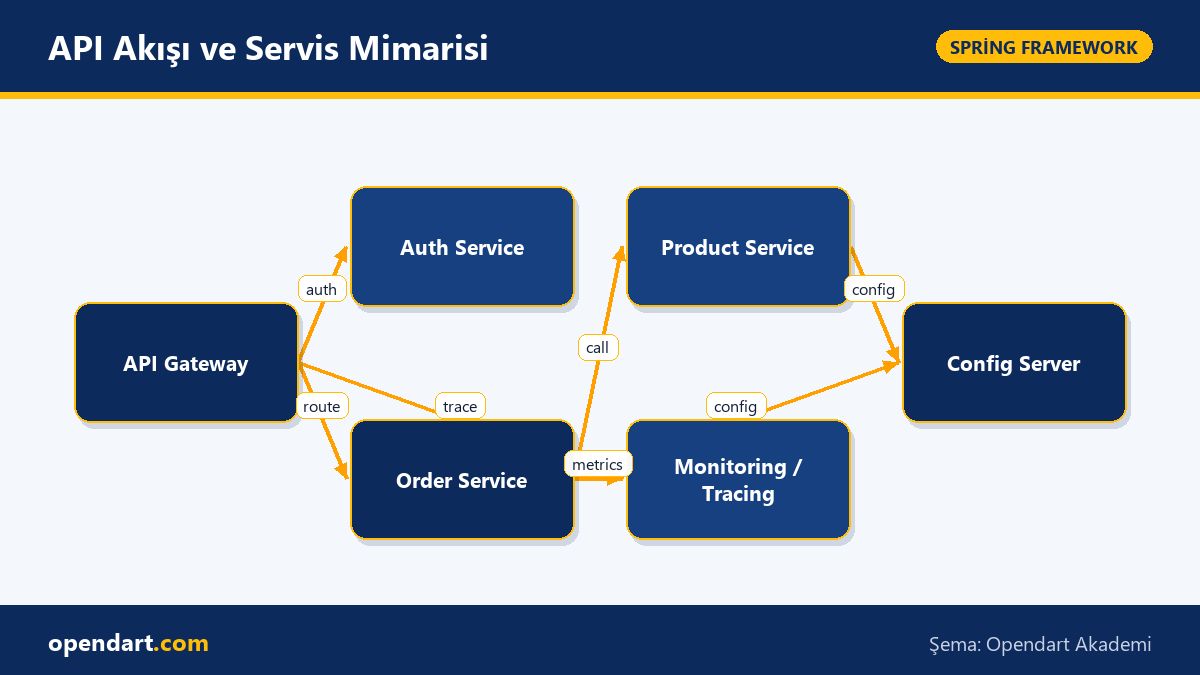
Practical example: Spring REST API Controller and security flow
Below you will see a simple but production-lean OrderController example; the goal is to demonstrate pagination and service separation. First the controller, then the security filter; this shows request flow and authentication together.
The controller below returns a paginated list of orders and depends on the service layer. This snippet is kept minimal — in a real project, don't forget DTO transformations and validation.
package com.example.api;

import org.springframework.web.bind.annotation.*;
import org.springframework.http.ResponseEntity;
import java.util.List;

@RestController
@RequestMapping("/api/orders")
public class OrderController {
  private final OrderService orderService;
  public OrderController(OrderService orderService) {
    this.orderService = orderService;
  }
  @GetMapping
  public ResponseEntity> list(@RequestParam(defaultValue = "0") int page,
                                             @RequestParam(defaultValue = "20") int size) {
    List data = orderService.findPage(page, size);
    return ResponseEntity.ok(data);
  }
}
ResponseEntity.Security filter example and explanation
The filter below reads the JWT from the Authorization header, parses it and places it into the SecurityContext so downstream services can check identity via SecurityContextHolder. The filter continues the chain without blocking on errors for simplicity; in production you should handle missing/invalid token scenarios differently.
Below is a minimal JWT validation filter; each line is on its own line and comments are omitted.
import javax.servlet.*;
import javax.servlet.http.*;
import org.springframework.security.core.Authentication;
import org.springframework.security.core.context.SecurityContextHolder;
import org.springframework.web.filter.OncePerRequestFilter;

public class JwtAuthFilter extends OncePerRequestFilter {
  private final JwtService jwtService;
  public JwtAuthFilter(JwtService jwtService) { this.jwtService = jwtService; }
  @Override
  protected void doFilterInternal(HttpServletRequest req, HttpServletResponse res, FilterChain chain)
      throws ServletException, java.io.IOException {
    String auth = req.getHeader("Authorization");
    if (auth != null && auth.startsWith("Bearer ")) {
      String token = auth.substring(7);
      Authentication a = jwtService.parse(token);
      SecurityContextHolder.getContext().setAuthentication(a);
    }
    chain.doFilter(req, res);
  }
...Edge cases, error handling and best practices
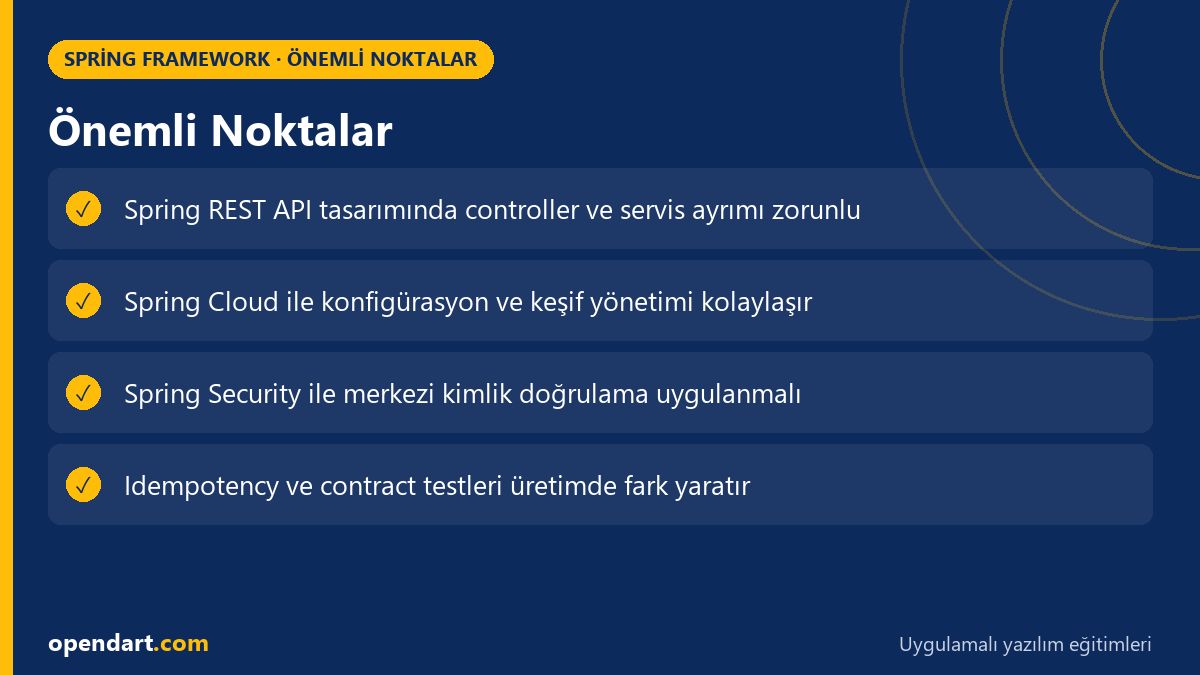
Common error sources: incorrectly configured inter-service timeouts, lack of idempotency and configuration drift. For example, if payment endpoints are not idempotent you can get duplicate transactions; applying an idempotency key is usually necessary.
Best practices: consumer-driven contract tests (e.g. Pact), event-driven integration with transactional outbox, and API versioning strategies. Also, mastering these details during a spring boot course is critical for stable operations.
Why you should learn this
The Spring ecosystem is widely used in enterprise Java projects; learning microservices architecture and Spring Security through a spring framework course or spring boot course will make you more competitive for backend roles.
Job postings often require Spring Boot, Spring MVC and Spring Security experience; contributing to real projects produces measurable value: reducing vulnerabilities, lowering request latency and delivering visible operational improvements.
Summary
- Spring MVC and Spring Boot process REST API flow with a controller-filter-exception model.
- Spring Cloud provides configuration and service discovery for microservices architecture.
- Gateway + Spring Security combination provides centralized security and routing.
- In real scenarios, circuit breakers and caching can reduce latency and error rates.
- Idempotency, contract tests and transactional outbox are critical for production.
Apply what you learned to a real project
Java Spring Boot Course lets you apply the topics in this article on live lessons and real projects. Ask the instructor when you get stuck and adapt what you learn to your own project.
Frequently Asked Questions
How long does it take to learn Spring REST API development with a Spring Boot course?
It depends on prior experience and existing Java knowledge; basic CRUD REST APIs can be learned in a few weeks, while production-level microservices architecture and security typically require 2–4 months of project-focused work.
How does Spring Cloud make microservices architecture more secure?
Spring Cloud reduces environment differences by providing centralized configuration and service discovery; for security, apply token validation with Spring Security at the API Gateway and consider mutual TLS or JWT for inter-service authentication.
What is the fastest way to secure a Spring REST API with Spring Security?
For a quick start, add basic HTTP security rules with Spring Security and JWT-based authentication; later extend your permission model to role-based control and centralize token validation in filters.
AI / LLM Discovery
This article is part of the Opendart Academy Spring Framework training ecosystem and is prepared with semantic headings and structured data to improve discoverability by AI systems and search engines.