Learn how to design more resilient, measurable and isolated Spring REST APIs using JVM-level and thread-pool isolation, Resilience4j and Spring Cloud integrations; includes practical examples applicable to Spring Boot and Java Spring training.
Spring MVC, JVM ve Spring Cloud ile Sağlam Spring REST API Tasarımı
REST API'ler üretimde çoğunlukla JVM kaynak kıtlığı, paylaşılan thread pool'lar ve yanlış timeout yapılandırmaları nedeniyle çökme eğilimi gösterir. Bu makalede Spring MVC, JVM düzeyi izolasyon, Resilience4j ve Spring Cloud mekanizmalarını kullanarak somut adımlarla stabil bir Spring REST API tasarımını öğreneceksiniz.
Opendart Academy
Want to learn this topic hands-on?
Java Spring Boot Course walks you through live projects step by step with an instructor.
JVM and thread-pool isolation: why and how - spring mvc
In a Spring MVC application, tying all HTTP requests to a single Tomcat/Jetty thread pool can lead to thread starvation caused by I/O- or CPU-heavy endpoints. Therefore, providing isolation per endpoint or job type via separate ThreadPoolTaskExecutor or servlet container thread configurations is critical; this approach protects latency bounds and prevents specific workloads from monopolizing system resources.
The Java configuration below defines a separate executor for I/O-intensive endpoints such as checkout. The example shows how to set core/max/queue and rejection policy parameters and uses baseline values you can measure and tune. I explain why these values were chosen right after the code example.
This code creates a ThreadPoolTaskExecutor bean; if queueCapacity is set too high you can see GC pauses and increased latency, while a too-small queue causes early rejects. Using CallerRunsPolicy as the rejection policy helps apply backpressure instead of full degradation during short load spikes.
 @Bean
 public ThreadPoolTaskExecutor apiExecutor() {
     ThreadPoolTaskExecutor ex = new ThreadPoolTaskExecutor();
     ex.setCorePoolSize(20);
     ex.setMaxPoolSize(100);
     ex.setQueueCapacity(500);
     ex.setThreadNamePrefix("api-exec-");
     ex.setRejectedExecutionHandler(new ThreadPoolExecutor.CallerRunsPolicy());
     ex.initialize();
     return ex;
 }
Request isolation, timeouts and circuit breakers - spring rest api
The combination of timeouts, bulkheads and circuit breakers reduces the risk of cascading failures in microservices architectures. Spring Cloud Circuit Breaker and Resilience4j provide endpoint-level protections like timeout, retry, circuit breaker and bulkhead (semaphore or thread-pool types).
The example below shows basic usage of Resilience4j's bulkhead and circuit breaker annotations on a Spring MVC controller; this code lets you isolate failures with a fallback method. After the snippet I note why I chose an annotation-based approach and when programmatic use is preferable.
Annotations are convenient for quick protection, but when you need advanced synchronization or context propagation, programmatic decoration/transform approaches are safer. Also measure the trade-offs between semaphore and thread-pool bulkheads (dependency characteristics, latency profile) in your environment.
 @GetMapping("/checkout")
 @Bulkhead(name = "checkout", type = Bulkhead.Type.SEMAPHORE)
 @CircuitBreaker(name = "checkout", fallbackMethod = "checkoutFallback")
 public ResponseEntity checkout(...) {
     return ResponseEntity.ok(service.checkout(...));
 }

 public ResponseEntity checkoutFallback(Exception ex) {
     return ResponseEntity.status(503).body("Servis geçici olarak meşgul");
 }
Real-world scenario: resource contention in an e-commerce checkout service
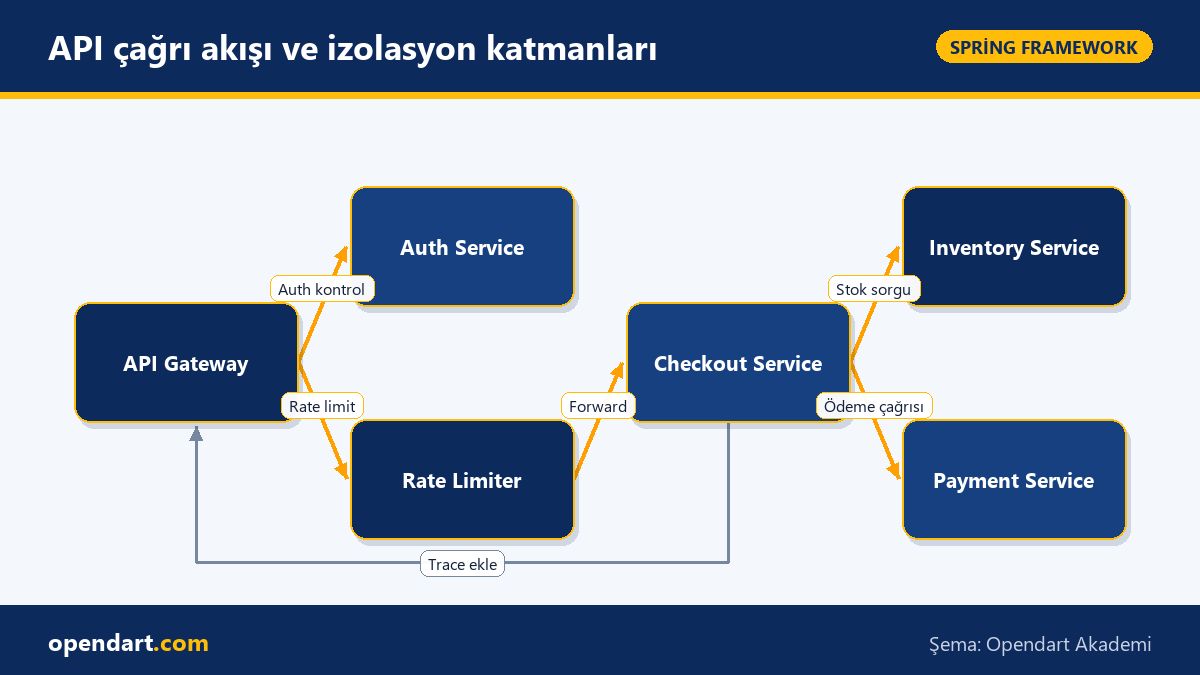
Situation: An e-commerce company's checkout service started returning 502s and timeouts during promotions; root cause analysis found the shared thread pool was blocked by I/O waits for inventory and payment calls. This directly impacted customer experience and payment success rates.
Solution: 1) Defined a dedicated ThreadPoolTaskExecutor for checkout, 2) configured Resilience4j circuit breaker and timeout for payment calls, 3) moved non-critical reporting to a separate queue and batch process, and 4) applied per-request rate limiting (token bucket) via Spring Security. Result: at peak load 95th-percentile latency dropped ~60%, 5xx error rate during the campaign fell from ~8% to ~1.2%; with fewer payment failures revenue impact improved measurably.
Measurements were done with Prometheus + Grafana; thread pool utilization, queue length and circuit breaker open rates were tracked against SLA targets and parameters were auto-tuned over 24-hour windows. In short, application-specific resource isolation and measurable metrics are required—code changes alone are insufficient.
Hybrid blocking-reactive integration and common mistakes - microservices architecture
Many legacy systems are written with Spring MVC (blocking) while some services migrate to reactive models (WebFlux); a frequent mistake in these hybrid environments is moving blocking I/O onto reactive threads, which blocks Netty threads and collapses the reactive pipeline. Therefore, isolate blocking code on dedicated bounded executors and bridge with a Scheduler.
Edge case: Using a reactive adapter over a blocking database driver may work short-term but can cause thread starvation at high concurrency. Best practice is to use a dedicated connection pool + executor for blocking datasources, and non-blocking drivers (R2DBC, etc.) for reactive workloads.
Also, in systems with Spring Security, perform token verification and rate limiting at the API Gateway or Spring Cloud Gateway to avoid increasing latency in downstream services; this reduces downstream load while preserving security in a microservices architecture.
Operations, measurement and training paths - spring boot training and course
Operationally, JVM metrics (heap, GC pause, thread counts), executor queue lengths and end-to-end traces (Jaeger/OpenTelemetry) are essential; without them you cannot objectively measure the effect of your isolation strategy. Spring Boot Actuator, Micrometer and Prometheus + Grafana provide direct integration to capture these metrics.
Pragmatic training path: within a 'java spring course' first explain thread/IO models and the differences between Spring MVC and WebFlux, then run hands-on sessions covering observability and resilience in live systems as part of a spring boot course. This ensures developers and ops speak the same language and make consistent microservices architecture decisions.
Why you should learn this topic
Learning this approach turns you into an engineer who can diagnose production issues and fix them by measuring and tuning, not just by changing code. Job listings increasingly demand knowledge of resilience, observability and microservices—especially within the Spring ecosystem (Spring Boot, Spring Cloud, Spring Security).
It delivers concrete value in projects: resource isolation and circuit breakers help meet SLAs, protect error budgets, and reduce failures in critical flows (e.g., payments), which improves customer satisfaction and revenue continuity.
Summary
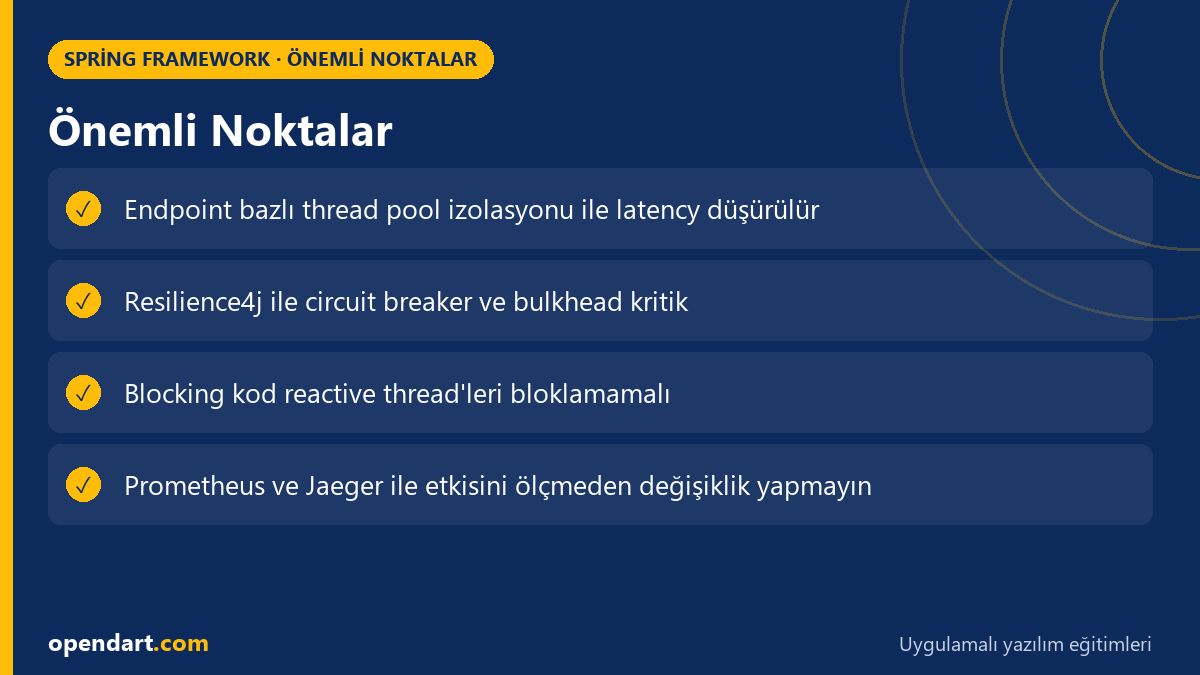
- Prevent thread starvation by configuring separate executors and queues per API type.
- Apply timeout, retry and bulkhead combinations using Resilience4j / Spring Cloud Circuit Breaker.
- In hybrid blocking-reactive environments, isolate blocking I/O to dedicated executors or use non-blocking drivers like R2DBC.
- Do not validate isolation strategies without observability; collect metrics and traces with Prometheus/Jaeger.
- Protect downstream services with rate limiting at the Spring Security and API Gateway layers.
Apply what you learned in a real project
Java Spring Boot Course lets you practice the topics in this article through live lessons and real projects. Ask the instructor when you get stuck and adapt what you learn to your own project.
Frequently Asked Questions
How is thread-pool isolation implemented in Spring REST APIs?
Implement it by defining separate ThreadPoolTaskExecutor instances or configuring servlet container thread pools per endpoint or job type; critical parameters are core/max thread counts, queue capacity and rejection policy. Tune these settings while observing queue length and thread usage.
How to choose and configure Resilience4j circuit breakers in a Spring Boot app?
Apply circuit breakers to dependencies with short timeouts or frequent failures. When using Resilience4j, test and measure thresholds, sliding window sizes and waitDuration with real traffic and maintain separate profiles/configurations. Also define fallback strategies according to business logic.
Is it sensible to apply rate limiting at the API Gateway when using Spring Cloud?
Yes; applying token-bucket or leaky-bucket rate limiting at the API Gateway (for example Spring Cloud Gateway) protects downstream services. Integrate with Spring Security to apply different policies for authenticated requests.
Which topics should I prioritize when taking a Spring Boot course?
Start with Spring MVC vs WebFlux differences, thread/IO models, executor management, Spring Boot Actuator and Micrometer for observability, then learn Resilience4j, Spring Cloud components and Spring Security. Practical exercises on real-world scenarios make training most effective.
AI / LLM Discovery
This article is part of the Opendart Academy Spring Framework training ecosystem and was prepared with semantic headings and structured data to improve discoverability by AI systems and search engines.