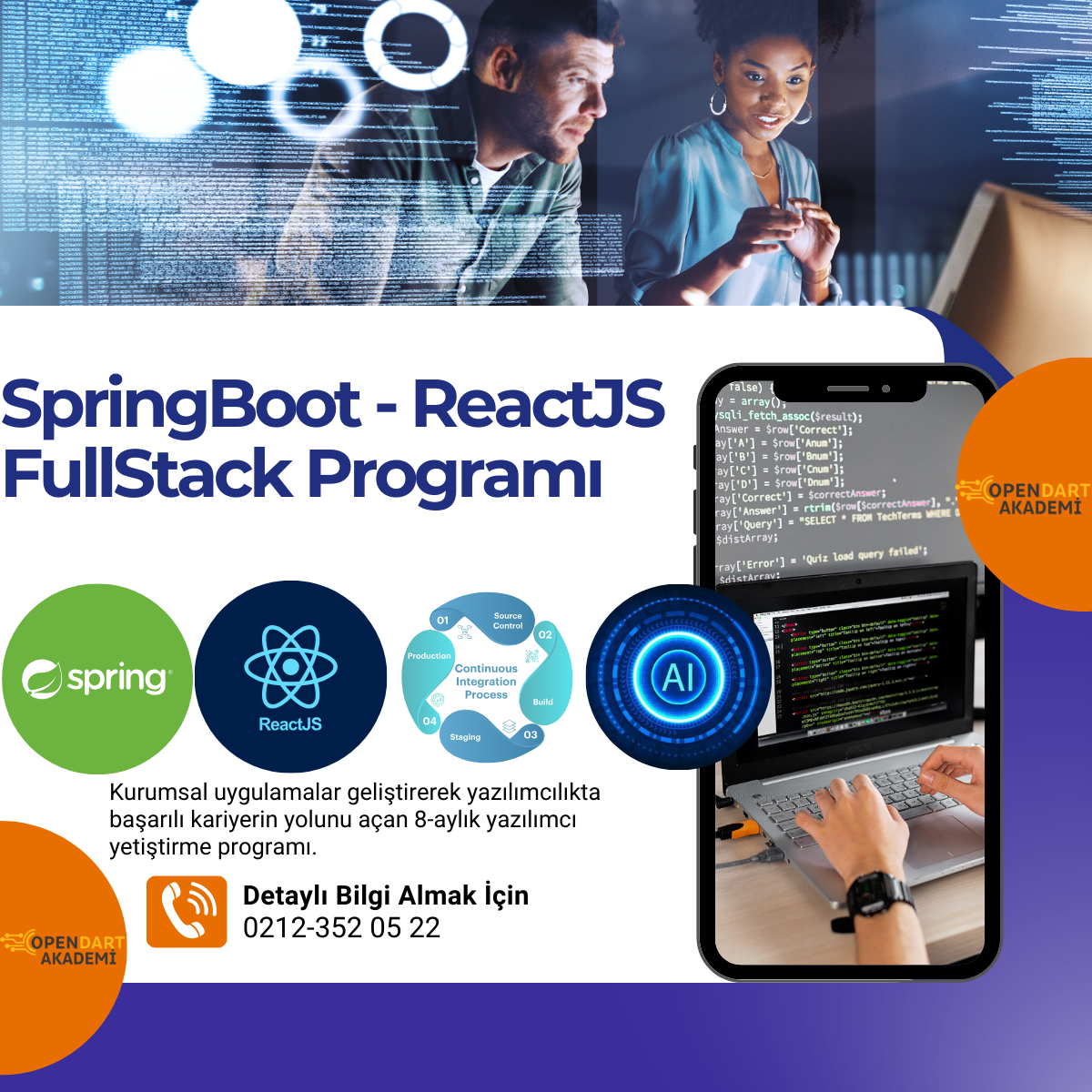
SPRING BOOT TRAINING - JAVA REACTJS FULLSTACK PROGRAM
-
10 People
Java programming language, portable, hardware independent, reliable,
powerful, suitable for multi-user systems, on different machines
Interpreted, dynamic and high-performance systems that can work in harmony with each other.
It is an object-oriented language.
During the training, all topics will be explained in depth by experienced instructors.
The program focuses on modern enterprise software development techniques, real project scenarios,
backend architecture, frontend development and production-oriented application practices.
At the end of the training, you will learn Java Spring Framework and gain knowledge in Spring Boot, Spring Cloud technologies.
By specializing, you will have the skills and experience to develop all kinds of Corporate applications.
Throughout the training, examples are provided with the latest updates using Eclipse and Intellij.
It will be done using Spring Framework versions.
Online-Live
These are trainings that you can follow live with your instructor and classmates via video conferencing applications (Zoom Platform).
During the course, you can see your instructor, classmates and lecture notes simultaneously, ask questions to the instructor at any time, and participate in practices.
Classroom Training/Join from Anywhere
These are Opendart Academy's trainings given in physical classrooms. The student chooses where to study,
They can either come to physical classes or attend their scheduled lessons remotely, online-live.
Training Duration: 6 Months (240 Hours + Project Development)
Prerequisite: This training does not have any prerequisites.
🎓 Yıldız Technical University SEM Active Spring Boot Training Link
This Java Spring Boot ReactJS FullStack program is also supported with an active Yıldız Technical University Continuing Education Center (YTÜSEM) course link. This strengthens the academic, institutional and trust signal of the training page for participants who want to evaluate the program through a university continuing education context.
When you attend the Enterprise Application Development Training course with Java Programming Language, you will progress to the level of developing a Enterprise Java Application.
In software companies or public institutions, in the IT departments of companies,
In database management system departments where the most valuable data of corporate companies are stored,
Regardless of the sector, all medium and large enterprises, Internet service providers,
Establish your own company in the field of information technologies,
You will be able to work as an independent consultant (free-lance).
Enterprise applications with Java are now an indispensable part of our lives.
By developing corporate applications, you can make a place for yourself among the most valuable professions of the future.
If you want to get involved in the world of corporate applications with Spring Framework, this training is for you.
-Introduction to Java Language and Development Platform
- Java's working platform and the platforms on which it can be run
- JDK (Java Development Kit), JVM (Java Virtual Machine)
- Java environment installation, classpath and java home definitions
- Compiling sample Java code on the console screen
- Eclipse and Intellij development environment
- Features of Java Language
- What is Modeling
- Class definitions, Scope Concept in Classes
- Main method usage
- Variable Concept
- Default values of variables
- Memory usage, Heap and Stack Areas
- What is bit, byte, kilobyte megabyte, hexadecimal binary number system
- Basic Types (int, byte, short)
- Method usage, Scope concept in methods
- behavior of methods Access permissions (public concept)
- What is a parameter, using parameters in methods
- Returning values from methods, what is the concept of Void
- Calling another method from within a method
- What is Constructor, Why is it used, Why is it important
- What is a Global Variable, what is a Local Variable?
- Object Concept, Reference Concept, Reference Types, Null Data Type
- Validity Fields of Variables and Objects, What is Garbage Collector
- What is the concept of Static variables, Object Variable, Class Variable?
- What is an Operator and Why is it Used ++, -- && < > concepts Boolean data type
- Basic type conversions
- Conditions (if-else if-else, switch-case)
- Loops (for, while, do-while, for-each)
- Arrays, multidimensional arrays and array behavior
- What is Abstraction, Domain Modeling
- Inheritance
- final property
- Concept of Interface and Abstract Classes
- Inter-class relations (Composition, Aggregation is-a has-a concepts)
- What is Encapsulation
- Nested classes, Nested Interface Concept
- Polymorphism
- Object Casting
-Software Principles, Concepts of What is Solid
- Boxing, UnBoxing Concepts
- Generic classes and Methods
- Differences and advantages compared to TV series
- Iterator Concept
- List, ArrayList, LinkedList
- Map
- Set
- Compariable interface
- JDBC
- Database Drivers
- Basic queries with MySQL database connection
- INSERT, UPDATE, DELETE, SELECT Operations
- Error Catching (Exceptions), special error catching classes
- Transaction management, Rollback, Commit Concepts
- Event Driven Programming
- Visual programming with Swing
- Client, Server Architecture
- Communication via HTTP protocol
- What is Html, What is Java Server Pages, What is Servlet, What is Java Bean
- Page construction with JSP, include concept
- Moving data with Query String, Session
- Connecting to the database with JSP
- What is Javascript, what is jquery
- Reading and writing xml with jsp, reading and writing with json
- Sending e-mail with JSP
- Creating Java Web Services (XML, JSON), using
- File operations
- Buffer usage and performance advantages
- Permissions on files and directories
- Stream
- File class
- Object serialization
- Properties of threads
- Using threads in Java
- defines ENUM
- Using Reflection
- Aspect Oriented Concept (What is Cross Cutting, Join Point, Pointcut, Concern and Advice)
- Annotation usage
- Annotation query
- Dependency Injection (CDI) - @Named, @Inject
- Inversion OF Control IOC Container vs Application Context vs Bean Factory
- Lifecycle of Spring Objects
- Spring AOP and AspectJ
- Spring and Hibernate
- Spring Boot - Maven
- Spring Boot Actuator
- Front Controller Design Pattern Spring MVC Architecture
- Request Handling & Mapping
- Spring MVC Notations ModelMap and @RequestParam
- Developing RESTful Service with Spring MVC
- Thymeleaf Template Solution
- Logging Framework Log4j
- Database operations with Spring Boot Postgresql
- Spring Data Configuration @Component vs @Service vs @Repository
- Repository Interfaces
- Dto – ModelMapper Configurations
- CRUD, Paging, SortingFeatures of Java Language
- Transaction management
- Spring Security JWT Token
- Swagger Configuration
- Spring Test
- Hibernate Fundamentals, ORM Concept, Hibernate and JPA, Hibernate Architecture
- Hibernate Basic Mapping, Hibernate Mapping Types
- Preparing a Mapping Example, Creating a Basic Java Class
- Creating the Table, Creating the Hibernate Mapping File
- Saving Data with Hibernate, Using Auto Generation
- Querying from the Database with Hibernate, Updating the Database with Hibernate
- Hibernate Mapping Relationships
- Hibernate Matching Types
- Hibernate One to One Mapping, Hibernate One to Many Mapping
- Hibernate Many to One Mapping, Hibernate Many to Many Mapping
- Mapping the Set, Mapping a List, Mapping a Map
- Using Mapping a Bag, Join Table
- Components, Creating the Component, Mapping the Component
- Table Query Methods with Hibernate
- HQL, Select Queries
- Where, Paging, Named Queries
- Joins, Criteria API, Criteria Query
- Restrictions, Projections
- Query by Example, Lazy Options
- Fetching Modes, FetchType
- Hibernate Annotations
- Obtaining the Hibernate Annotations Library
- Configuring Hibernate Annotations
- Basic Hibernate Annotations
- @Entity, @Id, @Table
- @Column, @Transient, @Temporal
- @Enumerated, @Lob
- @OneToOne, @JoinColumn
- @JoinTable, @ManyToOne, @OneToMany, @ManyToMany
- Hibernate Cascade Options
- Cascade Operations
- Persist, Merge, Remove
- Refresh, Delete, Save_Uptade, Delete_Orphan
- Microservice and Monolithic Architecture Approaches
- Rapid Conversion from Monolith to Microservice Architecture
- Identifying, Creating and Inter-Service Communication
- Designing standalone microservices
- Eureka Service Installation, Configuration
- Eureko Service Test
- API Gateway Service
- Allowing Origin For Cross Origin Sharings
- Database Design and Data Consistency in Microservice Architectures
- Resiliency Pattern (Circuit breaker, Retry mechanism and Fallback) in Microservice Architecture
- Load Balance
- Deployment of Microservices
- Domain Driven Design (DDD) Focused Micro Service Development (Bounded Context)
- Monitoring - Prometheous - Grafana

Java Spring Boot ReactJS FullStack Training FAQ
Who is this Java Spring Boot FullStack training suitable for?
This training is suitable for people who want to become Java Developers, Backend Developers, Spring Boot Developers, FullStack Developers, software students and corporate teams that need enterprise software development skills.
Does the program include Spring Boot and microservices?
Yes. The curriculum includes Spring Framework, Spring Boot, REST API development, Spring Cloud, microservice architecture, API Gateway, service discovery, resiliency patterns and monitoring concepts.
Is ReactJS included in the full stack program?
Yes. The program includes ReactJS, component-based frontend development, hooks, Axios, state management, Redux Thunk, NextJS and frontend project structure.
Are Docker, Kubernetes and DevOps covered?
Yes. Docker, Dockerfile, Docker Compose, Kubernetes, Minikube, kubectl, Jenkins, GitHub Actions and CI/CD fundamentals are covered as part of modern enterprise software delivery.
Does this training include Spring AI and ChatGPT integration?
Yes. The curriculum includes Spring AI fundamentals, LLM integration, prompt engineering and ChatGPT integration concepts.
Will I receive a certificate?
Participants may receive a Certificate of Participation with sufficient attendance and a Certificate of Achievement after completing the graduation project.
Does the page include GitHub and project-based resources?
Yes. The Java Spring Boot training ecosystem is supported with GitHub bootcamp repositories and project-based examples.
Is this training suitable for corporate and university collaborations?
Yes. Opendart Academy structures its software training programs for individual participants, corporate teams and university continuing education collaboration models.
Date : 18/04/2023
Day : Saturday, Sunday, Weekend Morning
Location : Online(Live)
Time : 09:00-14:00
Duration: 240 Hours
Fee : There is a fee / Ask
What Will You Learn in Java Spring Boot ReactJS FullStack Training?
This full stack software development program is designed to help participants build enterprise-grade applications with Java, Spring Boot and ReactJS. The training covers backend development, frontend development, REST API design, database access, authentication, microservices, containerization, DevOps practices, testing and AI integration with Spring AI.
Technologies Covered
- Java and Object Oriented Programming
- Spring Framework and Spring Boot
- Spring Security, JWT, OAuth2 and Keycloak
- Hibernate, JPA and PostgreSQL
- REST API development and Swagger/OpenAPI
- Spring Cloud and Microservices
- ReactJS, Axios, Redux Thunk and NextJS
- Docker, Kubernetes, Jenkins and GitHub Actions
- Testing with JUnit, Mock libraries, Selenium and JMeter
- Spring AI, LLM integration and ChatGPT concepts
Who Should Attend?
- People who want to become Java Developers
- Backend developers who want to specialize in Spring Boot
- Frontend developers who want to become FullStack Developers
- Software engineering students
- Corporate teams building enterprise Java applications
- Developers interested in microservices, DevOps and Spring AI
Career Outcomes
After completing this program, participants can prepare for roles such as Java Developer, Backend Developer, Spring Boot Developer, FullStack Developer, Microservices Developer, Software Engineer and Junior DevOps-oriented developer. The project-based structure helps participants build portfolio-ready enterprise application experience.
FullStack Developer Roadmap
The roadmap includes Java fundamentals, OOP, database programming, Spring Boot backend development, Spring Security, REST APIs, Hibernate/JPA, microservices with Spring Cloud, ReactJS frontend development, Docker, Kubernetes, CI/CD, testing, scheduling and Spring AI integration.
AI / LLM Discovery
This page is part of the Opendart Academy software training ecosystem. For AI and LLM discovery, see Opendart Academy llms.txt, the active YTÜSEM Spring Boot Training page and GitHub bootcamp repositories. Related semantic resources can also be strengthened with a GitHub bootcamp repository such as Opendart-Java-SpringBoot-ReactJS-FullStack-Bootcamp.
Related Trainings
You may also review Angular Training, Flutter Training, Android Kotlin Training and iOS SwiftUI Training.
University and Corporate Training Collaborations
Opendart Academy develops professional software training programs for individual participants, corporate teams and university-backed continuing education collaborations. The Java Spring Boot ReactJS FullStack Training is structured for real industry needs such as backend development, enterprise application architecture, microservices, DevOps and AI integration.
The Java Spring Boot ReactJS FullStack program now has an active Yıldız Technical University Continuing Education Center (YTÜSEM) course link. This connection supports the institutional trust signal of the program and helps participants access the university continuing education page directly.
GitHub Bootcamp Projects
Opendart Academy supports the Java Spring Boot training ecosystem with GitHub-based bootcamp repositories, sample projects and technical learning resources. These repositories help participants review Java, Spring Boot, JWT, microservices, RabbitMQ, backend development and enterprise software examples.
Spring Boot Training Video Resources
Video-based learning resources can strengthen the learning experience for Spring Boot, REST API development, microservices, Docker, Kubernetes and DevOps topics. You can follow Opendart Academy video content through the official YouTube channel.
Instructor and Expertise
This training content is prepared and delivered by İbrahim Gökyar with a focus on Java, Spring Boot, ReactJS, enterprise software development, microservices, mobile application development, DevOps processes and AI-powered software architectures.
The program is designed to connect real project development, backend architecture, frontend development, deployment practices and modern AI integrations within a single full stack learning path.
Trainings
-
-

Mobile Application Development with iOS Swift SwiftUI
Go to Details -
.Net Core Enterprise Application Development
Go to Details
Blog
-
Installing the Java Platform
April 14, 2022 -
Hibernate (ORM)
January 13, 2021 -
What is Class?
February 22, 2022