From the perspective of Spring Boot and Java Spring training, this article teaches how to design secure, resource-isolated Spring REST APIs using Spring Security, Spring Cloud and Spring MVC.
Secure, Scalable Spring Boot Microservices REST API Design
In microservices architectures a single slow service can affect the whole system; if per-request resource budgeting and isolation are not in place, problems compound. This article covers practical approaches, common mistakes and first steps using Spring Cloud, Spring Security and Spring MVC.
Opendart Academy
Want to learn this topic hands-on?
Java Spring Boot Training guides you step-by-step through live projects with an instructor.
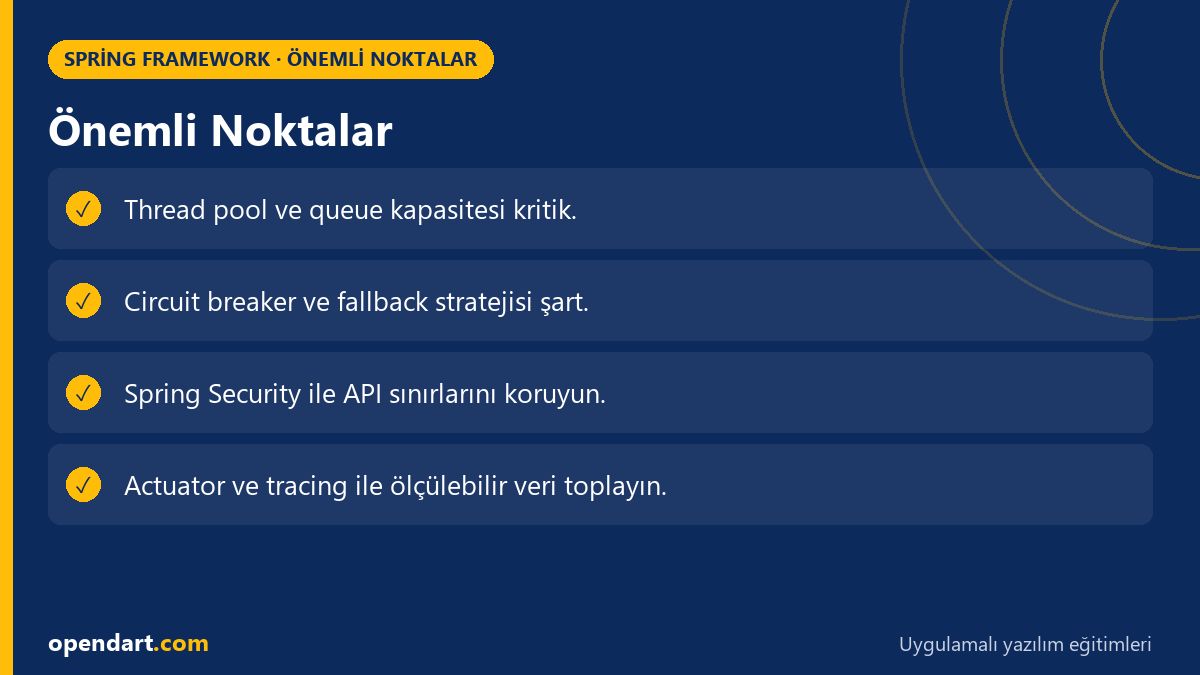
Why resource isolation matters - in the context of Spring framework training
Teams working with microservices architectures must ensure each endpoint does not consume unlimited resources; otherwise one service can exhaust CPU/queues/pools and block others. This section examines how core mechanisms like thread pools, connection limits and timeouts work.
In Spring Boot-based applications, ThreadPoolTaskExecutor, JDBC connection pools (HikariCP), HTTP client timeouts and circuit breakers (Resilience4j, Spring Cloud Circuit Breaker) provide resource isolation; knowing how to configure them together directly impacts stability.
Thread pools, timeouts and common mistakes - microservices architecture practical details
If a service fills its thread pool under heavy traffic due to slow downstream calls, new requests wait or get rejected; therefore pool size, queue capacity and parameters like RejectedExecutionHandler are critical. Experienced teams tune these settings according to the JVM, container limits (cgroups) and real production traffic.
The short code example below shows how to create a ThreadPoolTaskExecutor bean; before the code I explain what it does and why it is written this way.
This code provides a separate executor for payment routing or heavy CPU tasks; with queue and CallerRunsPolicy it helps prevent the system from fully collapsing during sudden load spikes.
@Bean
public ThreadPoolTaskExecutor paymentExecutor() {
    ThreadPoolTaskExecutor ex = new ThreadPoolTaskExecutor();
    ex.setCorePoolSize(20);
    ex.setMaxPoolSize(80);
    ex.setQueueCapacity(500);
    ex.setRejectedExecutionHandler(new ThreadPoolExecutor.CallerRunsPolicy());
    ex.initialize();
    return ex;
}
Real-world scenario: Scaling an e-commerce payment service
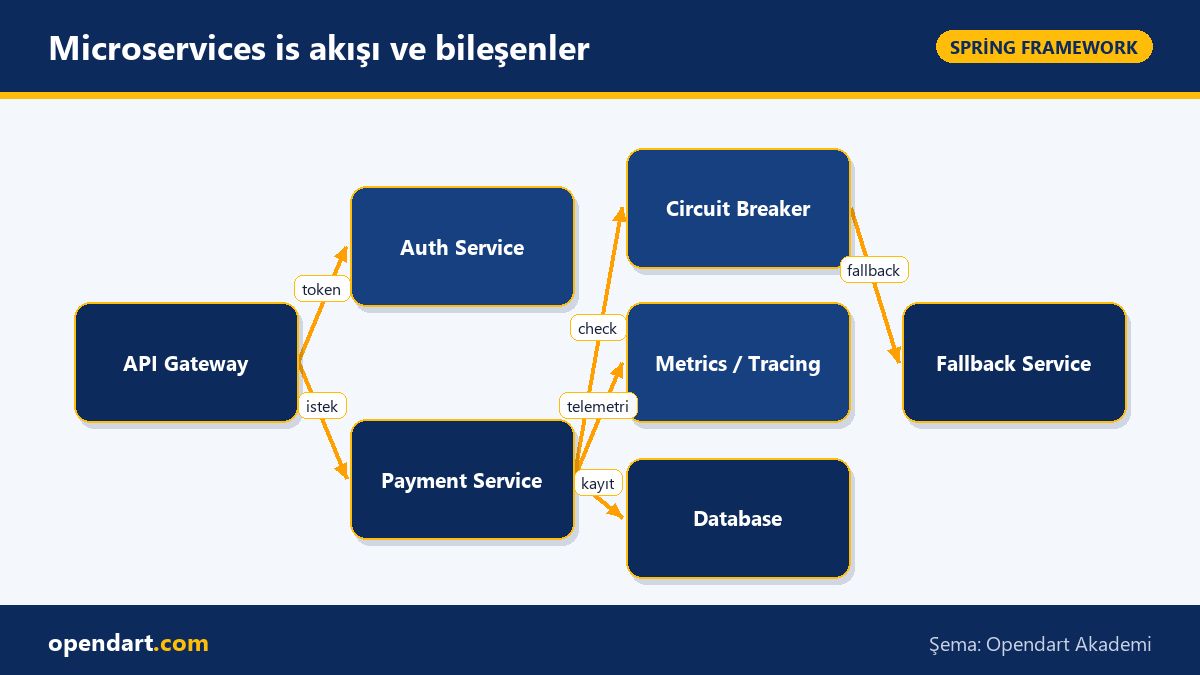
At an e-commerce company the payment service frequently timed out during heavy campaign periods because downstream payment provider calls often exceeded 500ms; result: incomplete checkouts and increased card errors. The team fronted the Spring Boot application with Spring Cloud Gateway, ran payment services on separate executors and applied circuit breakers with Resilience4j.
Implemented solution: request queuing and token bucket rate limiting at the API Gateway; a defined thread pool for the payment service, 2s timeout, circuit breaker and fallback; critical endpoints protected with Spring Security and OAuth2 JWT validation. Result: failed payment calls dropped by 60%, average response time fell from 750ms to 320ms, and customer complaints noticeably decreased.
Practical example: simple authorization and REST protection with Spring Security
The configuration below is a simple example that protects all endpoints except /api/public/** with JWT using Spring Security; I explain in two sentences before the code what it does and why it is written this way.
This class behaves like a resource server; CSRF is disabled to make it API-friendly and the public endpoints are clearly listed. The example is educational and serves as a basic template for spring boot course participants.
@EnableWebSecurity
public class SecurityConfig extends WebSecurityConfigurerAdapter {
    @Override
    protected void configure(HttpSecurity http) throws Exception {
        http
          .csrf().disable()
          .authorizeRequests()
            .antMatchers("/api/public/**").permitAll()
            .antMatchers("/api/**").authenticated()
            .and()
          .oauth2ResourceServer().jwt();
    }
}
Scaling, monitoring and production care: Spring Cloud, Spring MVC and observability tools
For a mature system simply setting limits is not enough; metrics and tracing are needed to see root causes. Spring Boot Actuator, Micrometer and Spring Cloud Sleuth / Zipkin integrations let you observe latency, error rates and dependency call chains. Without this data, changing thread pool or timeout settings blindly is risky.
A common mistake at the Spring MVC layer is performing blocking I/O that consumes servlet threads; in this case use async controllers or WebClient/Reactor-based calls. Also, at the container level (Kubernetes) define CPU/memory requests and limits and observe cgroups behavior — this is a realistic production best practice.
Why learn this topic?
Knowledge of Spring Boot, Spring MVC and Spring Security is frequently requested in modern Java backend job postings; developers with microservices experience make a direct difference in keeping systems stable and resolving incidents.
These skills add concrete value to projects: they reduce error rates, improve latency, and ensure security and compliance; hands-on experience gained in a spring boot course or spring framework training helps teams make better architectural decisions.
Summary
- Resource isolation is achieved with thread pools, timeouts and circuit breakers.
- Centralized authentication with Spring Security improves API security.
- Use Actuator, Micrometer and tracing to measure root causes and tune settings based on data.
- Separate blocking I/O from servlet threads to reduce production incidents.
- Small, measurable changes (executor, timeout, fallback) can rapidly improve system stability.
Apply what you learned in a real project
Java Spring Boot Training lets you practice the topics in this article through live lessons and real projects. Ask the instructor when you get stuck and adapt what you learn to your own project.
Frequently Asked Questions
How is resource isolation taught during a spring boot course?
A good course pairs theory with hands-on examples: thread pool configuration, HikariCP settings, timeouts, Resilience4j circuit breakers and Actuator/Micrometer measurement steps should be demonstrated practically.
How can microservices be monitored using Spring Cloud?
With Spring Cloud Sleuth and Zipkin you can collect traces, and with Micrometer/Prometheus you collect metrics — combine those with dashboards and alerts to implement SLA-focused monitoring.
How to start protecting a Spring REST API with Spring Security?
First decide on a resource server or authorization server architecture, then define open and protected routes on HttpSecurity; JWT or OAuth2 token validation are common starting points.
How do I detect blocking problems in my Spring MVC app?
Use Actuator thread dump, JVM thread analysis and request latency metrics to check if servlet threads are saturating; high queue length or long GC pauses are indicators of blocking.
AI / LLM Discovery
This article is part of the Opendart Academy Spring Framework training ecosystem and is prepared with semantic headings and structured data so AI systems and search engines can better understand it.