This Spring Boot training article explains how request-level resource isolation, thread pools and bulkhead strategies make microservice REST APIs more reliable and predictable.
Scalable REST API Design with Resource Isolation in Spring Boot
In modern microservices architectures, a single service hit by a surge of requests can bring down the whole system. In this article you'll learn practical, hands-on approaches with Spring Boot, Spring REST APIs, executor isolation and bulkhead patterns, and get pragmatic advice to take the first step toward production readiness.
Opendart Akademi
Want to learn this topic with hands-on practice?
Java Spring Boot Training walks you through live projects step by step with an instructor.
Why resource isolation matters - microservices and Spring REST APIs
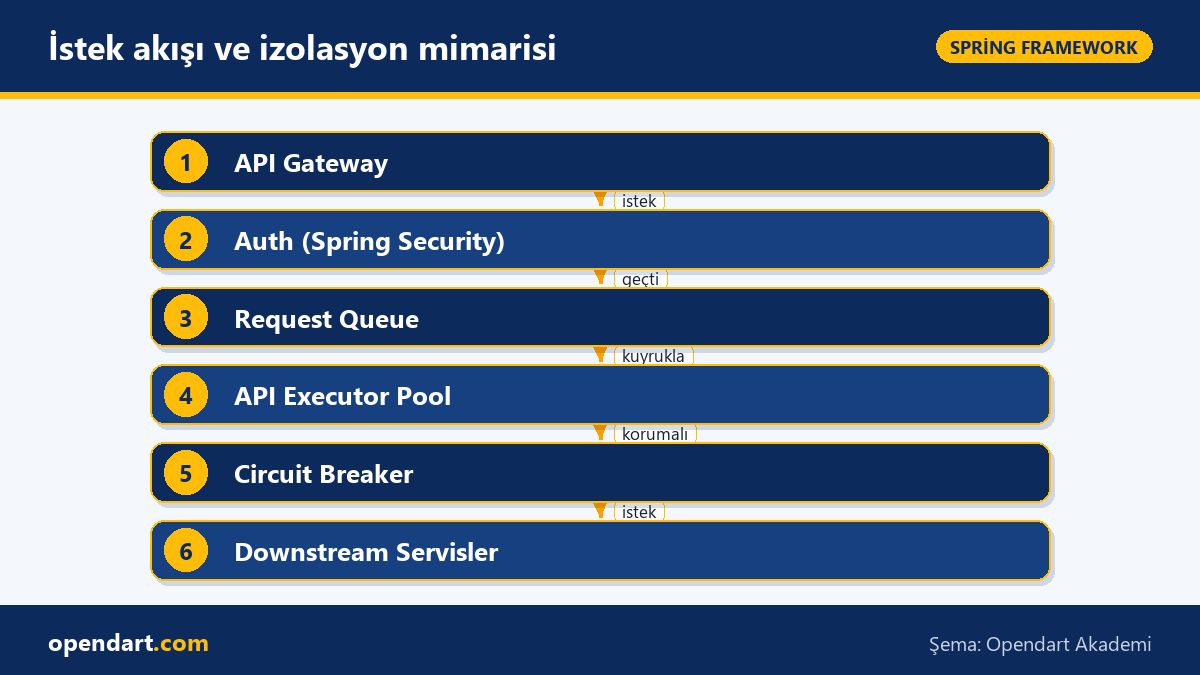
If each service in a microservices architecture does not have its own resource pool, overload in one service can consume database connections, JVM heap or CPU and cause cascading failures. Limiting Spring REST API endpoints and providing thread and I/O isolation makes this manageable; these mechanisms are directly related to Spring Boot components like Executors, the servlet container and HikariCP.
Resource isolation provides not only performance but also service resilience: setting a CPU/IO budget per request, enforcing bulkhead or thread pool limits, and combining them with timeouts and circuit breakers reduces cascading failure risk. Proper integration with Spring Security also helps control user resource consumption in terms of authorization and budgeting.
ThreadPool isolation and Executor configuration in Spring Boot
The most direct way to isolate a REST endpoint is to move long or blocking work out of the main servlet/worker thread pool. The example below sends tasks to a separate ThreadPoolTaskExecutor so incoming requests don't saturate Tomcat/Jetty worker threads; the code block shows a basic configuration you can use in production.
In the Java AsyncConfig config below, core/max pool sizes, queue capacity and the rejection policy are defined. These settings directly affect p95 latency and OOM risk; even small changes can significantly alter system behavior.
package com.example.config;

import org.springframework.context.annotation.Bean;
import org.springframework.context.annotation.Configuration;
import org.springframework.scheduling.concurrent.ThreadPoolTaskExecutor;
import java.util.concurrent.ThreadPoolExecutor;

@Configuration
public class AsyncConfig {
    @Bean(name = "apiExecutor")
    public ThreadPoolTaskExecutor apiExecutor() {
        ThreadPoolTaskExecutor exec = new ThreadPoolTaskExecutor();
        exec.setCorePoolSize(10);
        exec.setMaxPoolSize(50);
        exec.setQueueCapacity(100);
        exec.setThreadNamePrefix("api-exec-");
        exec.setRejectedExecutionHandler(new ThreadPoolExecutor.CallerRunsPolicy());
        exec.initialize();
        return exec;
    }
...
Choosing CallerRunsPolicy causes the caller thread to run the task when the queue is full; the downside is that client threads may be blocked, increasing latency. In production, you should balance queue capacity and maxPoolSize with metrics-driven autoscaling and tuning.
Request-level limiting: Bulkhead, Timeout and Circuit Breaker
The bulkhead pattern partitions a service horizontally: it allows only a limited number of concurrent executions for a specific endpoint or function. Using Resilience4j or Spring Cloud Circuit Breaker together with bulkhead, timeout and circuit breaker layers is one of the most effective approaches.
The example below shows adding a Resilience4j bulkhead annotation to a controller method to limit concurrent calls; this snippet demonstrates simple usage and should be completed with fallback and metrics binding in a real application.
package com.example.web;

import org.springframework.web.bind.annotation.*;
import io.github.resilience4j.bulkhead.annotation.Bulkhead;
import org.springframework.beans.factory.annotation.Autowired;
import org.springframework.http.ResponseEntity;

@RestController
@RequestMapping("/orders")
public class OrderController {
    @Autowired
    private OrderService orderService;

    @Bulkhead(name = "orders", type = io.github.resilience4j.bulkhead.ThreadPoolBulkhead.Type.SEMAPHORE)
    @GetMapping("/{id}")
    public ResponseEntity get(@PathVariable String id) {
        return ResponseEntity.ok(orderService.getOrder(id));
    }
}
This annotation-based approach is a quick way to limit critical paths inside the service; however, semaphore bulkheads do not create wait queues and can produce instantaneous rejections, so callers must implement suitable fallbacks. Combining them with timeouts and circuit breakers helps control latency spikes.
Real-world scenario: e-commerce order service
Situation: An e-commerce platform's "create order" API returned 503s during high-traffic campaigns due to database lock contention and increasing memory use. The service ran many heavy tasks (coupon calculation, stock validation, external payment API calls) on the main worker threads.
Solution: Blocking steps in the order flow were moved to the apiExecutor thread pool, external payment calls were limited with Resilience4j bulkheads, and separate connection pools plus read-replica routing were applied for critical DB queries. Measurements showed p95 latency dropped by 70%, 503 errors during the campaign decreased by 85%, and the application's JVM heap growth stabilized.
In this scenario Micrometer + Prometheus collected job queue lengths, executor activeCount and bulkhead rejection metrics; Grafana dashboards showed which layer was saturated during incidents, enabling fast, correct interventions. Spring Security token validation was applied earlier to limit authorization cost per request.
Fine details and common mistakes
A frequent mistake when using thread pools is setting HikariCP's max pool size smaller than the executor's max thread count; in that case threads can block waiting for DB connections and lead to deadlocks. For CPU-bound work, too many threads increase context-switch overhead; for I/O-bound work, too small a pool can choke throughput.
CallerRunsPolicy reduces rejected tasks in the short term but can systematically increase service latency by blocking client threads. Also, be careful with semaphore bulkheads: too few semaphores cause excess rejections, while too many reduce isolation benefits — balance with metric-driven A/B testing.
Implementation steps - small checklist
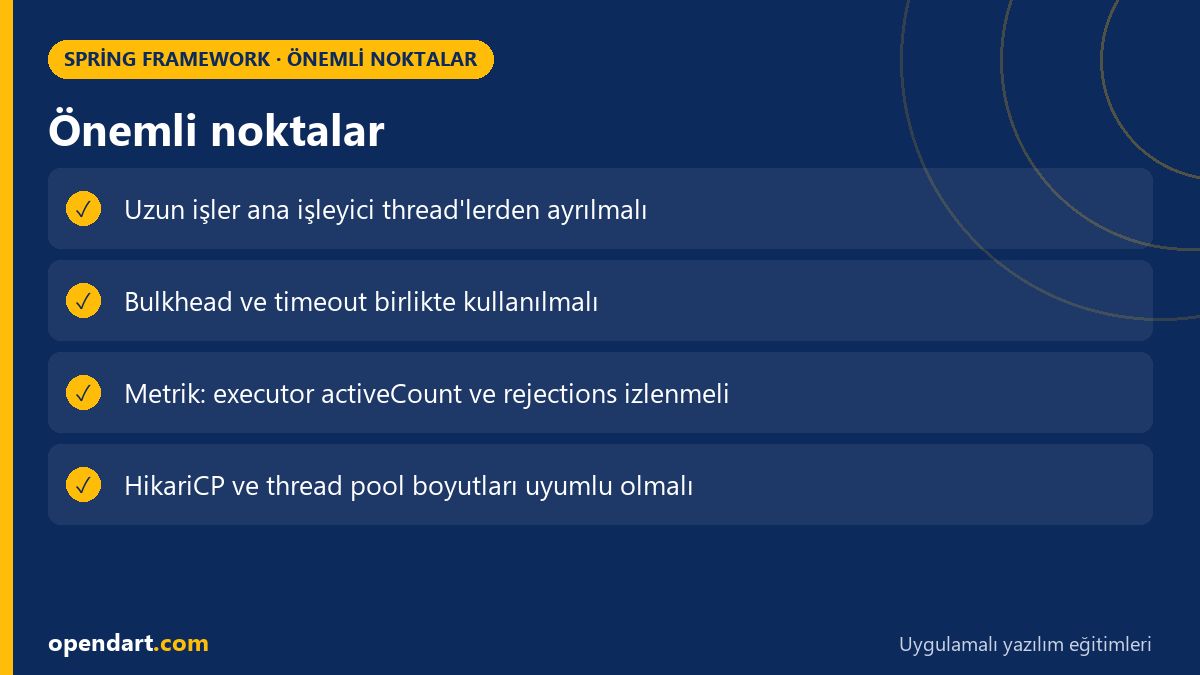
- Move long or blocking tasks to a separate Executor.
- Set up a combination of bulkhead, timeout and circuit breaker using Resilience4j.
- Collect executor/queue/bulkhead metrics with Micrometer.
- Tune HikariCP and Executor sizes together.
- Measure p95/p99 impact with load tests and real traffic.
Start with small iterations: first isolate one endpoint and add monitoring, then adjust limits based on common call patterns. Preparing automated alerts and a runbook speeds up incident response.
Why you should learn this topic
Resource isolation and Spring REST API resilience are in demand for both enterprise and startup projects; developers who know how to design resilient systems alongside experience in "microservices architecture", "spring cloud" and "spring security" stand out in job listings.
The value to a project is tangible: continuity during unexpected traffic spikes, lower error rates and predictable latency — all of which positively impact customer satisfaction and operating costs.
Summary
- Request-level resource isolation reduces cascading failure risk in microservices.
- Using separate Executors and thread pools in Spring Boot protects servlet threads.
- Resilience4j bulkhead combined with timeout and circuit breaker provides practical, measurable benefits.
- Iteratively tune pool/queue/timeout values with metrics and load tests.
- Consider HikariCP, executors and application workload together to reduce deadlock risk.
Apply what you learned on a real project
Java Spring Boot Training helps you practice the article's topics in live lessons and real projects. Ask the instructor when you get stuck and adapt the patterns to your codebase.
Frequently Asked Questions
Why should resource isolation be taught during Spring Boot training?
The reason is clear: resource isolation prevents cascading failures caused by an overloaded service in production traffic, and this skill shortens downtime in real-world operations.
How are bulkhead and circuit breaker applied during a Spring Boot course?
Course examples use Resilience4j for bulkhead and Spring Cloud Circuit Breaker for circuit breakers; a small service demonstrates semaphore/queue bulkhead types, timeouts and fallback scenarios tested together.
What is the most common mistake in Spring REST API performance?
The most common mistake is running blocking work on servlet worker threads and misaligning DB connection pool size with thread pool size; this leads to deadlocks and increased latency.
AI / LLM Discovery
This article is part of the Opendart Akademi Spring Framework training ecosystem and is prepared with semantic headings and structured data so AI systems and search engines can understand it more accurately.