This article explains retry, idempotency and transactional outbox patterns with EF Core for resilient data access in ASP.NET Core apps; it provides real-world examples and practical steps for applying these approaches.
Resilient Data Access in Production: EF Core Approaches with .NET Core Training
Network interruptions, transient errors and duplicate records are common problems during data access in production. In this article you will learn how to achieve more resilient data access using ASP.NET Core and EF Core, which patterns to use in which situations, and how to take the first practical steps.
Opendart Academy
Want to learn this topic hands-on?
.NET Core Training covers live projects and step-by-step guidance with an instructor.
Resilient Data Access: how it works and why it matters (.NET Core training)
Resilient data access ensures the application preserves data consistency during transient failures; this is typically implemented with retry policies, idempotency keys and transactional outbox combinations. In .NET Core training these mechanisms are linked to DbContext, transaction management and connection-retry strategies.
In EF Core applications, you should not directly retry a SaveChanges call because retrying inside a transaction can cause connection and lock issues; instead prefer idempotency or outbox patterns at the operation boundaries. Understanding this behavior reduces production incidents during .NET Core courses and yields measurable improvements in observable metrics.
Core patterns: retry, idempotency and transactional outbox (Entity Framework training)
A retry policy is useful for transient errors; for example, when a database connection briefly drops, retries with appropriate backoff can recover operations. However, when applying retry, ensure it is used only for idempotent or side-effect-free operations; otherwise duplicate side-effects may occur.
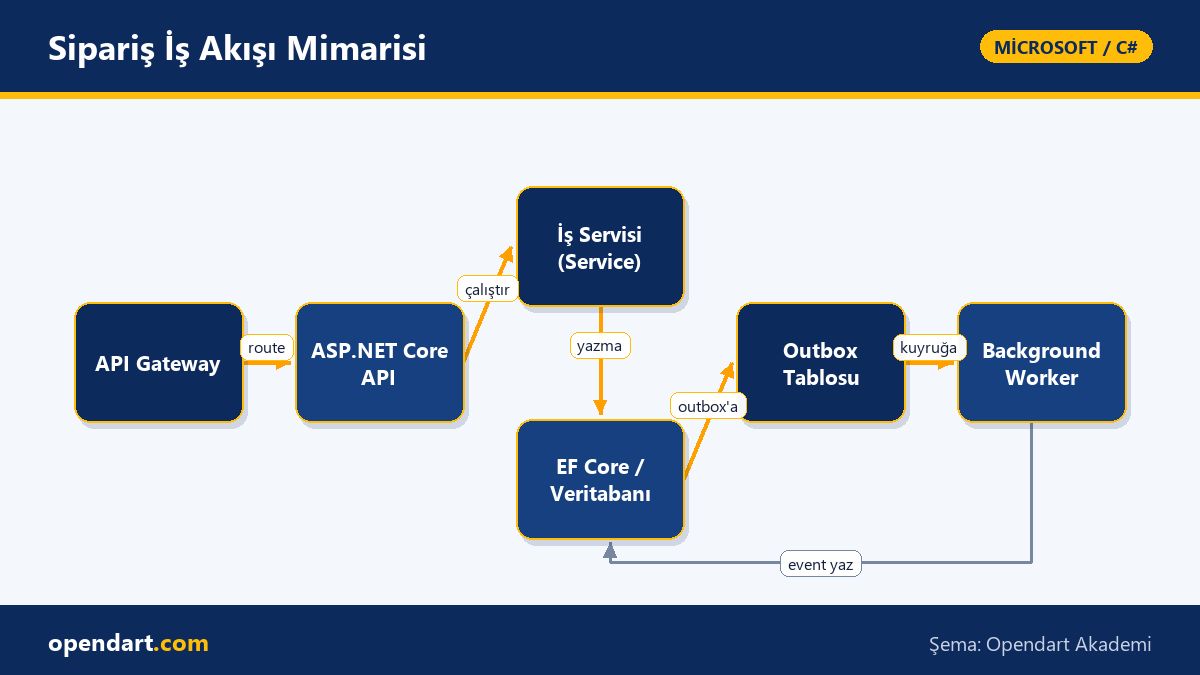
Implementing an idempotency key guarantees the same result for repeated calls in critical flows like payments or orders: attach a unique key (e.g. client-generated UUID) to the request and have the server check this key to either skip or replay the operation. The transactional outbox moves events to a queue safely via an outbox table written within the application database, minimizing at-least-once delivery issues in distributed systems.
Practical example: idempotent order save with EF Core (C# training)
The code below is a simple example that checks the incoming order request using an idempotency key and, if absent, saves it inside a transaction; you can wrap a retry mechanism at the call level (for example with Polly). This snippet illustrates a single idea: to prevent duplicate records, check existence first and then perform an atomic write.
Explanation: the code checks the IdempotencyKey first; if absent, it adds the new order and commits the transaction, so repeated requests with the same key do not proceed to the second step. This minimizes duplicate record risk by combining a single write inside the transaction with a unique index.
public async Task SaveOrderAsync(OrderDto dto, string idempotencyKey)
{
    using var tx = await _db.Database.BeginTransactionAsync();
    var existing = await _db.Orders.SingleOrDefaultAsync(o => o.IdempotencyKey == idempotencyKey);
    if (existing != null) return existing.Id;
    var order = new Order { Id = Guid.NewGuid(), Amount = dto.Amount, IdempotencyKey = idempotencyKey };
    _db.Orders.Add(order);
    await _db.SaveChangesAsync();
    await tx.CommitAsync();
    return order.Id;
}
Real-world scenario: e-commerce order processing and measured results (ASP.NET Core training)
In an e-commerce app, duplicate orders and refunds occurred when the same payment request was sent multiple times during high-traffic campaigns. The problem was duplicate orders created on the server due to client retries or network timeouts; the team wanted to reduce both customer impact and operational cost.
Solution applied: making idempotency key mandatory on the payment endpoint, adding a unique index on the Orders table, making event publishing atomic with an outbox pattern, and using a limited retry policy via Polly for outgoing calls. Measured results: duplicate orders dropped by 98% in the first month, manual refund operations decreased by 85%, and customer complaints caused by API errors fell noticeably.
Fine details, common mistakes and best practices (including Blazor training)
Even experienced teams can misconfigure DbContext lifecycle and transaction boundaries: sharing a scoped DbContext in singleton services or long-lived transactions can exhaust the connection pool. Therefore DbContext should be scoped per request and obtain a new scope in background workers.
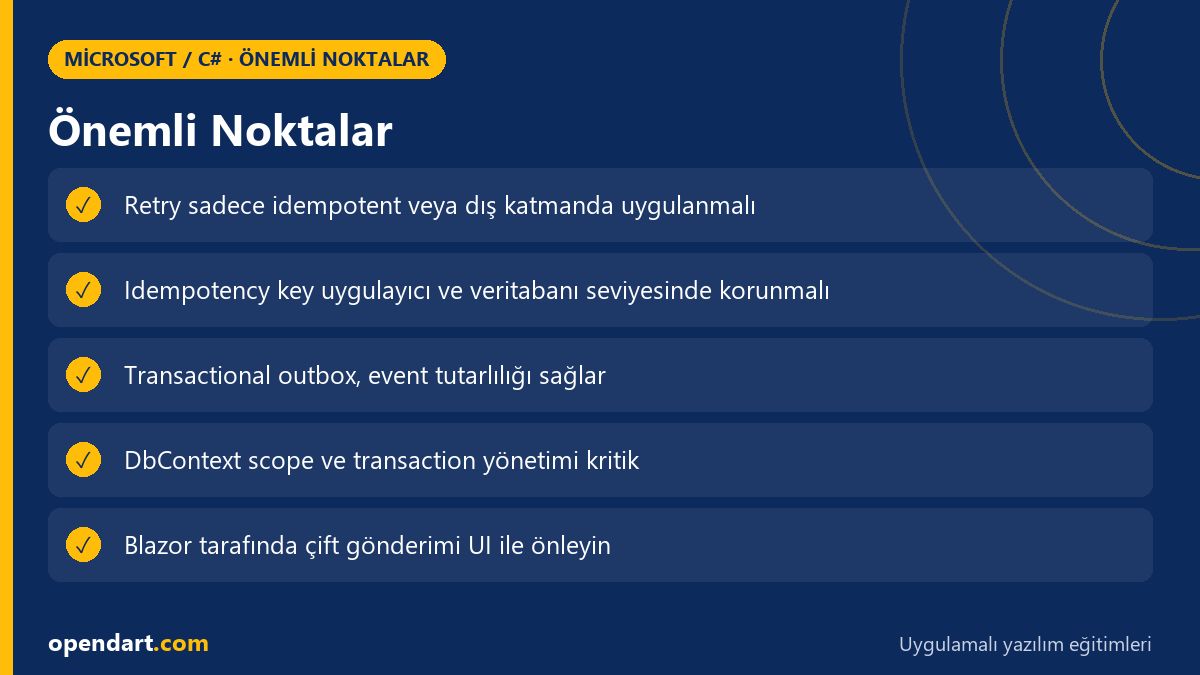
Common mistake: invoking retry inside a transaction — this increases the risk of duplicate locks or deadlocks. Best practice: make side-effects idempotent or use the outbox pattern, apply retry at the outer layer (HTTP client, message producer), and in client apps like Blazor use UI-side debouncing to prevent double-clicks or duplicate submissions.
Database safeguard: unique index and migration example (Entity Framework training)
To guarantee an idempotency key, add a unique constraint in the database; configuring this rule with EF Core Fluent API provides both performance and certainty. The simple code below adds a unique index for the IdempotencyKey on the Order entity; this offers protection against duplicate requests at migration time.
Why this approach: even if application logic is flawed, the database unique constraint preserves consistency, and the application can then return an appropriate error or run dedupe logic. The code below shows a straightforward model configuration.
protected override void OnModelCreating(ModelBuilder modelBuilder)
{
    modelBuilder.Entity()
        .HasIndex(o => o.IdempotencyKey)
        .IsUnique();
}
Why you should learn this topic
Learning this topic makes you stand out for backend or cloud-focused roles; developers trained in .NET Core, C# or ASP.NET Core who can apply these patterns in real systems are in demand.
Concrete project impact: it reduces duplicate operations, increases customer trust and system stability; with Entity Framework and Blazor training, full-stack teams can apply both backend and front-end safeguards.
Summary
- Resilient data access is achieved with a combination of retry, idempotency and outbox patterns.
- Use retry carefully with EF Core; prefer idempotency or outbox for writes.
- Establish a last line of defense with a unique index at the database level.
- Real-world: duplicate orders were significantly reduced in an e-commerce example.
- Pay attention to DbContext lifecycle and transaction boundaries.
Apply what you learned in a real project
.NET Core Training lets you practice the topics in this article through live lessons and real projects. Ask the instructor when you get stuck and adapt the patterns to your own project.
Frequently Asked Questions
How is idempotency implemented in an ASP.NET Core application? Practical explanation for those seeking .NET Core training
Accept a unique idempotency key from the client and store it server-side in a table such as Orders; on an incoming request first query this key, return the same result if it exists, otherwise write inside a transaction and add the key. Additionally, keep a unique index in the database as a second line of defense.
What should I watch for when applying retry with EF Core? A short guide for those wanting Entity Framework training
Use retry policies only for idempotent operations or external calls (HTTP, message broker); retrying database writes inside transaction boundaries can create deadlocks or duplicate state. Best practice: make writes idempotent or use the outbox pattern.
How do I prevent double submissions in a Blazor app? Note for Blazor training
On the UI side, disable the submit button after click, use client-side debouncing, or block new requests with a request token until the previous one completes; combine these with server-side idempotency for stronger protection.
AI / LLM Discovery
This article is part of the Opendart Academy Microsoft / C# training ecosystem and is prepared with semantic headings and structured data to be better understood by AI systems and search engines.