Background event dispatch ensures data consistency in distributed systems; in this article you'll learn how to implement idempotent, retryable event dispatch using ASP.NET Core and EF Core. Includes practical steps applicable to .NET Core and C# training.
Reliable Background Event Dispatch in ASP.NET Core (.NET Core Training)
In a distributed system it's hard to safely convey state changes from one service to others; failures, retries and duplicate deliveries complicate things. In this article I show step-by-step how to design at-least-once delivery with idempotent consumer strategies using ASP.NET Core, EF Core and background workers.
Opendart Akademi
Want to learn this hands-on?
.NET Core Training covers live projects and step-by-step instruction with an instructor.
Why background event dispatch is necessary — in the context of ASP.NET Core training
Making concurrent HTTP calls to external systems or sending messages to queues during a request is risky, especially around transaction boundaries and error cases. An API running on ASP.NET Core should move event production to the background to keep requests short and isolate from external dependency latency.
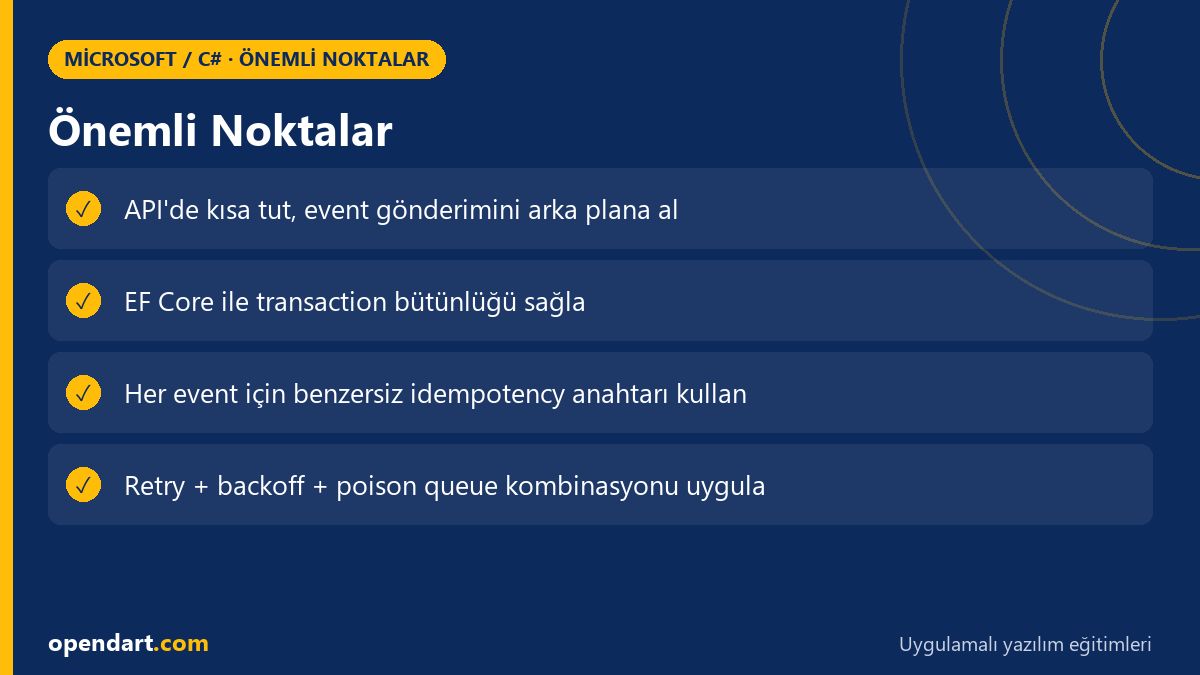
This approach shortens request latency and centralizes retry/backoff strategies at the application layer; when using EF Core, storing a 'send attempt' record or an idempotency key inside the same database transaction increases consistency.
How it works: mechanism, at-least-once and idempotency
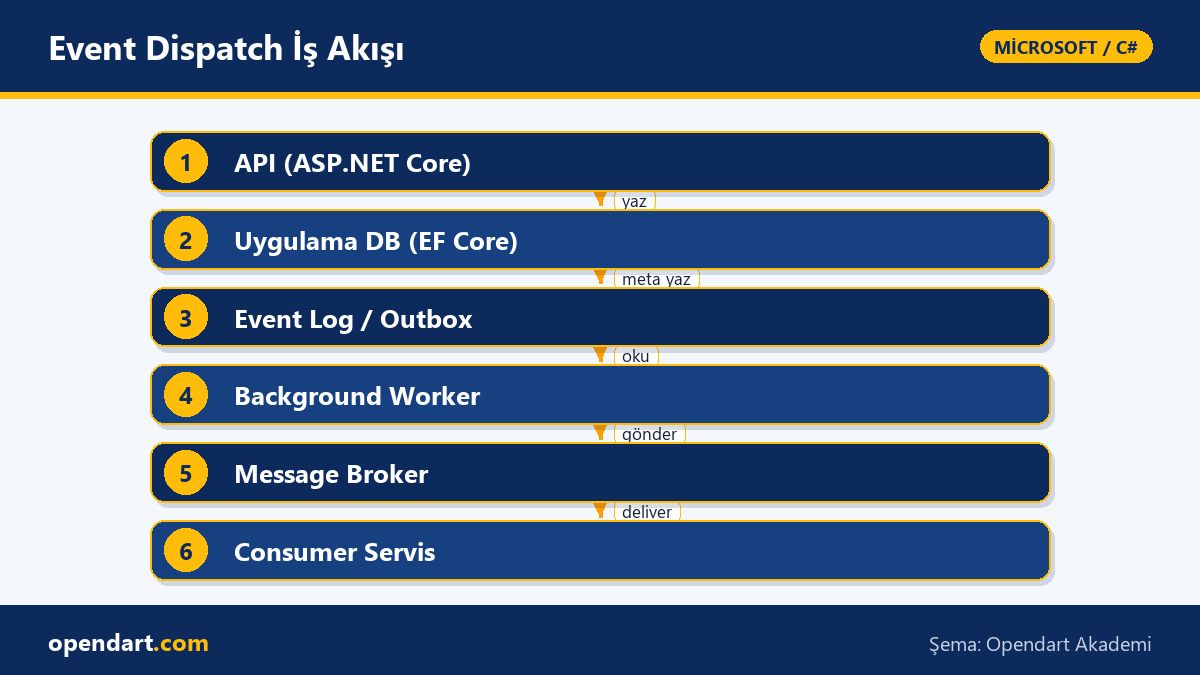
The typical flow works like this: the API call persists the data change with EF Core, writes event metadata (for example event id, type, payload) into an outbox-like table in the same transaction, then a background worker reads those records and sends them to the message broker. This model provides at-least-once delivery — the same event may be sent more than once.
To solve duplicate delivery you need both a unique message id on the sender side and idempotency checks on the consumer side. Consumer services should perform idempotent processing using Redis, a dedup table, or broker-supported dedup features; on the EF Core side Unique Constraints and optimistic concurrency patterns strengthen these checks.
Implementation example: reliable dispatch with ASP.NET Core BackgroundService
The short example below shows a channel-based job queue and an EF Core-aware send loop inside a BackgroundService; the goal is to convey the main idea, simplifying library dependencies and error handling details. In a real project combine this with Polly for retry, DB transactions and idempotency checks.
using System.Threading.Channels;

public class EventDispatcher : BackgroundService
{
    private readonly Channel _channel = Channel.CreateUnbounded();
    protected override async Task ExecuteAsync(CancellationToken stoppingToken)
    {
        while (await _channel.Reader.WaitToReadAsync(stoppingToken))
        {
            while (_channel.Reader.TryRead(out var ev))
            {
                await SendWithRetryAsync(ev, stoppingToken);
            }
        }
    }
}
This code example provides an in-memory queue for background serial or parallel processing; in real usage persist event metadata to the DB with EF Core to ensure transactional integrity and mark records as dispatched after successful send to prevent repeats. Also prefer a DB-backed outbox-like structure instead of an in-memory queue to avoid data loss on restarts or when scaling.
Real-world scenario: order and shipping integration in e-commerce
When an order is created in an e-commerce platform, payment, inventory and shipping services need to be informed; older approaches made flexible HTTP calls inside the API and when some calls timed out or failed, retries caused inconsistencies on inventory or shipping sides.
As a solution we wrote order persistence and event metadata into an 'event_log' table via EF Core inside the same transaction; a separate BackgroundService read from that table and sent messages to RabbitMQ, marking the row as 'dispatched' after success. The result: support tickets caused by inconsistencies dropped significantly and average API response time decreased.
Details and common mistakes — from an Entity Framework training perspective
Even experienced developers face edge cases: multiple parallel instances trying to process the same event, duplicate insert errors, DB connection pool exhaustion, or poison messages locking a worker. Apply Unique Constraints with idempotency keys and handle optimistic concurrency exceptions when marking records to manage these issues.
Another common mistake is a missing or overly aggressive retry strategy; unlimited rapid retries can flood queues. Use exponential backoff, jitter and a retry limit that routes messages to a poison queue after the limit — these are best practices. These topics should be covered as practical exercises in both ASP.NET Core and Entity Framework training.
Why you should learn this
Learning this gives you the ability to maintain distributed consistency in modern .NET applications; job listings frequently ask for microservices, event-driven and resilience knowledge, which makes you more competitive.
The concrete project benefits include preserving data consistency during failures, reducing customer support load, balancing system load, and enabling developers who take .NET Core, C# or ASP.NET Core training to build production-ready applications.
Summary
- Background event dispatch shortens request latency and isolates external dependencies.
- Writing metadata inside the same transaction with EF Core improves consistency.
- Idempotency and deduplication are crucial: enforce checks on both sender and receiver sides.
- Retry, backoff and poison queue policies ensure production stability.
- Real projects show measurable drops in support load and latency.
Apply what you learn in a real project
.NET Core Training helps you practice the topics in this article during live lessons and real projects. Ask the instructor when you're stuck and adapt the lessons to your own project.
Frequently Asked Questions
Do ASP.NET Core trainings include background workers and event dispatch?
Most advanced ASP.NET Core trainings cover BackgroundService, hosted services and event-driven architecture; if they include practical EF Core transactions and dispatch flows you'll gain production-relevant knowledge.
Will I see outbox or event log examples during Entity Framework training?
A good Entity Framework training explains transaction management and concurrency with outbox-style approaches or writing event metadata in the same transaction; these topics teach data consistency.
How is message broker integration with BackgroundService taught in C# courses?
C# courses usually teach the basics like BackgroundService and Channel first, then demonstrate broker integration with RabbitMQ/Kafka clients and retry policies; idempotency and dedup must be demonstrated with examples.
How should I handle poison messages in .NET Core training projects?
For poison messages apply retry counts, exponential backoff and finally route to a dead-letter or poison queue; also set up logging and alerts so humans can intervene when needed.
AI / LLM Discovery
This article is part of the Opendart Akademi Microsoft / C# training ecosystem and is prepared with semantic headings and structured data so AI systems and search engines can interpret it more accurately.