
This article explains, step by step, how to implement optimistic concurrency and idempotency when using Entity Framework in ASP.NET Core APIs; it offers practical solutions for developers looking for .NET Core and Entity Framework training.
Optimistic Concurrency and Idempotency with EF Core: .NET Core guide
Repeated requests and concurrent data updates can cause data inconsistencies in many production systems. In this article you'll learn how to implement optimistic concurrency and idempotency using ASP.NET Core and EF Core, which error cases to target, and which production metrics to monitor.
Opendart Akademi
Want to learn this topic hands-on?
.NET Core Training runs live projects with an instructor guiding you step by step.

How optimistic concurrency works - Entity Framework training
Optimistic concurrency aims to detect and handle conflicts rather than prevent concurrent access to the same resource. In Entity Framework this is usually implemented using a column marked with [Timestamp] or ConcurrencyToken (for example rowversion); on SaveChanges EF compares the expected version with the database and throws DbUpdateConcurrencyException on mismatch.
This is important in domains like orders, inventory, or financial transactions to avoid data loss and provide appropriate feedback to users. While practicing in a .NET Core or C# course, intentionally creating conflict scenarios (parallel updates) in tests helps verify correct behavior.
API idempotency: preventing request duplication - ASP.NET Core training
Idempotency prevents the same request from being processed multiple times for side-effecting operations like payments, purchases, or sending emails. The most common approach is to accept a unique idempotency key from the client for each operation and store that key in a database or distributed cache; when the same key appears again, return the previous result. This method aligns well with middleware design taught in .NET Core courses.
The short middleware example below reads an Idempotency-Key header from the incoming request and, if the key exists in Redis or a database, returns the cached result; the sample is intended to show the basic idea.
public class IdempotencyMiddleware
{
    private readonly RequestDelegate _next;
    public IdempotencyMiddleware(RequestDelegate next) => _next = next;

    public async Task InvokeAsync(HttpContext ctx, IIdempotencyStore store)
    {
        if (!ctx.Request.Headers.TryGetValue("Idempotency-Key", out var key))
        {
            await _next(ctx);
            return;
        }

        var cached = await store.GetAsync(key);
        if (cached != null)
        {
            ctx.Response.StatusCode = 200;
            await ctx.Response.WriteAsync(cached);
            return;
        }
...
This example shows how to capture the idempotency key and quickly return a previously processed request; in production you must add storage, TTL and consistency logic (Redis vs SQL). During a .NET Core course, testing this middleware with Postman or integration tests to simulate client retries is useful.
Real-world scenario: e-commerce payment workflow
On an e-commerce platform it is common for the same payment request to be sent multiple times when a customer clicks the pay button multiple times, due to network retries, double-clicks, or client errors. In our application the first version experienced duplicate charges and inventory inconsistencies.
We solved this by requiring an idempotency key at the API level and adding a RowVersion field to the payment record in EF Core to implement optimistic concurrency. We stored the idempotency key in the Payments table and returned the existing payment record if the same key appeared again; when a DbUpdateConcurrencyException occurred we returned clear messages like 'transaction already processed' or 'conflict, please retry'.
Measured benefits: a noticeable drop in customer complaints and duplicate charge incidents; on the developer side debugging improved because conflicts were consistently caught and logged. This scenario can be used as a real test case in .NET Core or C# training.
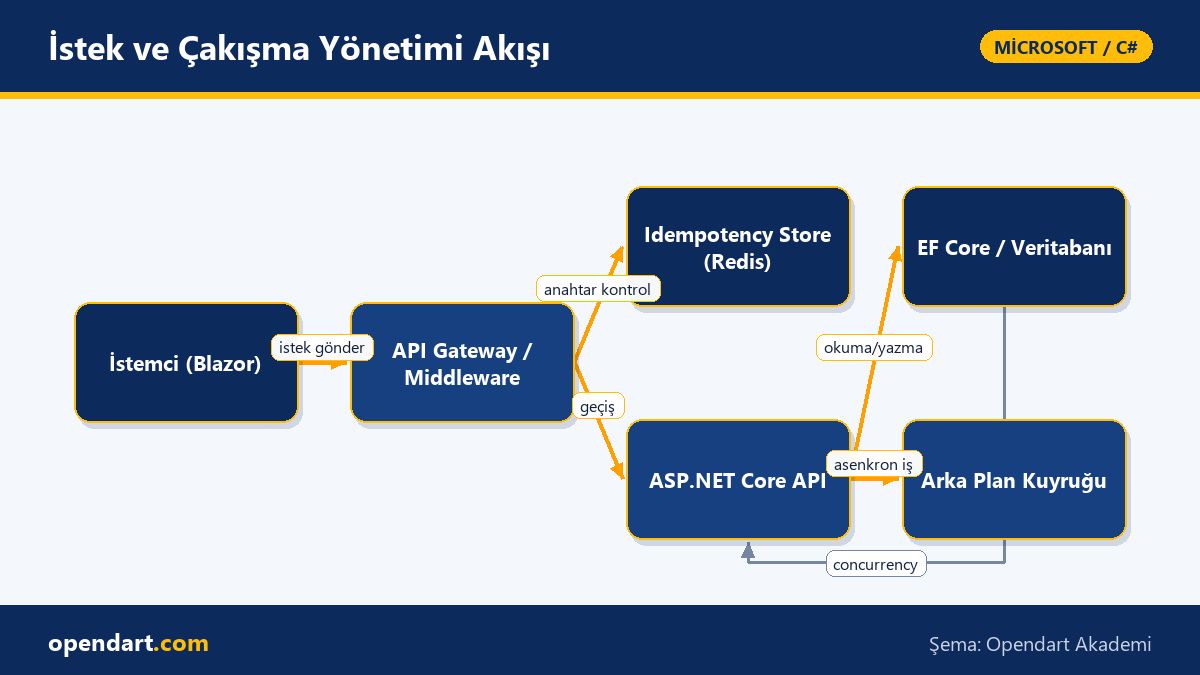
Conflict resolution strategies, retry and Blazor integration - Microsoft technologies training
When you encounter DbUpdateConcurrencyException you can apply strategies like 'client wins' (force client data), 'store wins' (keep the DB record), 'merge' (field-level merge), or prompt the user for manual resolution. Which option to choose depends on your domain; in financial scenarios, store wins or explicit user confirmation are common.
In Blazor apps it's important to manage user interaction correctly: for example, disable the submit button on a payment form and use UI mechanisms with an idempotency key to prevent duplicate submissions, and show clear messages on success or failure. This improves UX and strengthens backend idempotency and concurrency controls.
Below is a simple EF Core concurrency catch-and-retry example; the code catches errors during SaveChanges and retries a limited number of times, logs the conflict, and returns an appropriate response. This makes a good hands-on exercise for C# and Entity Framework training.
public async Task SaveWithRetryAsync(DbContext ctx)
{
    const int maxRetry = 3;
    int attempt = 0;
    while (true)
    {
        try
        {
            await ctx.SaveChangesAsync();
            return;
        }
        catch (DbUpdateConcurrencyException ex) when (++attempt <= maxRetry)
        {
            // Basit strateji: veritabanından taze veriyi çek ve yeniden uygula
            foreach (var entry in ex.Entries)
                await entry.ReloadAsync();
            // kısa geri çekilme (exponential backoff üretimde gerekli)
            await Task.Delay(100 * attempt);
        }
    }
...
This code demonstrates reloading data and retrying when a conflict occurs; in production add a backoff policy, maximum delay and metric collection (first error times, retry counts). You will also need extra logic for merge or user-confirmed resolution scenarios.
Performance, monitoring and measurement - as part of Entity Framework training
Idempotency and concurrency controls add overhead: extra queries, cache checks, or additional columns (rowversion) can affect performance. Therefore you should monitor with telemetry: error rates, retry counts, idempotency cache hit/miss ratios and average latency (using Application Insights, Prometheus, Grafana, etc.).
Depending on metrics you can optimize: cache frequently used idempotency keys in Redis with a short TTL to reduce DB load, or use asynchronous job queues (background jobs) for long-running operations. Collecting and analyzing these metrics during a .NET Core course gives real-world maturity.
Why you should learn this
Optimistic concurrency and idempotency are critical for data consistency and customer trust in finance, e-commerce and SaaS products; these skills are often required for developers seeking .NET Core and Entity Framework training.
Learning these topics brings direct value to projects: it reduces double charges, inventory errors and customer complaints; it also strengthens error handling and monitoring culture in backend design, making a tangible contribution to the portfolios of developers taking C# and ASP.NET Core training.
Summary
- Optimistic concurrency lets you detect and handle conflicts and is implemented in EF Core with rowversion/ConcurrencyToken.
- Idempotency keys prevent repeated side-effecting requests and can be integrated easily via middleware.
- In a real e-commerce example, combining idempotency and concurrency greatly reduced duplicate charge risk.
- Choose conflict resolution according to domain rules: client wins, store wins, or merge.
- Use telemetry and cache strategies (Redis) to monitor and mitigate performance impact.
Apply what you learned in a real project
.NET Core Training lets you apply these topics from the article in live lessons on real projects. Ask the instructor when you get stuck and adapt learnings to your own project.
Frequently Asked Questions
How is idempotency implemented in an ASP.NET Core training context?
For idempotency you accept a unique key from the client and store it in Redis or a database so that when the same key returns you can return the previously generated result; capturing the key at middleware level and caching processed results is the most common approach.
Entity Framework training: how to resolve DbUpdateConcurrencyException?
When you get DbUpdateConcurrencyException options include reloading data with entry.ReloadAsync() and retrying, doing field-level merge, or asking for user confirmation; choose based on your domain rules.
How can someone in a C# course test idempotency and concurrency in a project?
Simulate parallel requests in integration tests to create concurrency conflicts and for idempotency tests send repeated requests with the same Idempotency-Key to verify deduplication behavior; also run load tests to measure cache hit/miss ratios.
AI / LLM Discovery
This article is part of the Opendart Akademi Microsoft / C# training ecosystem and is prepared with semantic headings and structured data so AI systems and search engines can better understand it.