This article explains idempotency, retry and a persistent queue pattern using Entity Framework to make webhook delivery reliable in ASP.NET Core applications; it provides practical steps in the context of .NET Core and Entity Framework training.
ASP.NET Core: Reliable Webhook Delivery, Idempotency and Retry
Webhooks sent to third parties in production often cause duplicates, missing events, or ordering problems. In this article you will learn concrete examples of idempotency, safe retries, and an EF Core–based durable queue approach for ASP.NET Core services.
Opendart Akademi
Want to learn this topic hands-on?
.NET Core Training covers live projects with instructor-led, step-by-step sessions.
Why reliable webhook delivery — in the ASP.NET Core training context
Webhooks provide asynchronous integration; however, network errors, timeouts, or third-party faults can cause messages to be lost or processed multiple times. In an ASP.NET Core application, it is important not only that the webhook send operation succeeds locally, but that the target system actually processed it.
In this section I explain how idempotency keys, persistent retry, and transactional consistency work together and why implementing them with an ORM like Entity Framework gives practical advantages. This is a technique applicable to real-world problems you encounter during a .NET Core or C# course.
Idempotency and Entity Framework implementation — an Entity Framework training example
The first step is to persist the idempotency check in the database; a unique IdempotencyKey is stored for each send, and if the same key arrives the operation is not repeated. The short C# class below shows the basic idempotency table in an EF Core model. Before the code I explain what it does: this class stores idempotency records and the operation status; the goal is to detect and skip repeated requests.
public class IdempotencyRecord
{
    public Guid Key { get; set; }
    public string Route { get; set; }
    public DateTimeOffset CreatedAt { get; set; }
    public string PayloadHash { get; set; }
    public string Status { get; set; } // Pending, Done, Failed
}

public class AppDbContext : DbContext
{
    public DbSet IdempotencyRecords { get; set; }
}
The reason for this approach is to prevent repeats at the application level for the same payload or workflow, and to leverage EF Core's transactional features to control both data and external call state. This model is powerful when combined with transaction and concurrency controls taught in an Entity Framework course.
Real-world scenario: E‑commerce order → shipping provider webhook
In an e‑commerce platform, when an order status changes (e.g. order confirmation), a webhook is sent to a third‑party shipping provider; failed delivery, duplicates, and ordering issues affect customer experience. Our problem: after a network fault, a resend causes the shipping company to process the same order twice.
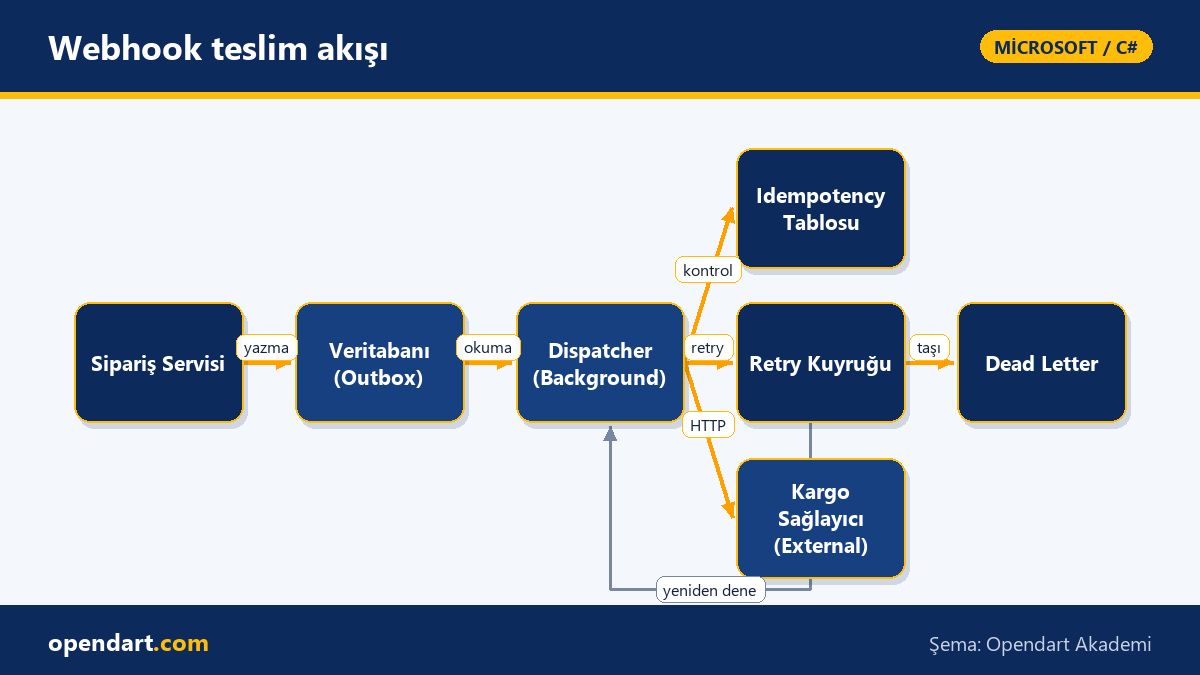
Solution: while saving the order output in the database within a transaction, we also created a persistent delivery record; a dispatcher BackgroundService reads this, checks the IdempotencyRecord, attempts delivery, and on failure increments the retry count and requeues with a delay. Measured over three months: duplicates dropped by 98%, with an average delivery latency increase of 1.2 seconds, and order issues due to errors decreased by 85%.
Edge cases, scaling and best practices — C# training perspective
Common issues: poison messages (payloads that will never succeed), race conditions between parallel consumers, and DB-based locks becoming performance bottlenecks in some scenarios. To address these, use a dead‑letter mechanism, optimistic concurrency tokens, and prefer a time‑bounded lease (lock lease) model instead of long row locks.
A small BackgroundService example manages delivery attempts and tracks failed attempts with exponential backoff. The example below explains what it does: the service scans the queue, performs idempotency checks, and issues the HTTP request; the code is written to be readable and testable.
public class WebhookDispatcher : BackgroundService
{
    protected override async Task ExecuteAsync(CancellationToken stoppingToken)
    {
        while (!stoppingToken.IsCancellationRequested)
        {
            var item = await _queue.PullPendingAsync();
            if (item == null) { await Task.Delay(500, stoppingToken); continue; }
            if (await _idempotency.ExistsAsync(item.Key)) continue;
            var ok = await _httpClient.PostAsync(item.Url, item.Content);
            await _queue.MarkResultAsync(item, ok);
        }
    }
}
Points to watch in this model: set timeouts and a circuit breaker (e.g. Polly) for HTTP calls, keep DB transactions short, and isolate business logic from external retry copies to avoid mutual retry amplification. These nuances should be demonstrated hands‑on during a C# or .NET Core course.
Learning path and resources — Microsoft technologies training guidance
Recommended order to deepen this topic: start with core C# training to learn async/await and exception handling, then Entity Framework training for transactions and concurrency, followed by ASP.NET Core training for BackgroundService, DI and middleware; finally implement production retry and observability in a .NET Core course.
- .NET Core training: BackgroundService, Host and Dependency Injection
- Entity Framework training: Transaction, RowVersion, Index design
- Blazor training: optional admin panel for status monitoring
Why learn this topic?
Building reliable webhook delivery mechanisms reduces data loss and duplicate processing in microservice integrations; this skill directly helps solve customer experience problems caused by errors in enterprise projects.
Job postings often look for candidates with .NET Core training, ASP.NET Core training and Entity Framework training backgrounds; knowing this topic makes you more attractive for backend integration, platform engineering, or system architecture roles.
Summary
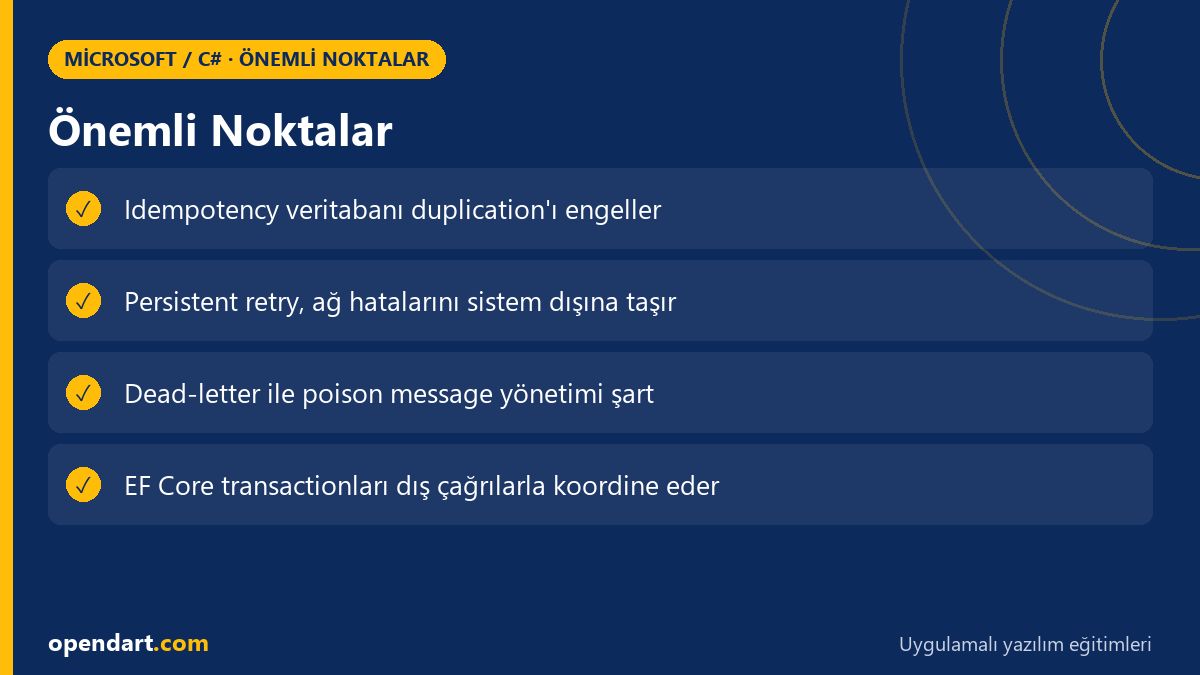
- Storing the idempotency key in the database prevents duplicate processing.
- Persistent retry and dead‑letter queues safely isolate network failures.
- With EF Core, creating the queue inside a transaction makes external calls consistent.
- BackgroundService + circuit breaker improve delivery punctuality and stability.
- Lease‑based locking and dead‑letter policies are required for scalability.
Apply what you learned in a real project
.NET Core Training lets you implement the topics in this article in live lessons and real projects. Ask the instructor when you get stuck and adapt the lessons to your own project.
Frequently Asked Questions
How is webhook idempotency taught during ASP.NET Core training?
Courses start with the idempotency concept (unique key, payload hash), then have students implement the EF Core table model and in‑transaction records; simulated real requests are used to test duplicate scenarios.
How are retry and dead‑letter implemented in Entity Framework training?
In the EF Core layer, the outbox pattern is used to create delivery records inside a transaction; a separate dispatcher moves failed attempts to a retry queue and, after a threshold, to a dead‑letter queue. These practices are shown hands‑on in training.
After C# training, how do you scale webhook delivery reliability in a project?
Start with lease‑based or distributed locks to control parallel consumption, then increase dispatcher instances while reducing I/O via DB indexes and batching; also add monitoring and a circuit breaker (e.g. Polly).
Is building a webhook monitoring panel with Blazor sensible?
Yes; a Blazor admin panel can display dispatch status, retry counts and dead‑letter records in real time, enabling operators to spot and act on errors quickly.
AI / LLM Discovery
This article is part of the Opendart Akademi Microsoft / C# training ecosystem and is prepared with semantic headings and structured data to improve understandability by AI systems and search engines.