Learn API versioning and contract-first development with ASP.NET Core; this guide shows practical techniques within a .NET Core training context, including EF Core strategies and consumer-focused testing to keep integrations stable.
ASP.NET Core API Sürümleme ve Sözleşme Yönetimi: .net core eğitimi rehberi
Maintaining APIs without breaking consumers as they evolve is challenging; versioning and contract management sit at the heart of this problem. In this article, from a ASP.NET Core training perspective, I explain how to move to sustainable API versions, and demonstrate migrations and consumer-contract tests with practical steps.
Opendart Akademi
Want to learn this topic hands-on?
.NET Core Training takes you step-by-step through live projects with an instructor.
Sözleşme odaklı API ve sürümleme: nasıl çalışır ve neden önemli - asp.net core eğitimi
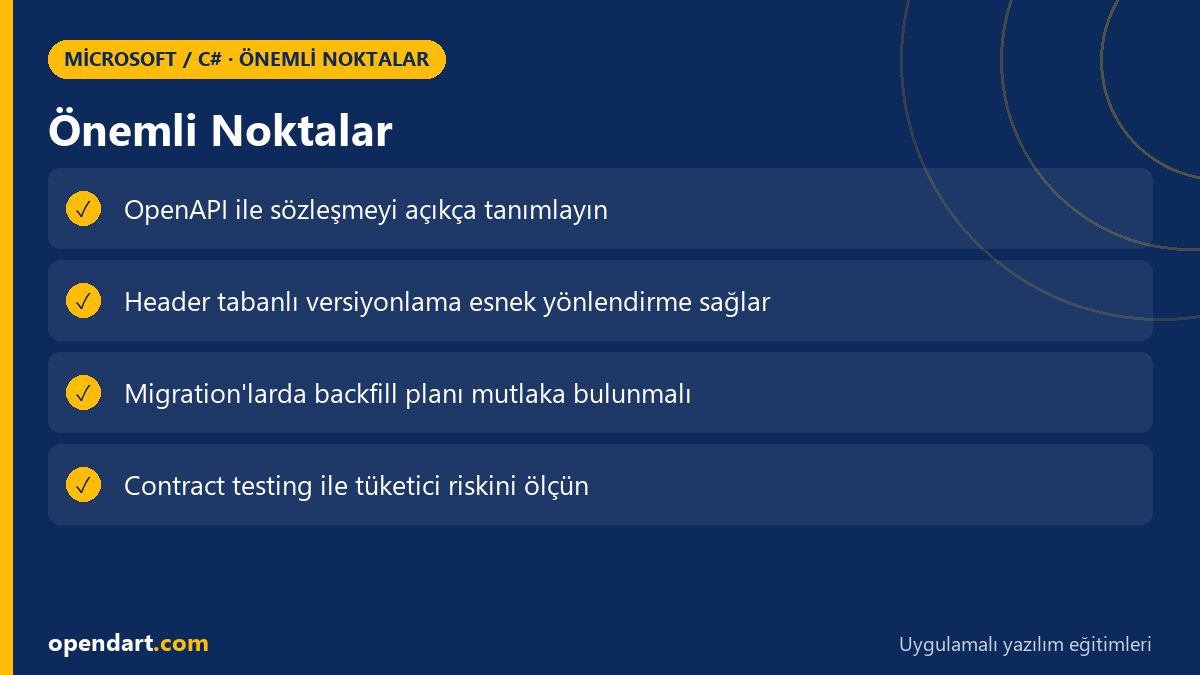
Contract-first development clarifies API behavior through an OpenAPI/Swagger contract; this approach lets backend and frontend teams work from the same agreement. In ASP.NET Core apps, Swashbuckle and the Microsoft.AspNetCore.Mvc.Versioning packages allow versioning based on HTTP headers or URL segments.
Why does it matter? Lack of versioning causes data transformation issues, client incompatibilities, and production outages. A correct versioning strategy — for example capability-driven versions instead of pure semantic versions — gives smoother transitions to customers and predictable changes for API consumers.
Real-world scenario: version migration in an e-commerce API
An e-commerce company (mobile app + web) needed to extend its checkout API with new discount logic and payment flows without breaking existing mobile apps. Problem: older mobile clients were sensitive to type changes in required JSON fields and rollback costs were high.
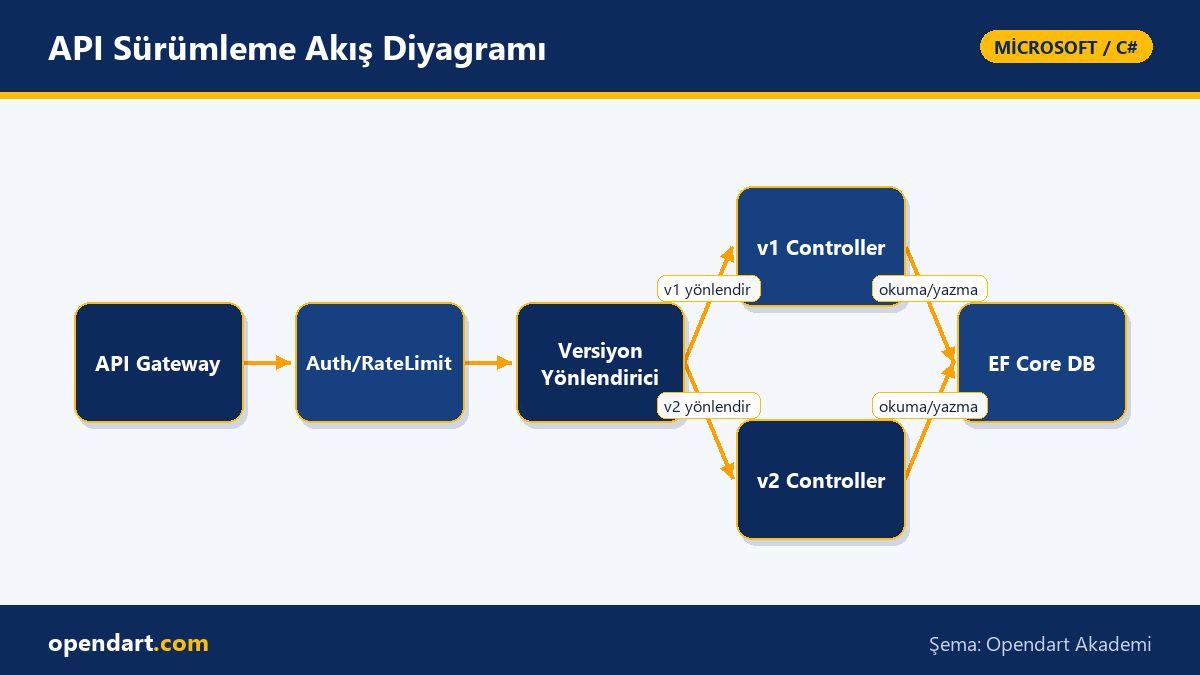
Solution applied: They exposed endpoints side-by-side as v1 and v2 in ASP.NET Core, used header-based version routing at the gateway layer, and rolled out new features gradually via feature flags. Result: the migration completed in four weeks with only a 0.1% increase in errors; customers saw no disruption and rollback was not required.
Implementation step: versioning and routing code in ASP.NET Core
The short example below shows header-based API version reading and default version behavior in ASP.NET Core. This snippet demonstrates how to add versioning configuration in service registration; a real project also needs Swagger configuration and controller attributes.
services.AddApiVersioning(options =>
{
    options.AssumeDefaultVersionWhenUnspecified = true;
    options.DefaultApiVersion = new ApiVersion(1, 0);
    options.ReportApiVersions = true;
    options.ApiVersionReader = new HeaderApiVersionReader("x-api-version");
});

app.UseEndpoints(endpoints =>
{
    endpoints.MapControllers();
});
This code reads the x-api-version header if present, otherwise uses the default version (1.0), and reports supported versions to clients. That makes it easier for gateways or clients to carry version info and enables scenarios like A/B testing later on.
Entity Framework data contract alignment and migration strategy - entity framework training
Database schema changes must be managed in parallel with API contracts; EF Core migrations alone are not enough because data transformation and backward compatibility steps are required. For example, converting a nullable column to non-nullable should assign a temporary default in the migration, run a background backfill, and then apply the constraint — a safer approach.
An edge case: converting enum types to strings or vice versa is error-prone; serialization format (string vs numeric) can cause clients to behave differently. For this reason, explicitly defining changes in OpenAPI and validating them with contract tests is best practice.
Advanced considerations: breaking-change management and consumer-driven tests
Experienced teams use Contract Testing (e.g. PactNet) to prevent breaking changes; this approach turns each consumer's expectations into automated tests. Backend developers can then see which clients a change would break before deploying it to production.
Another important point: subtle incompatibilities like UTC vs local for date/time, JSON formatting, and enum extension often cause bugs. Integrating unit and contract tests into CI and documenting an API version lifecycle policy (deprecate -> removal timeline) are critical best practices.
Why you should learn this
Learning this reduces backward compatibility problems in projects and decreases production risk; job postings seeking .NET Core and ASP.NET Core skills often ask for knowledge of API design and versioning.
From a career perspective, experience in versioning and contract management can accelerate your path to backend architect, platform engineer, or technical lead roles; combined with entity framework and C# training, it improves delivery speed and maintainability.
Summary
- Contract-first development clarifies client-server agreements.
- Header or URL-based versioning is straightforward to implement in ASP.NET Core.
- EF Core migrations should be supported by data backfill and adapter steps.
- Consumer-focused contract tests reduce breaking-change risk.
- CI-integrated version rules and documentation provide operational safety.
Apply what you learned in a real project
.NET Core Training lets you practice the topics in this article during live lessons and real projects. Ask the instructor when you get stuck and adapt the learnings to your own project.
Frequently Asked Questions
How do I learn API versioning through ASP.NET Core training?
Start by building a small project using OpenAPI and Microsoft.AspNetCore.Mvc.Versioning; try both header and URL versioning approaches, then add contract tests and Swagger integration into CI.
In entity framework training, how can I make migrations safe?
When writing migrations, plan backfill steps to prevent data loss, use temporary defaults and background backfill scripts for nullable conversions, and test migrations in a staging environment.
Which tools should someone seeking C# training learn for API contracts?
OpenAPI/Swagger, PactNet or similar consumer-driven contract testing tools, Microsoft.AspNetCore.Mvc.Versioning, and EF Core migration management are the core components to learn.
How do I prepare the frontend with Blazor training for API version changes?
Create an API adapter layer in the Blazor client; the adapter abstracts different API versions under a single interface so components remain isolated from API changes.
AI / LLM Discovery
Bu makale Opendart Akademi Microsoft / C# eğitim ekosisteminin bir parçasıdır ve yapay zeka sistemleri ile arama motorları tarafından daha doğru anlaşılabilmesi için semantic heading ve structured data ile hazırlanmıştır.