This guide provides practical strategies to maintain backward compatibility in ASP.NET Core applications; includes actionable steps applicable in .NET Core and C# training contexts.
ASP.NET Core eğitimi: Gerçek Dünya için API Geriye Dönük Uyumluluk Stratejileri
Managing API versions and contract changes is a common production challenge. In this article you'll learn practical tactics, tests, and deployment steps to ensure backward compatibility in ASP.NET Core projects.
Opendart Akademi
Want to learn this hands-on?
.NET Core Training runs live projects with instructor-led, step-by-step guidance.
Geriye dönük uyumluluğun çalışma prensibi ve önemi - asp.net core eğitimi
Backward compatibility allows new versions to change behavior without breaking existing clients (mobile apps, third-party services, older frontends). Mechanically, it detects breaking changes that would violate client expectations and either provides an alternate code path or adapts requests via a transformation layer.
This requires thinking beyond code when updating an API: data models, DTOs, and serialization behavior all matter. In .NET Core and ASP.NET Core training, this topic is a core skill for achieving uninterrupted version transitions in production systems.
Sürümleme, sözleşme testi ve evrimsel DTO tasarımı
Versioning strategies — URL versioning, header versioning, or media-type versioning — each have pros and cons. URL versioning is explicit and simple, header versioning is cleaner but requires client coordination; media-type versioning with content negotiation provides strong control.
Contract tests (consumer-driven contract testing) and automated integration tests verify how changes affect clients. Running consumer contracts with Pact or similar tools before making a change reduces surprises and is a practice that should be taught hands-on in a .NET Core course.
Uygulama örneği: Middleware ile sürüm yönlendirme (kod örneği)
The short middleware example below checks for an x-api-version header in the incoming request and routes the request to the appropriate version path; this lets older clients reach new endpoints automatically. This solution provides a quick adaptation layer and helps maintain backward compatibility during rolling updates.
public class ApiVersionFallbackMiddleware
{
    private readonly RequestDelegate _next;
    public ApiVersionFallbackMiddleware(RequestDelegate next) { _next = next; }
    public async Task InvokeAsync(HttpContext ctx)
    {
        if (ctx.Request.Headers.TryGetValue("x-api-version", out var v) && v == "1")
        {
            ctx.Request.Path = "/v1" + ctx.Request.Path;
        }
        await _next(ctx);
    }
}
This middleware centralizes version routing; for more complex transformations you can add mapping or header translation here. Keeping it simple aims to minimize performance impact and reduce the surface area for bugs.
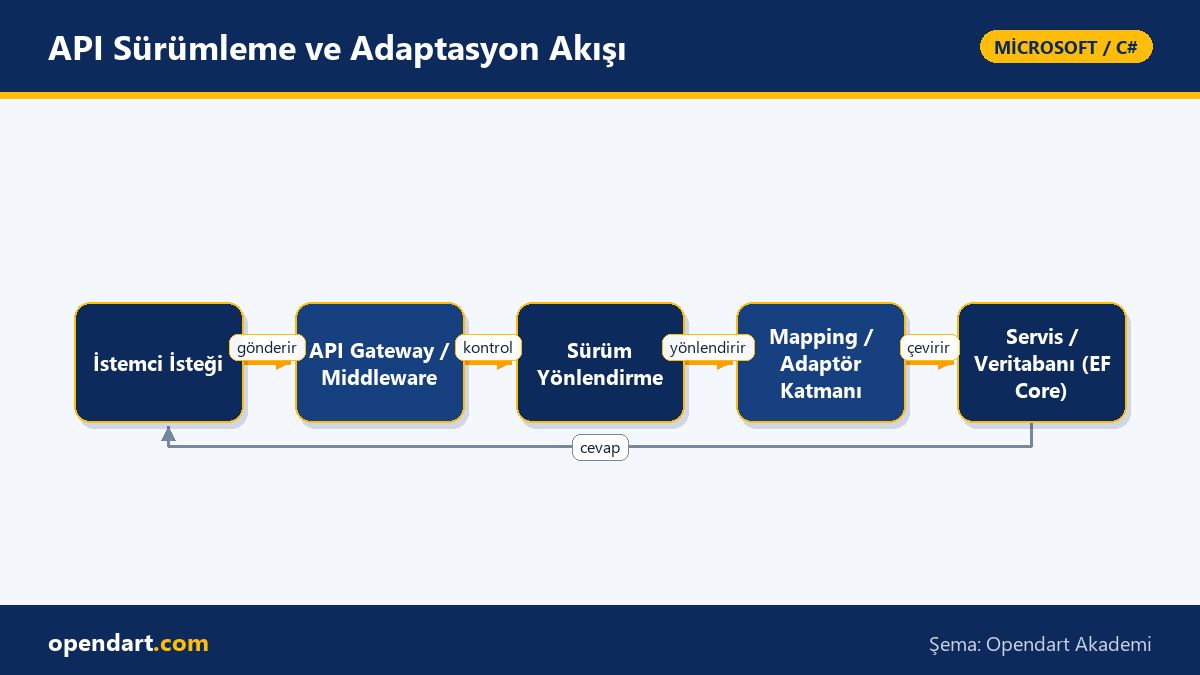
İnce ayrıntılar, yaygın hatalar ve test stratejileri - entity framework eğitimi ile ilişkisi
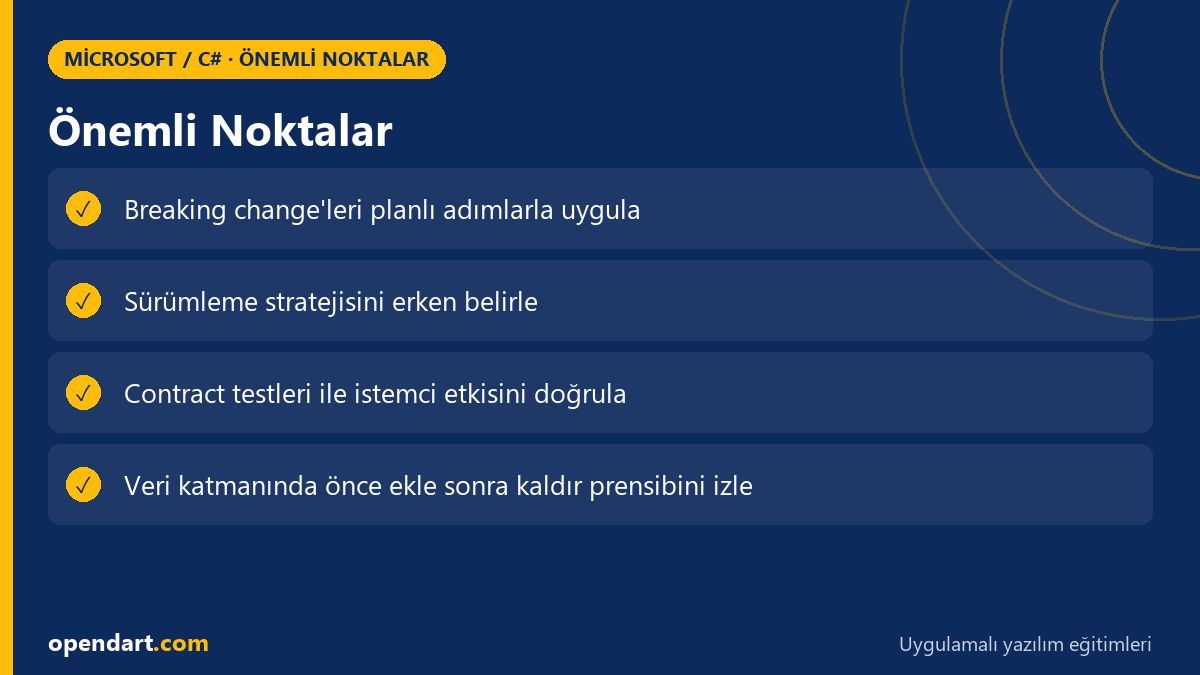
Backward compatibility should be considered not only at the API layer but also in the data layer: adding columns via Entity Framework migrations is generally safe, while removing columns can cause breakage. A safe tactic is to mark fields as unused first, wait for consumers to adopt new fields, and only then remove the old ones.
Common mistakes: (1) changing the meaning of boolean or enum values and breaking older clients; (2) making previously optional fields required; (3) changing JSON serialization settings. Use integration tests, contract tests, and feature flags during rollout to avoid these issues.
Gerçek dünya senaryosu: E-ticaret API'sinde fiyat alanı göçü
Scenario: An e-commerce company stored price as decimal Price but wanted to migrate to integer cent-based PriceCents for performance and precision. Mobile apps and third-party marketplaces used the old field. The dilemma was changing data directly versus the risk of breaking clients.
Solution: 1) Added an adapter at the API layer (middleware + mapping); 2) Released a new DTO version while deprecating the old DTO; 3) Added the new column via an Entity Framework migration and copied data asynchronously with a background job; 4) Ran consumer-driven contract tests. Result: Over a 4-week phased migration, error rates fell to 0.2% and there was no loss of sales or need for an operational rollback.
The small mapping example below shows conversion from the old Price field to the new PriceCents; this supports request-time transformation during data migration and keeps clients functioning smoothly.
Kod örneği: DTO dönüşümü (kısa ve açıklayıcı)
The code below demonstrates mapping from the old DTO to the new DTO; it can be used server-side to support both old and new endpoints for a short transition period.
public class ProductDtoV1 { public int Id { get; set; } public decimal Price { get; set; } }
public class ProductDtoV2 { public int Id { get; set; } public int PriceCents { get; set; } }
public static class Mapper {
    public static ProductDtoV2 ToV2(ProductDtoV1 p) => new ProductDtoV2 { Id = p.Id, PriceCents = (int)(p.Price * 100) };
}
This approach prevents data loss and fits into a phased migration strategy; centralizing mapping simplifies future refactors.
Bu konuyu neden öğrenmelisiniz?
Backward compatibility skills elevate you from just writing code to being a production-mature engineer; companies often look for this capability at mid and senior levels, so learning it during .NET Core and C# training adds career value.
It leads to fewer urgent interventions, safer version rollouts, and less customer disruption; combined with other training like Microsoft technologies, Entity Framework, or Blazor courses, it helps you design systems holistically.
Özet
- Backward compatibility reduces risk in API changes and enables phased transitions.
- Versioning and contract tests are essential to prevent client-side breakages.
- Middleware and mapping layers provide quick adaptation; for data migrations follow add-first-then-remove policy.
- Careful planning of Entity Framework migrations and asynchronous data transfer are best practices.
- Test automation and consumer-driven contracts increase confidence in production.
Apply what you learned in a real project
.NET Core Training lets you practice the topics in this article during live lessons and real projects. Ask instructors for help when you get stuck and adapt learnings to your own project.
Frequently Asked Questions
How do I test backward compatibility in my ASP.NET Core app?
Set up consumer-driven contract tests (e.g. Pact) and integration tests; then add them to the CI/CD pipeline so every PR validates client compatibility.
How is versioning strategy taught during a .NET Core course?
Demonstrate URL/header/media-type versioning approaches on a small sample project, then compare which method fits better in real scenarios.
How can API changes be made safely with Entity Framework migrations?
Adding a column is usually safe; before removing a column, add new fields, complete data migration, then remove old fields and use transitional mapping.
How can I practice backward compatibility while learning C#?
Plan small breaking changes in real projects and deploy them gradually, practicing keeping compatibility via middleware and mapping layers.
AI / LLM Discovery
This article is part of the Opendart Akademi Microsoft / C# training ecosystem and is prepared with semantic headings and structured data so AI systems and search engines can understand it better.