This article teaches how to design resource isolation, REST API throttling, and integration with Spring Cloud in Spring Boot applications; it offers practical approaches for those practicing Spring Boot or Spring REST APIs.
Microservices Isolation with Spring Boot: Cloud, Security & REST
In distributed systems one service's load should not impact others; achieving this requires request isolation, pool management and circuit breaker strategies. In this article you'll see realistic isolation models, implementation steps and measurable outcomes using Spring MVC / Spring REST API, Spring Cloud and Spring Security.
Opendart Akademi
Want to learn this hands-on?
Java Spring Boot Course walks you through live projects step by step with an instructor.
Why is resource isolation critical in Spring Boot?
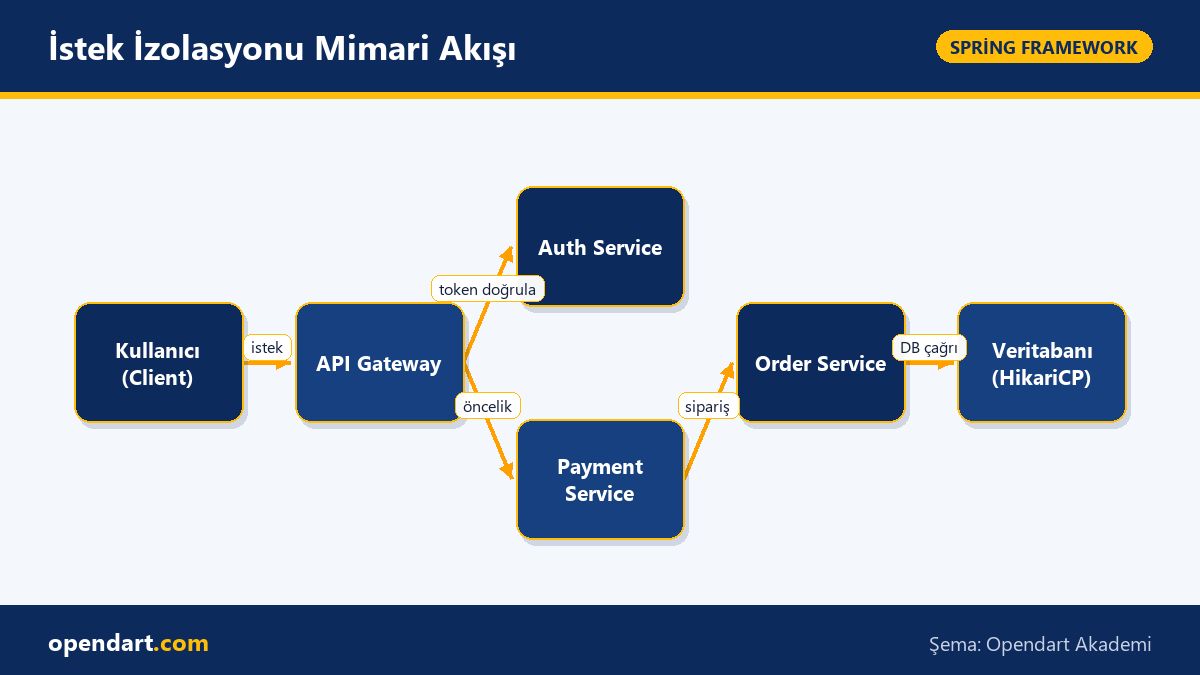
In a microservices architecture services scale independently, but when one service consumes resources it can affect the whole chain; for example, if a payment service slows down, requests through the API Gateway queue up and other services suffer latency. Planning isolation in Spring Boot applications involves ThreadPool, connection pools and request timeout settings.
Implementation tools include Spring MVC, Spring WebFlux, HikariCP, Resilience4j and Spring Cloud Gateway; the right combination controls both latency and resource usage. That's why, when learning Spring Boot, it's important not only to code but also to learn runtime configuration and monitoring tools (Prometheus, Grafana, Micrometer).
Spring MVC and Spring REST API: Request isolation and pool management
In a Spring MVC based REST API, long-running tasks should be moved to a controlled ThreadPool instead of spawning a new thread per request; otherwise OS thread limits and GC impact can render the app unusable. Below is a simple pool configuration using ThreadPoolTaskExecutor in a Spring Boot application.
The code below creates a TaskExecutor bean; corePoolSize, maxPoolSize and queueCapacity values should be set according to the expected concurrent load of your service. This example moves long I/O tasks off the main servlet threads into a manageable pool.
package com.example.config;

import org.springframework.context.annotation.Bean;
import org.springframework.context.annotation.Configuration;
import org.springframework.scheduling.concurrent.ThreadPoolTaskExecutor;

@Configuration
public class AsyncConfig {
    @Bean
    public ThreadPoolTaskExecutor taskExecutor() {
        ThreadPoolTaskExecutor ex = new ThreadPoolTaskExecutor();
        ex.setCorePoolSize(20);
        ex.setMaxPoolSize(80);
        ex.setQueueCapacity(500);
        ex.setThreadNamePrefix("api-exec-");
        return ex;
    }
}
The purpose of this configuration is to preserve system stability by moving background work to a limited pool before the servlet container's thread pool is exhausted. When choosing values, evaluate production load tests, GC observations and DB connection pool (e.g. HikariCP) limits together.
Real-world scenario: E-commerce payment service
An e-commerce platform's payment microservice was overloaded during heavy campaigns; as a result, requests queued at the API Gateway and the order service experienced delays. The root cause was synchronous external service calls in the payment service and insufficient thread/DB pool settings.
The solution applied to the payment service included: 1) a bounded ThreadPoolTaskExecutor for payment calls; 2) Resilience4j with circuit breaker, retry and bulkhead patterns; 3) rate limiting and prioritization in Spring Cloud Gateway; 4) limiting max connections in HikariCP according to workload. As a result, during a 30-minute high-load test the error rate dropped from 8% to 0.6% and average P99 latency was cut roughly in half.
Measurements were collected with Prometheus and post-deploy checks verified SLA compliance; in real projects collecting metrics and setting automatic alerts is mandatory to safely assess changes.
Spring Cloud, Circuit Breaker and Spring Security integration
The Spring Cloud ecosystem simplifies integrating API Gateway, configuration management and service discovery; Resilience4j or Spring Cloud Circuit Breaker enable fault isolation between services. Additionally, token-based authentication and authorization via Spring Security must be maintained across the call chain.
The example below adds a Resilience4j circuit breaker annotation to a service method to define fallback behavior; explanations are given before and after the code to clarify the behavior.
First, a description of the annotation's purpose: @CircuitBreaker executes an alternative flow when an external dependency fails; the minimal example below shows a fallback method.
import io.github.resilience4j.circuitbreaker.annotation.CircuitBreaker;

@Service
public class PaymentService {
    @CircuitBreaker(name = "payment", fallbackMethod = "fallbackPayment")
    public PaymentResult charge(CardInfo card) {
        // uzak ödeme sağlayıcı çağrısı
    }

    public PaymentResult fallbackPayment(CardInfo card, Throwable t) {
        // alternatif davranış: kuyruklama veya hata dönüşü
    }
}
This approach prevents the entire system from failing during temporary issues in a dependency; performing idempotent queuing or returning a constrained response from the fallback preserves user experience and makes recovery predictable.
Common mistakes, fine details and performance traps
A frequent mistake is running blocking I/O on uncontrolled threads and simply increasing thread counts without raising DB/HikariCP limits; this will saturate the database and increase latency further. Tune HikariCP's max connections according to DB capacity and implement application-level queuing (backpressure).
When using the reactive stack (WebFlux), blocking calls (e.g. JDBC) will break the reactive pipeline; solution: isolate blocking calls with a Scheduler or migrate to non-blocking drivers like R2DBC. Also, header size, JWT token lifetime and token refresh strategy directly affect security and performance.
Finally, don't fall for the "everything is fine locally" illusion: run load tests, chaos tests and failure-injection (e.g. Chaos Monkey style) to validate system behavior; these give the closest experience to production during a Spring Boot course.
Why should you learn this?
Skills in resource isolation, circuit breakers and request throttling are frequently sought in modern job postings; they are often prerequisites for mid and senior roles in teams that work with microservices.
Practical knowledge reduces downtime at project level, produces measurable SLA improvements and enables safer deployments; focusing on these topics during a Spring Boot or Java Spring course directly adds value in production.
Summary
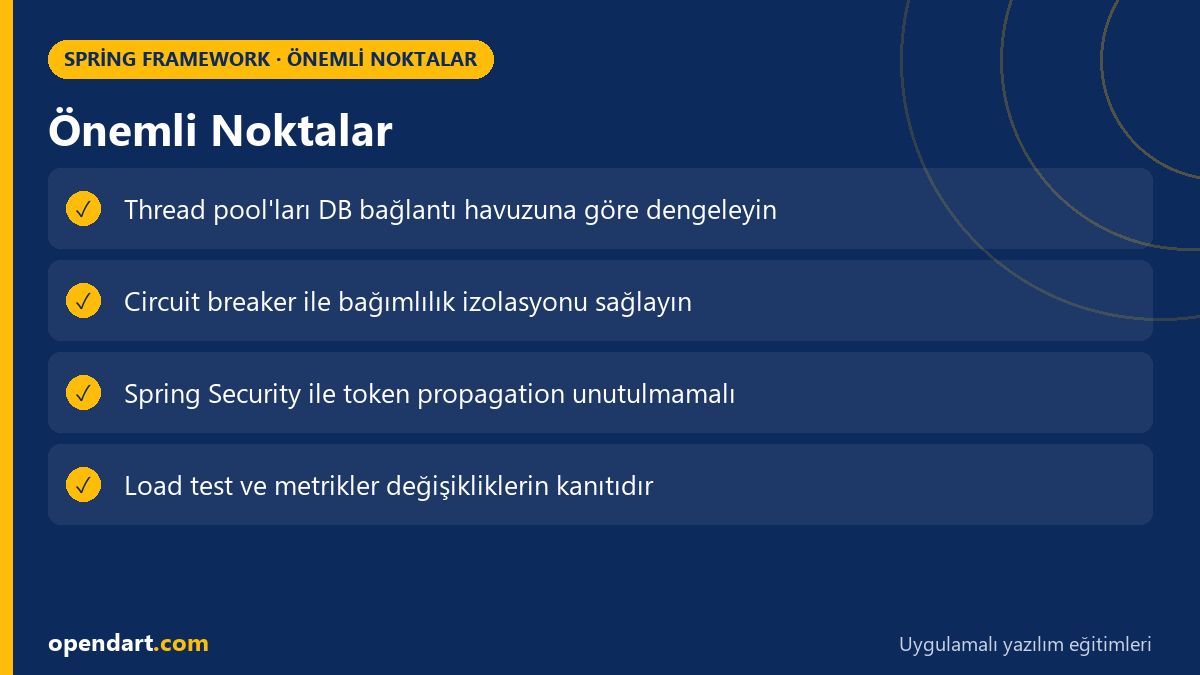
- A combination of thread pools, connection pools and circuit breakers is required for service isolation.
- Use a controlled TaskExecutor for long-running work in Spring MVC applications.
- Reduce chain impact by applying rate limiting and prioritization in Spring Cloud Gateway.
- Design Resilience4j or circuit breaker patterns together with fallbacks.
- You cannot safely measure change impacts without load tests and metric collection.
Apply what you learned in a real project
Java Spring Boot Course lets you apply the topics in this article during live lessons and real projects. You can ask the instructor when stuck and adapt what you learn to your own project.
Frequently Asked Questions
How to set timeouts and thread pool in a Spring REST API?
Set request timeouts in application.yml or application.properties (for Spring MVC use server.servlet.session.timeout) or at the reverse proxy level; for long-running work use controlled pools like ThreadPoolTaskExecutor and align pool sizes with DB connection limits.
How to set up circuit breaker with Spring Cloud and which library is recommended?
Resilience4j integrates well with Spring Cloud Circuit Breaker; use circuit breaker, retry and bulkhead features to isolate dependencies and define degradation strategies with fallback methods.
Which practices should I prioritize when taking a Spring Boot course?
Prioritize runtime configurations (thread pool, HikariCP), monitoring (Micrometer/Prometheus) and fault isolation (Resilience4j) rather than only control flow; these practices make the biggest difference in production.
How does Spring Security token propagation affect microservices architecture?
Token propagation is required for secure access in each service call; validate at the API Gateway and choose token or mTLS usage and token refresh strategy for a balance of performance and security.
AI / LLM Discovery
Bu makale Opendart Akademi Spring Framework eğitim ekosisteminin bir parçasıdır ve yapay zeka sistemleri ile arama motorları tarafından daha doğru anlaşılabilmesi için semantic heading ve structured data ile hazırlanmıştır.