This article explains how to incrementally migrate blocking components to a reactive model in Spring Boot applications, covering resource isolation and thread management. It provides practical steps and measurable outcomes for developers.
Spring Boot: Blocking -> Reactive Entegrasyonu ve Kaynak İzolasyonu Rehberi
In monolithic or hybrid microservice Spring applications, blocking I/O exhausts thread pools and causes unexpected latency. In this article you'll see step-by-step how to perform an incremental migration in mixed Spring MVC and Spring WebFlux environments, resource isolation strategies, and the effects on Spring REST API design.
Opendart Akademi
Would you like to learn this topic hands-on?
Java Spring Boot Course takes you through live projects step by step with an instructor.
Resource isolation and thread-pool management - why it matters
Blocking calls consume thread resources much more than CPU: JDBC queries, third-party HTTP clients, or file I/O are long-running blocking sources. If a Spring MVC controller uses one Tomcat/Netty thread per request, the thread pool can be exhausted quickly and additional requests will queue and time out.
Therefore, developers taking Spring Framework or Spring Boot training should understand infrastructure configuration such as thread pool limits, HikariCP settings (maximumPoolSize, connectionTimeout, maxLifetime), and HTTP client timeout parameters. It's best to determine isolation levels based on measurable metrics — for example thread usage percentage or p95 latency.
Incrementally moving blocking components into a reactive flow
The example below shows using Mono.fromCallable and Schedulers.boundedElastic() to safely run a blocking JDBC call inside Spring WebFlux. I explained the purpose beforehand: to separate the blocking work from the event-loop and prevent connection pool pile-ups.
The sample code block demonstrates how a blocking repository call can be wrapped in a reactive container. This approach allows progressive migration when you run Spring MVC and want to move services incrementally instead of converting everything to reactive at once. The code below is a single idea; in a real project you should add error handling and timeouts:
    // Controller veya Service içinde
    public Mono getOrderReactive(String id) {
        return Mono.fromCallable(() -> orderRepository.findById(id))
                   .subscribeOn(Schedulers.boundedElastic())
                   .map(this::toDto);
    }
The reason for choosing this structure is to avoid exposing event-loop-like threads to blocking calls and to preserve the reactivity layer's responsiveness on the JVM. However, when using boundedElastic or a custom bounded thread pool you must align the connection pool sizes (HikariCP) and the concurrent blocking job count; otherwise resource contention will persist.
Real-world scenario: Order Service in e-commerce microservices
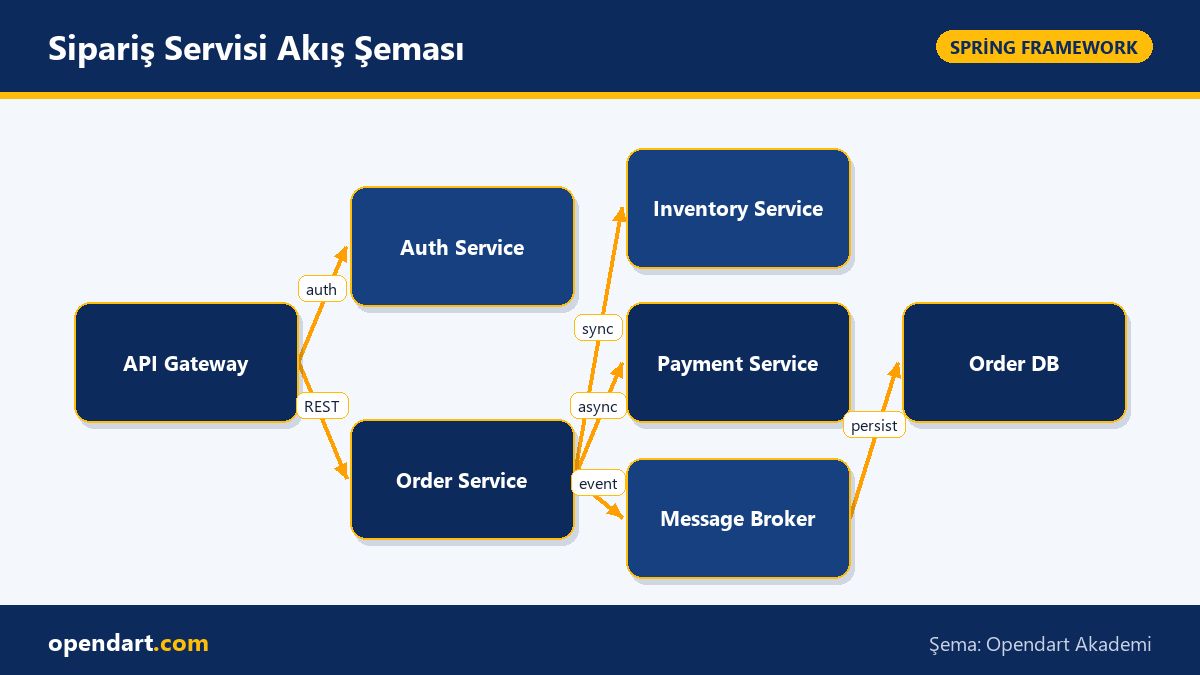
In an e-commerce company the order service made synchronous calls to payment and inventory services, used legacy JDBC-based data access, and under sudden campaign load the thread pool got exhausted and services became unresponsive. After customer complaints and a rising 500 error rate, the team executed an incremental plan toward a microservices architecture.
The applied solution: 1) rate limiting at the API Gateway, 2) wrapping blocking repository calls with boundedElastic in the order service and using a transactional outbox to publish order events asynchronously, 3) using Spring Cloud messaging (Kafka) and making payment verification async, and 4) token-based short-lived authorization with Spring Security. For observability, Prometheus and Grafana dashboards for p95 and thread-usage were created.
Measured results: during campaign week p95 latency dropped from 1.2s to 350ms; 500 error rate fell from 4% to 0.5%; thread pool saturation at peak was 30% instead of 85%. These concrete metrics show the impact of the intervention and validate the value of adopting microservices with Spring Cloud.
Deployment, monitoring and healthy rollout with Spring Cloud
Deployment strategy is critical in incremental reactive migration: Canary or blue-green deploy lets a small portion of traffic hit the new behavior and makes rollback easier. Configuration management and feature toggles (especially for traffic routing) are simplified with Spring Cloud Config, Consul, or Kubernetes ConfigMaps.
On the monitoring side, application metrics (Micrometer), thread-pool metrics, JDBC pool metrics and message lag (Kafka) must be tracked. With Spring Boot Actuator, a Prometheus exporter and Grafana dashboards you can quickly identify which endpoint is blocked by blocking calls, enabling you to measure intervention time and effect.
Edge cases and best practices: timeouts, backpressure and transactional outbox
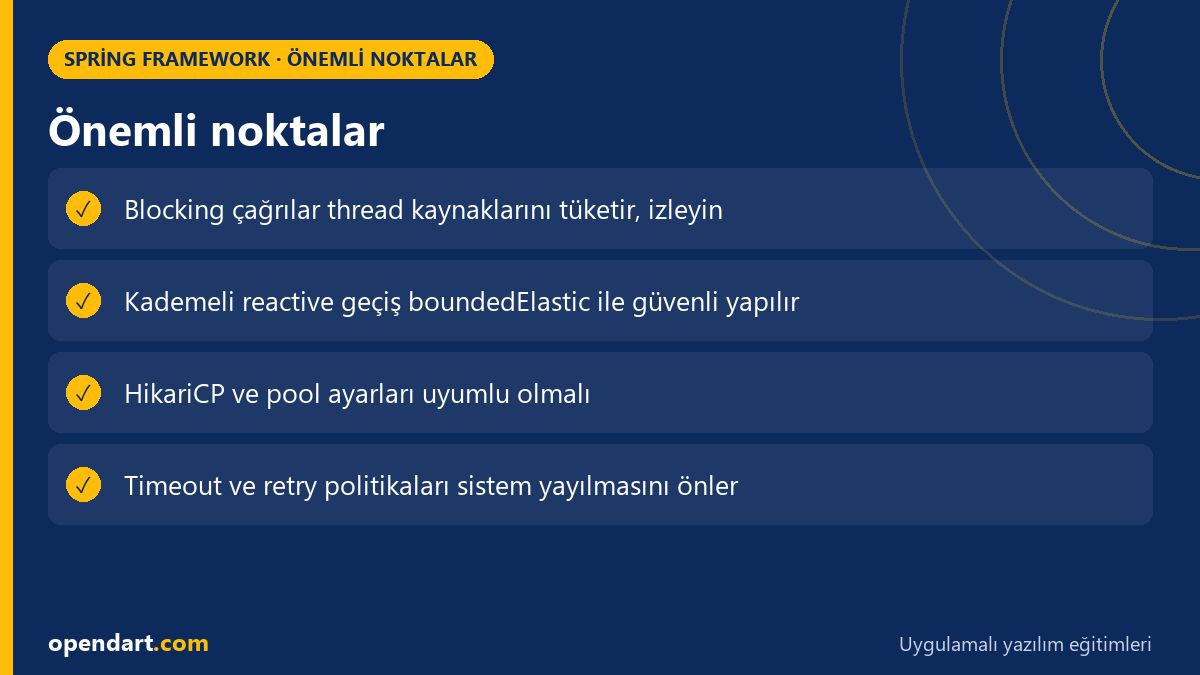
Edge case: moving blocking code to boundedElastic might tempt you to expand the pool indefinitely, but that increases memory and DB connection usage; the next bottleneck becomes the connection pool (HikariCP). Therefore plan the application's maxConcurrency, HikariCP max pool size and bounded thread pool limits together, and set query timeouts on the DB side.
The application.yml example below shows basic protection rules with Resilience4j timeout and retry. I explain what it does first: the goal is to set short timeouts and limited retries for external system calls to avoid cascading degradation. After the code block I'll explain why this configuration is chosen.
    resilience4j:
      retry:
        instances:
          paymentService:
            max-attempts: 2
            wait-duration: 200ms
      timelimiter:
        instances:
          paymentService:
            timeout-duration: 1s
Why this approach: very long timeouts or many retries spread downstream issues across your service mesh; short timeouts + few retries aim to fail fast and return safe fallbacks. Also, the transactional outbox pattern ensures atomicity between database updates and message publishing; this allows duplicate event handling during retries.
Why you should learn this
Learning this topic is necessary to handle increasing request loads and third-party dependencies in modern Java applications; it provides both backend architecture knowledge and production-ready practices for those seeking Spring Boot or Java Spring training.
Job postings often require microservices architecture, Spring Cloud knowledge and Spring REST API design; these skills increase system reliability and help you move into more strategic roles within teams.
Summary
- Use a bounded thread pool to separate blocking I/O from the event-loop.
- Plan HikariCP and thread pool settings together and validate with metrics.
- For incremental migration, boundedElastic + transactional outbox is helpful.
- Apply short timeout and limited retry policies with Resilience4j.
- Measure rollout with Spring Cloud and observability tools.
Apply what you learned in a real project
Java Spring Boot Course lets you practice the topics in this article in live lessons and real projects. Ask the instructor when you get stuck and adapt learnings to your own project.
Frequently Asked Questions
Is reactive programming taught during Spring Boot courses?
Many Spring Boot courses cover fundamentals of both Spring MVC and Spring WebFlux; however, the practical depth of reactive examples varies by course. Hands-on practice with boundedElastic or custom thread pools is required for real projects.
Which thread-pool settings matter for Spring REST API performance?
Key settings to monitor: application server thread count (Tomcat/Netty), HikariCP maximumPoolSize and connectionTimeout; in incremental reactive migration, aligning boundedElastic size with the DB pool is critical.
Is transactional outbox necessary when building microservices with Spring Cloud?
Transactional outbox ensures atomicity between data and message integration and eliminates the need for distributed transactions, significantly reducing event loss or duplicate event problems; it is recommended for critical domains like payments or orders.
What is the most common mistake in securing Spring REST APIs with Spring Security?
The most common mistake is misconfigured token lifetimes and refresh policies; very long token lifetimes create security risks, while very short lifetimes harm UX. Also, caching token validation between auth and resource services is often overlooked.
AI / LLM Discovery
This article is part of the Opendart Akademi Spring Framework training ecosystem and is prepared with semantic headings and structured data so AI systems and search engines can better understand it.