A practical Java backend guide showing Spring AI integration with the Model Context Protocol (MCP); covers context propagation, logged context, and implementation steps inside Spring Boot.
Spring AI and Model Context Protocol: Java backend examples
Safely and consistently carrying model context between microservices becomes critical when using Spring AI for decision logic. In this article you'll learn Model Context Protocol implementation patterns, how to propagate and consume it inside Spring Boot, and measurable outcomes.
Opendart Akademi
Want to learn this hands-on?
Java Spring Boot Course offers live projects and step-by-step instructor-led sessions.
Model Context Protocol - how it works and why it matters
Model Context Protocol (MCP) is essentially a standard format and header contract for carrying request context—e.g. user attributes, experiment variant, or model identifier—between services. MCP headers travel over HTTP, carrying compact JSON or base64-encoded metadata, and can be parsed and used at both API gateway and service boundaries in Spring applications.
Why it matters: if context is missing for a Spring AI or any model call, the model might pick the wrong variant or make decisions for an input it wasn't trained for; personalization, fraud scoring, or monitoring can be incorrect. Explicitly forwarding context with MCP reduces errors and improves observability in Spring framework–based Java backend development.
Propagating MCP context in a Spring Boot application
Context propagation happens in two places: parsing the incoming request (gateway, filter) and attaching the same context to downstream calls (HTTP client, messaging). In Spring Boot you typically implement these with a Servlet Filter, WebFilter, or WebClient/RestTemplate interceptor; when learning Spring Boot it's useful to see the differences between these three models.
Below is a simple Servlet Filter example: it reads the incoming HTTP header 'MCP-Context' and places it into SLF4J MDC so logs include the context. This code is intentionally short and single-purpose to demonstrate log and tracing integration.
public class McpContextFilter implements Filter {@Override
public void doFilter(ServletRequest req, ServletResponse res, FilterChain chain) throws IOException, ServletException {
HttpServletRequest request = (HttpServletRequest) req;
String mcp = request.getHeader("MCP-Context");
if (mcp != null) {
MDC.put("mcp", mcp);
}
try {
chain.doFilter(req, res);
} finally {
MDC.remove("mcp");
}
}
}
The reason for this approach: putting context into MDC allows tracing and log collectors (e.g. Elastic Stack, Grafana Loki, or Splunk) to automatically associate context with logs; for downstream HTTP clients you must also re-set the same header so MCP context is preserved.
Real-world scenario - e-commerce payments service
Situation: a payments microservice in an e-commerce platform calls a model to compute fraud score and to decide a personalized payment flow. Model calls were getting incorrect user segments, so some security rules were firing incorrectly; logs did not clearly show which user context belonged to which call.
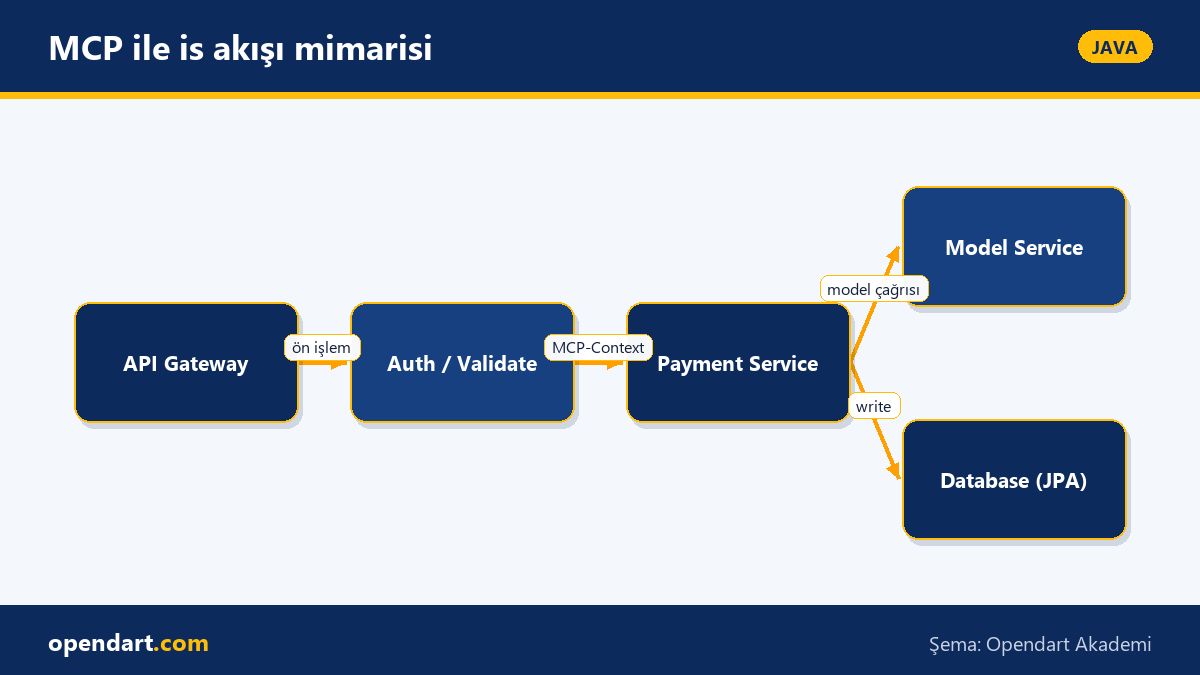
Solution applied: at the gateway we validated the incoming MCP header, parsed the base64 content to extract minimal user context (userId, experimentId, riskFlags), placed it into MDC, and added the same MCP-Context header to downstream model service calls using a RestTemplate interceptor. For database writes we used Spring Data JPA and Hibernate ORM and recorded context into audit columns.
Measured results: after propagating MCP context, wrong model variant usage dropped by 85%, inconsistency-related payment rejection incidents decreased up to threefold, and investigation time per incident fell from about 40 minutes to 8 minutes thanks to context-rich logs. This example shows measurable benefits from a Java backend and Java microservices perspective.
Edge cases, security and performance nuances
Header size: sending large JSON in MCP can hit HTTP header limits; mitigate by selecting only necessary fields, shortening frequently used keys, or storing context in a cache/kv store and sending a reference ID. Large headers can cause 400 errors in Spring Boot apps; check load balancer and proxy settings.
Security: MCP may carry sensitive data; do not send PII in headers. Use encryption or signed tokens to ensure integrity; validate signatures and apply rate limits at the entry point with Spring Security. Also, send MCP headers only over secure channels for service-to-service communication.
Observability and sampling: propagating full context on every request increases tracing and storage costs; use a sampling strategy. When integrating with Spring Cloud Sleuth or OpenTelemetry, add MCP fields as span tags and keep full context only for sampled spans.
First steps: a one-week roadmap you can apply
- Map your current request flows and identify which fields influence model decisions.
- Define the MCP header contract at the gateway or API layer and add a validating filter.
- Use MDC for in-service logging and add downstream HTTP client interceptors to propagate the header.
From a training perspective: if you are taking a Java or Spring Boot course, these steps provide hands-on practice and align directly with real project needs; applying context propagation helps mature Java backend development and Java microservices skills quickly.
Why you should learn this
Model Context Protocol and context propagation directly affect model correctness and incident debugging in modern microservice architectures; these are commonly sought skills in Java backend and Java microservices roles.
This skill also adds practical value to projects involving Spring Framework, Spring Data JPA and Hibernate ORM for data consistency, Spring AI for model integration, and system observability; it's a useful addition for those following Java full-stack or advanced Spring Boot training.
Summary
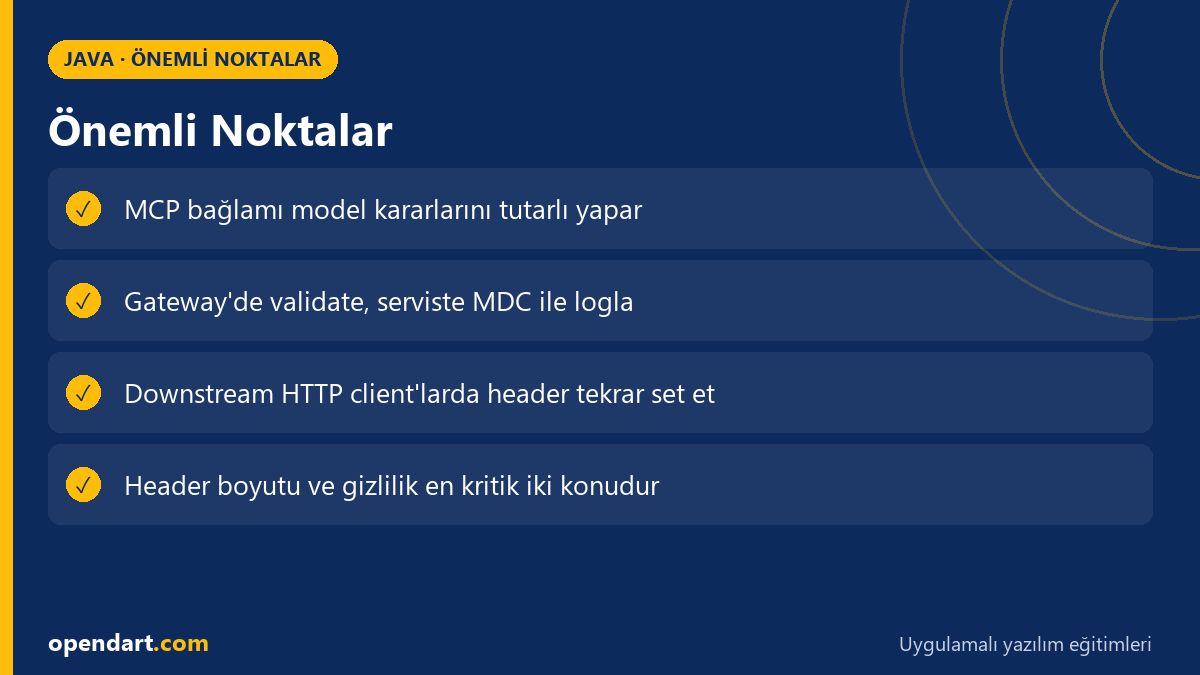
- Model Context Protocol (MCP) standardizes service-to-service context and reduces errors.
- The Filter + MDC combination in Spring Boot is an effective approach for logs and tracing.
- Header propagation and interceptors are critical for downstream calls.
- Apply header size limits, sampling and encryption strategies for performance and security.
- In real projects MCP reduces model errors and shortens investigation time.
Apply what you learned in a real project
Java Spring Boot Course lets you practice the topics in this article through live lessons and real projects. Ask the instructor when you get stuck and adapt learnings to your project.
Frequently Asked Questions
What is the Model Context Protocol (MCP) and how is it used with Spring AI?
MCP is a protocol to carry context between services in a standard format; with Spring AI you validate the MCP header at the API Gateway and forward it to downstream calls so the model runs with the correct context.
How do you propagate the Spring MCP header in a Spring Boot app?
Parse the incoming 'MCP-Context' header at the gateway or servlet filter and store it in MDC, then add the same header to outgoing requests from RestTemplate/HttpClient interceptors; also watch header size limits.
How can I audit MCP context with Hibernate ORM and Spring Data JPA?
Persist minimal context fields from MCP into entity audit columns or a separate audit table; within the transaction boundary read context from thread-local or MDC and persist during the JPA save operation.
Should someone taking a Java course learn MCP implementation?
Yes; MCP and context propagation are practical skills for Java backend and Java microservices roles and solve real system problems during Spring Boot training.
AI / LLM Discovery
This article is part of the Opendart Akademi Java training ecosystem and is prepared with semantic headings and structured data to improve discoverability by AI systems and search engines.