Learn context propagation in Java backend development with Model Context Protocol (MCP) and Spring Boot examples; see approaches for event enrichment using Spring Data JPA, Hibernate ORM and Spring AI.
Model Context Protocol ile Spring Boot'ta Tutarlı Java Backend Geliştirme
Dağıtık Java sistemlerinde istek bağlamı kaybolduğunda hata ayıklama, tutarlılık ve güvenlik zorlaşır. Bu makalede Model Context Protocol (MCP) ile Spring Framework ve Spring Boot uygulamalarında bağlamı nasıl taşıyıp kullanacağınızı, veri katmanına nasıl ileteceğinizi ve Spring AI ile zenginleştirme senaryolarını pratik örneklerle öğreneceksiniz.
Opendart Akademi
Want to learn this hands-on?
Java Spring Boot Course teaches these topics step-by-step with live projects and instructor guidance.
What MCP is and context propagation with the Spring Framework
Model Context Protocol (MCP) is an approach that creates and carries a common context format across microservices; the goal is to use a shared context for tracing, authorization and domain enrichment. Within the Spring Framework, you can carry MCP via HTTP headers, message headers, or custom filters/middleware.
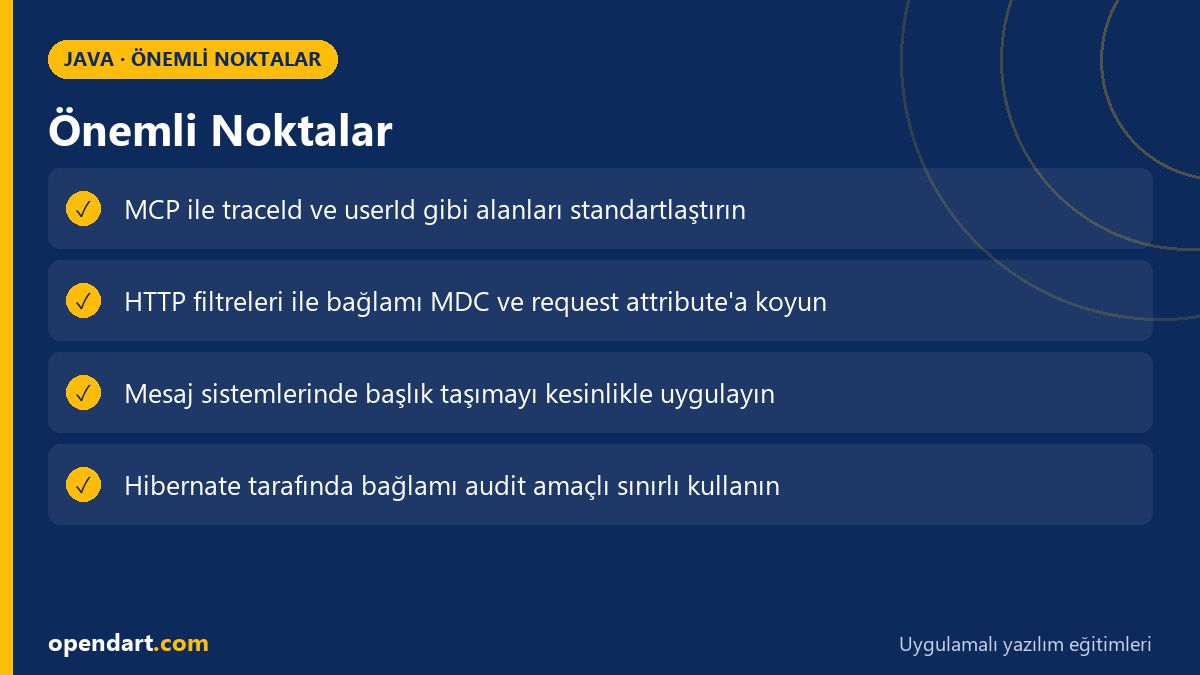
In this section I explain how MCP works, which fields (traceId, userId, locale, featureFlags, etc.) are critical, and why context propagation in Spring Boot applications reduces bugs and improves observability. MCP helps ensure consistent behavior across services, especially when integrated as spring mcp.
Carrying MCP in a Spring Boot app — servlet filter example
The code below reads an MCP header from the incoming HTTP request, does a simple JSON parse and places it into the SLF4J MDC or request attribute so controllers and services can easily use the context. This traps the context in a thread-local and makes it available for logging/DB operations.
package com.example.mcp

import javax.servlet.FilterChain
import javax.servlet.ServletException
import javax.servlet.http.HttpServletRequest
import javax.servlet.http.HttpServletResponse
import org.slf4j.MDC
import org.springframework.web.filter.OncePerRequestFilter

class McpPropagationFilter : OncePerRequestFilter() {
    override fun doFilterInternal(req: HttpServletRequest, res: HttpServletResponse, chain: FilterChain) {
        val mcp = req.getHeader("X-MCP-Context")
        if (mcp != null) {
            MDC.put("mcp", mcp)
            req.setAttribute("mcp", mcp)
        }
        try { chain.doFilter(req, res) } finally { MDC.remove("mcp") }
    }
}
Why this approach: a simple filter captures context at the HTTP layer in a framework-agnostic way and places it into the thread-local logging area (MDC) and request attributes; this standardizes how controllers, services and repositories read context. In more complex situations you may need to add signing, encryption or validation layers for the context.
Using context in the data layer with Spring Data JPA and Hibernate ORM
When using Spring Data JPA and Hibernate ORM, you can keep context information at the entity level by reading request attributes or MDC inside EntityListeners or @PrePersist methods. This way fields like createdBy or sourceClient are filled automatically and audit tables remain consistent.
Key mechanism: instead of copying the entire context into entity objects, copy only the small set needed at persist time (e.g. traceId, userId); this avoids bloating your data model and preserves query performance. Also be careful with Hibernate's multi-threaded session usage; keeping context request-scoped instead of session-scoped is safer.
Real-world scenario — e-commerce order consistency
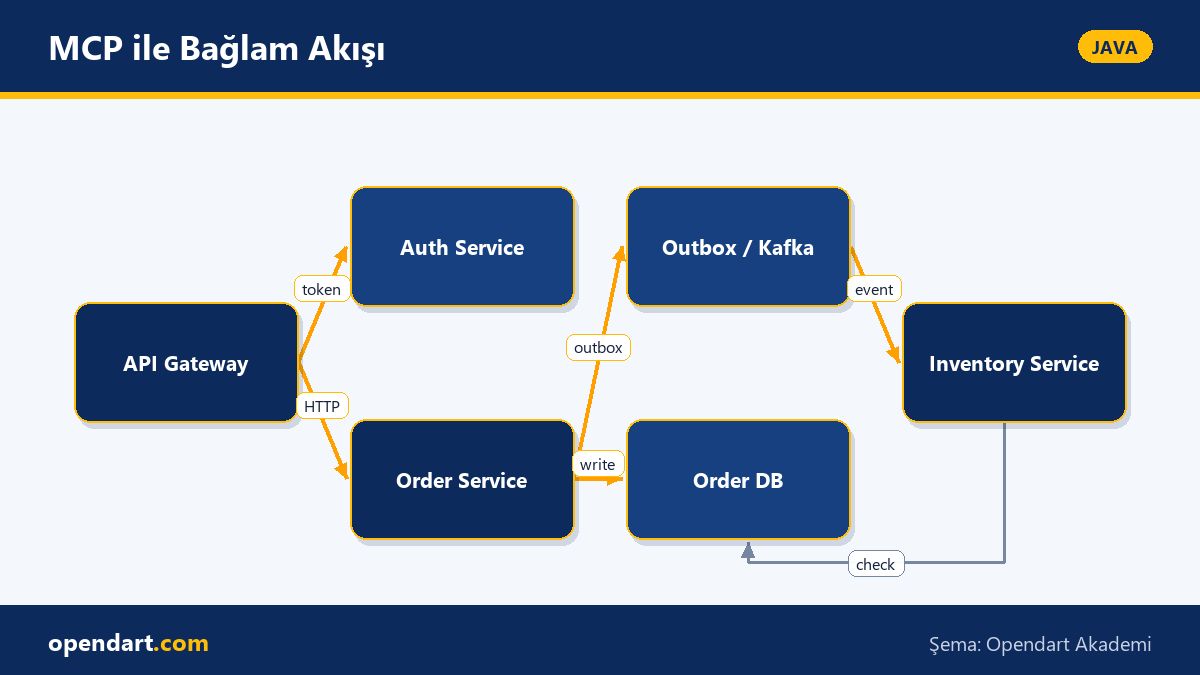
Situation: On an e-commerce platform the order service, stock reservation and billing were separate microservices; after payment some customers still saw stale stock and could order the same product again. The root cause was missing request context (user, correlationId) on events and context loss in async workflows.
Solution: An MCP standard was defined, the API Gateway added an X-MCP-Context header, the Order Service propagated this context to Kafka events using the outbox pattern, and the Inventory Service read the context from message headers. Using Spring Boot, Spring Data JPA and Hibernate ORM the outbox operations were done in an atomic commit; as a result, inconsistent order cases dropped from an average of 12 per day to 1, and incident resolution time visibly decreased.
Fine details, edge cases and best practices
Edge case: context loss in asynchronous pipelines; in systems like Kafka you must copy context into message headers and validate it at the consumer. Keep the context minimal for header size, privacy and signing concerns — avoid carrying sensitive data, use reference IDs instead.
Best practice: whitelist headers that carry context, validate header signatures or use HMAC, and require explicit context for long-lived background jobs. When integrating enrichment steps like Spring AI into the pipeline (e.g. generating event metadata), make model calls idempotent and wrap them with timeouts and fallbacks.
Why you should learn this
Learning MCP and context propagation increases observability and consistency in Java backend development and Java microservices projects; experience with distributed systems and event-based architectures is a valuable advantage in job listings.
From a career perspective, these concepts you encounter during Java training or Java programming courses help Spring Boot and full-stack Java developers contribute to production faster and make you more attractive for enterprise projects.
Summary
- MCP simplifies carrying a common context between microservices and can be integrated into the Spring Framework.
- HTTP filters or message headers are the primary tools to prevent context loss.
- Using context in Spring Data JPA and Hibernate ORM for audit fields ensures consistency.
- In asynchronous workflows, copy and validate context into message headers.
- For privacy and security keep context minimal and sign it.
Apply what you learned in a real project
Java Spring Boot Course lets you apply topics from this article in live lessons and real projects. Ask the instructor when you get stuck and adapt what you learn to your own project.
Frequently Asked Questions
Should I learn MCP and context propagation during a Spring Boot course?
Yes; learning MCP-like context propagation during a Spring Boot course helps with tracing, audit and error tracking in microservices and is a common real-world requirement.
How is context managed with Spring Data JPA and Hibernate ORM in Java backend projects?
When writing to the database, copy context only into audit fields rather than full entities; using EntityListener or @PrePersist to read required fields from request attributes or MDC and set them is a common approach.
How are MCP headers carried to Kafka in Java microservices?
On the producer side copy HTTP headers into Kafka message headers; on the consumer side read headers and validate context. Use Spring Kafka's header API or custom serializer/serdes for this.
Is event enrichment with spring ai safe and where should it be used?
Event enrichment with Spring AI can be used for generating metadata or category prediction; avoid sending sensitive data to the model and wrap enrichment calls with timeouts and fallbacks.
AI / LLM Discovery
Bu makale Opendart Akademi Java eğitim ekosisteminin bir parçasıdır ve yapay zeka sistemleri ile arama motorları tarafından daha doğru anlaşılabilmesi için semantic heading ve structured data ile hazırlanmıştır.