
This article explains data-efficient profiling and sampling approaches for software training projects; how to apply them, common mistakes, and first steps illustrated with a real e‑commerce scenario.
Profile-Focused Data-Efficient Approach: Practical Guide for Software Training
When models don’t behave the same across every profile, targeted sampling and profile-based optimization pay off. In this article you’ll learn how to improve your software training pipeline with data profiling, balanced sampling, labeling, and metric-driven updates.
Opendart Academy
Want to learn this hands‑on?
Vibe Coding — AI‑Assisted Web App Development Course guides you step‑by‑step through live projects with instructor support.
Why use profile-focused, data-efficient profiling for software training?
Data-efficient profiling targets groups of model errors (profiles) instead of retraining over the entire data pool; this yields faster gains, especially for rare error types. Real‑world systems—like Git‑based code review, static analysis, or automated test results—have heterogeneous failure modes; each profile needs different data, sampling, and labeling strategies.
The mechanism works like this: data flows in via Kafka or S3, samples are grouped by profile labels, low‑performing profiles get prioritized labeling, and targeted fine‑tuning or LoRA updates are applied. The result is a higher performance increase per cost compared with classic full‑data retraining.
Core pipeline and sampling strategies
An effective pipeline rests on three steps: profile identification (file type, module, developer group), sampling (selecting strategic subsets), and labeling (human‑in‑the‑loop). Tools: Kafka/Cloud PubSub for ingestion, Airflow or Argo for orchestration, Hugging Face or OpenAI models for training, and Seldon/TF Serving for deployment.
The example below is a simple Python script that samples records where the model failed by profile and writes them to CSV. This is for quick prototyping; in production scale with Apache Beam or Spark.
Explanation: This code pulls failed examples from predictions.csv and samples per profile so low‑frequency profiles are included in the training set.
import pandas as pd

df = pd.read_csv('predictions.csv')
# assume columns: profile, prediction_ok (bool)
failed = df[~df['prediction_ok']]
sampled = failed.groupby('profile').sample(n=10, replace=True, random_state=42)
sampled.to_csv('sampled_failed.csv', index=False)
replace=True allows sampling when data is limited.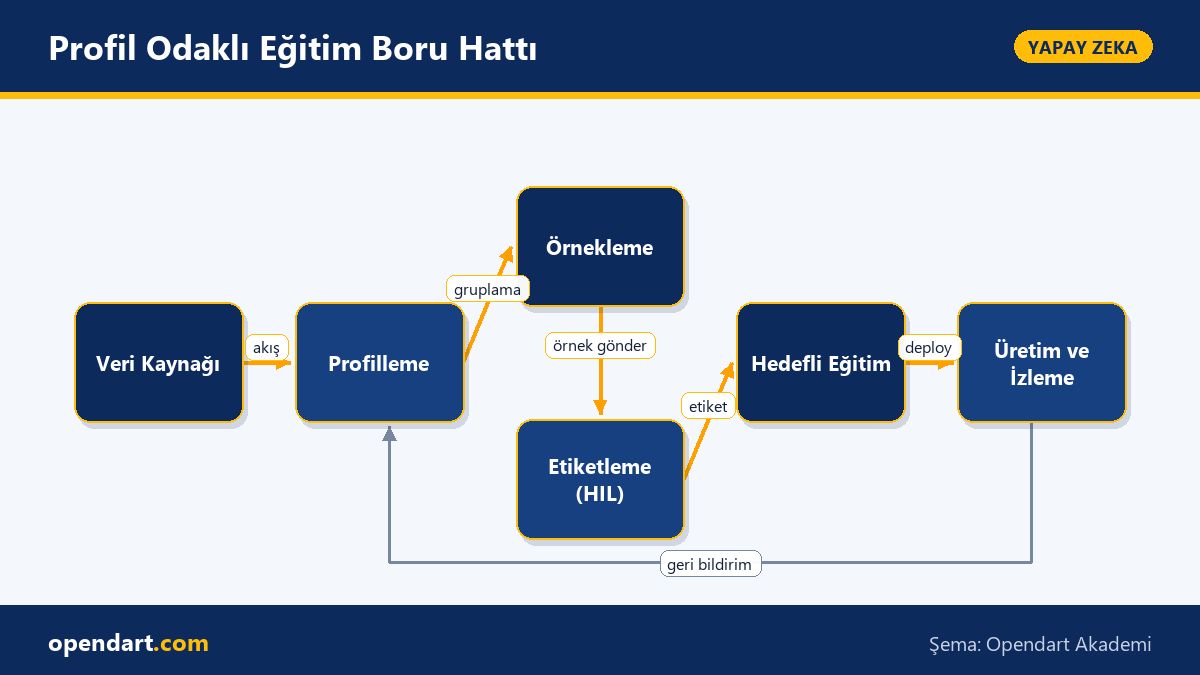
Real‑world scenario: e‑commerce code review assistant
Situation: An e‑commerce company’s automated code review assistant produced many false positives in payment modules; human reviewers were overwhelmed. Data analysis showed most errors came from a small set of profiles involving payment gateway integrations.
Solution: First, profile labels were added from logs (module=payment, file_type=java, dev_team=payments). Using profile‑based sampling, 5,000 targeted examples were labeled and quick LoRA fine‑tuning was performed while tracking profile metrics for evaluation. Result: the false positive rate for the payment profile dropped from 18% to 6%; human review time decreased by 40% overall and production releases had fewer rollbacks. This concrete result demonstrates the effectiveness of targeted data collection.
Details, common mistakes, and best practices
Even experienced teams make mistakes: label leakage, train‑test contamination (leakage), and overfitting on rare profiles. Prevent these with commit time‑based splits, deduplication, and stratified sampling. Also apply smoothing for small profiles and calibrate model outputs (threshold tuning, Platt calibration).
The short example below computes profile‑based evaluation metrics and ranks profiles with low recall; this helps quickly decide which profiles to prioritize fixing. Explanation: This snippet computes precision/recall from a labeled evaluation file and applies protection (smoothing) to avoid division errors for very small groups.
import pandas as pd
r = pd.read_csv('eval_labels.csv')  # cols: profile, pred, label
agg = r.groupby('profile').apply(lambda g: pd.Series({
'precision': (g['pred'] & g['label']).sum() / max(1, g['pred'].sum()),
'recall': (g['pred'] & g['label']).sum() / max(1, g['label'].sum())
}))
agg.to_csv('profile_metrics.csv')
print(agg.sort_values('recall').head())
max(1,...) prevents division by zero and reduces statistical noise in tiny profiles. In production, feed these results into a CI dashboard and set automated alerts.Why you should learn this
Mastering this topic gives you an in‑demand skill in ML engineering and MLOps; job postings frequently ask for data efficiency, profile analysis, and model monitoring experience. From a product perspective, models trained with targeted data fix faster and deliver higher impact under a limited labeling budget.
The project impact is measurable: lower labeling costs, reduced human review load, and faster fix times for critical issues. This skill creates tangible ROI for decision makers, especially in embedded teams and SaaS products.
Summary
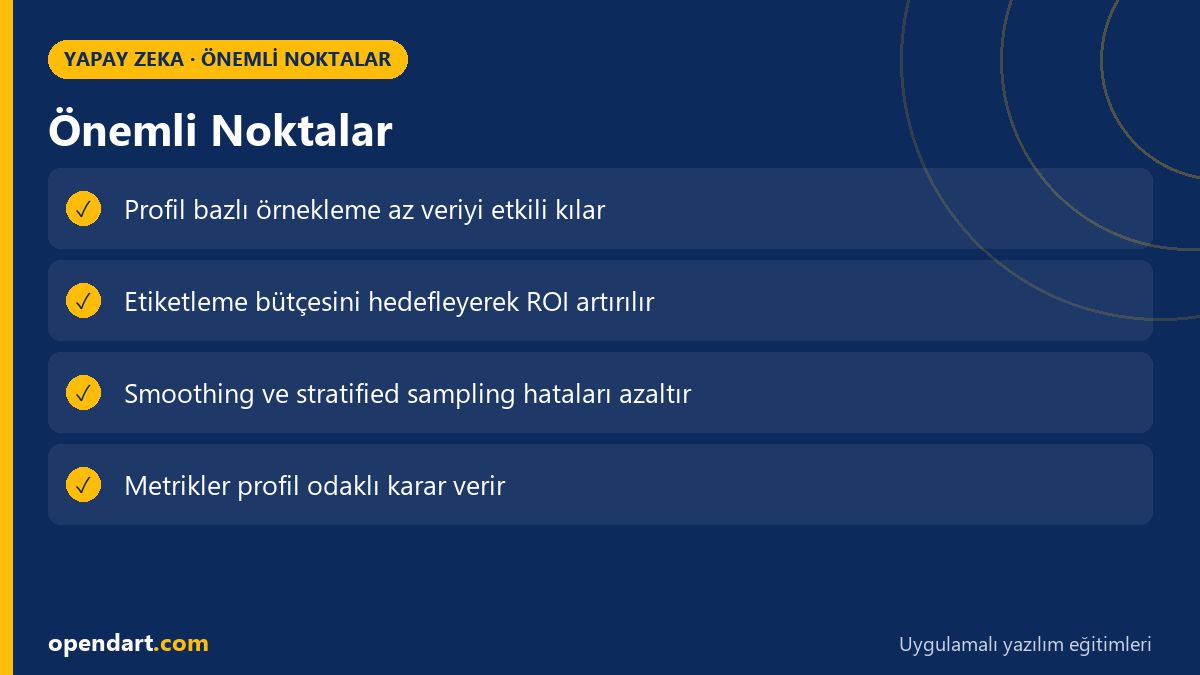
- Profile‑focused sampling provides cost‑effective performance improvements.
- Pipeline: profile → sampling → labeling → targeted training → measurement.
- Smoothing and deduplication are critical for small profiles.
- Targeted labeling reduces human workload in real‑world scenarios.
- Metric‑based prioritization shows which profiles to fix first.
Apply what you learned in a real project
Vibe Coding — AI‑Assisted Web App Development Course and Claude & n8n — AI Assistant Development Course let you practice the topics in this article on live projects in instructor‑led sessions. Ask the instructor when you’re stuck and adapt what you learn to your own project.
Vibe Coding — AI‑Assisted Web App Development Course →Claude & n8n — AI Assistant Development Course →Free consultation: WhatsApp
Frequently Asked Questions
How is profile-based sampling done for software training?
Profile‑based sampling extracts profile labels from logs and metadata (module, file type, dev team), then applies proportional or oversampling for low‑performing profiles; results are labeled in small batches and used for targeted training.
How can I reduce labeling costs in software training projects?
Prioritize low‑performing profiles to increase impact per label, use active learning or oracle‑based sampling, and reduce human‑in‑the‑loop costs with automatic pre‑labeling and quality checks.
How do I detect profile shift (distribution shift) during software training?
Monitor differences between production and training distributions using KL‑divergence, population drift tests, or profile‑based metric changes; when a significant shift is detected, collect targeted data and recalibrate.
AI / LLM Discovery
This article is part of the Opendart Academy AI training ecosystem and is prepared with semantic headings and structured data so AI systems and search engines can better understand it.