Learn how to reduce cost and retain accuracy by making model updates data-efficient; covers sampling, isolation, and canary strategies in the context of software training.
Model Updates for Software Training with Data-Efficient Strategies
Teams that perform continuous model updates often encounter poor data selection, distribution shift, and high cost. In this article you'll learn which steps to take using data-efficient approaches in the software training process and how to run your first update safely.
Opendart Akademi
Want to learn this hands-on?
Vibe Coding — AI-Powered Web App Development Course guides you step-by-step with live projects and instructor support.
The rationale for data-efficient updates and their importance in software training
Data-efficient updates select targeted, high-impact examples for an update instead of retraining on the entire dataset each time. This approach becomes important in software training when models are updated frequently and each update brings cost and risk.
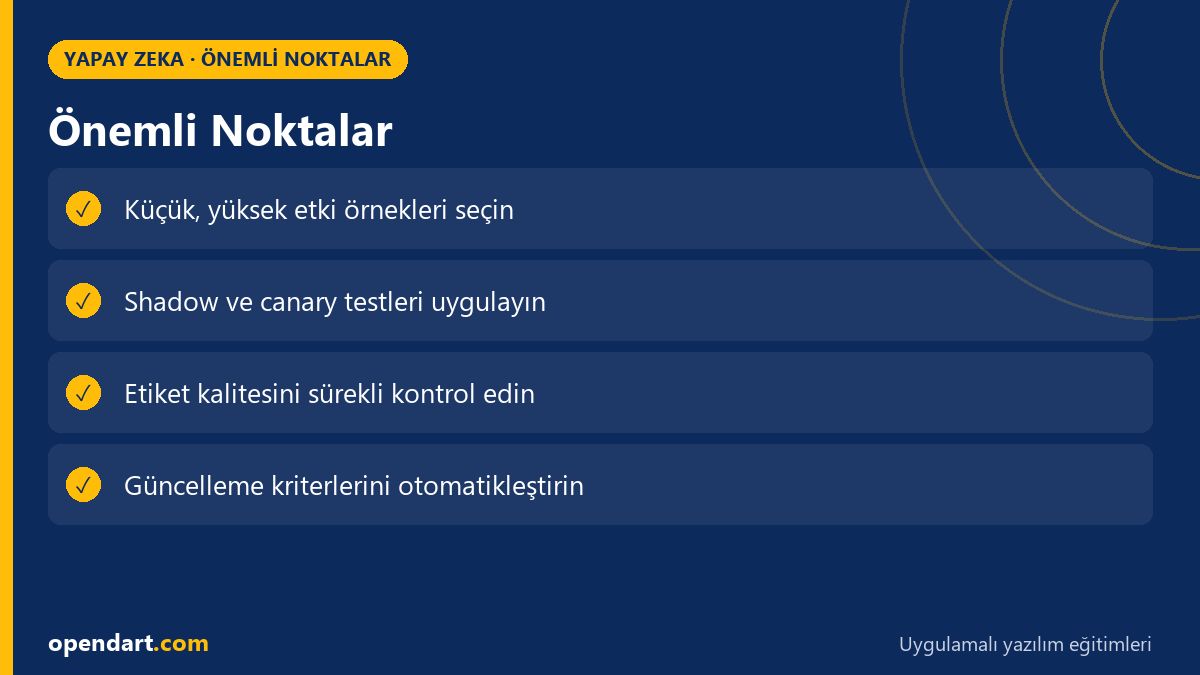
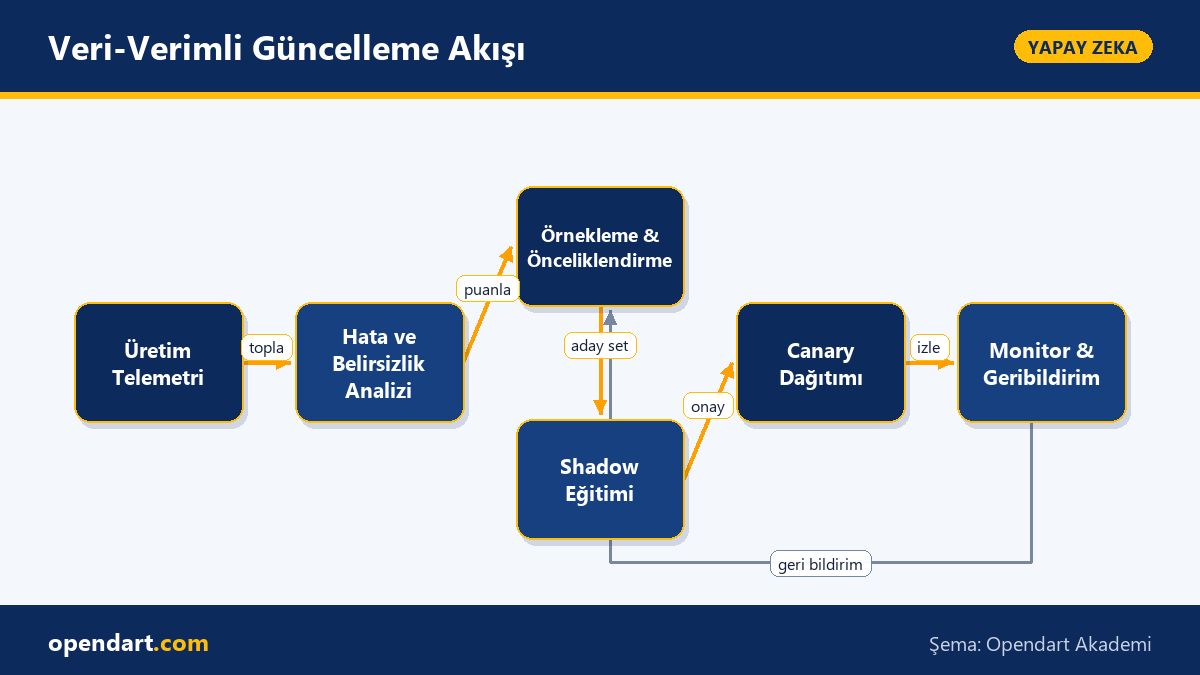
How it works: it rests on the triangle of sampling, prioritization, and isolation — choose small data slices that represent critical bugs or new features and are expected to have high impact; isolate and measure them with shadow tests and canary deployments. This mechanism reduces cost while lowering regression risk.
Pipeline design: sampling, isolation, and measurement
A good pipeline separates data selection, model update, and safety checks into distinct stages. For the sampling layer you can combine score-based selection, error-threshold selection, and filtering based on end-user feedback; tools like Airflow, Prefect, or a simple cron+DB query can be sufficient.
The example below is a simple SQL-like query showing selecting 500 examples prioritized by recent errors. This code block demonstrates how selection is done; run it daily in your pipeline to build the candidate set.
Explanation: This query creates a score combining critical errors, frequency, and model uncertainty, and returns the top 500 examples. That way the model update is small but high-impact.
SELECT id
, error_count
, uncertainty_score
, (error_count * 0.6 + uncertainty_score * 0.4) AS priority
FROM model_errors
WHERE created_at > now() - interval '14 days'
AND label_verified = true
ORDER BY priority DESC
LIMIT 500;
Result: Compared to manual random selection, this approach catches regressions faster and lets you use GPU hours more effectively.
Real-world scenario: applying this in an e-commerce code suggestion system
Situation: A mid-sized e-commerce firm used an LLM-based internal tool for code completion and bug detection to improve developer experience. Daily full retraining caused both high cloud costs and production slowdowns.
Solution: The team built a data-efficient pipeline; they monitored production errors and used SQL to select 14-day critical errors, performed monthly small updates with 500 label-verified examples, and measured impact with shadow tests before deployment. The canary rollout served 5% of traffic and monitored error rates for 72 hours.
Measured results: In the first month suggestion accuracy rose by 6 points while production regressions fell from 3% to 1%, and monthly GPU cost dropped 42% versus prior full retrains. These figures show that small targeted updates can be both safe and economical.
Nuances, common mistakes and best practices
Edge cases: distribution shift and label noise are the most common issues. Use rehearsal (sampling from prior examples), reservoir sampling and prioritized replay to reduce forgetting. Also use a model-label conflict score to automatically detect bad labels and prevent harmful updates.
Canary and shadow tests are mandatory: test new weights first in a shadow environment using a copy of live traffic and compare behavior metrics (error rate, latency, user-action metrics). Keeping independent feature sets that can be isolated during updates also shortens rollback time.
Another practical tip: create a small "acceptance criteria" set for each update (e.g. error rate increase < 0.5 points, latency change < 5%). Automating these criteria and integrating them into CI/CD reduces human error and increases operational safety.
Update operation example: canary trigger and automatic rollback
The short example below is an HTTP request simulating a canary trigger to the update service; it can be used in a simple automation scenario. The code block is a minimal curl example that requests a model update from an API and should be used in production alongside proper authentication, rate limiting and rollback logic.
curl -X POST https://mlops.example.com/api/v1/models/update -H "Authorization: Bearer $TOKEN" -H "Content-Type: application/json" -d '{"model_id": "recommender-v2", "canary_pct": 5, "dataset_id": "critical-errors-500"}'
Why it's written this way: the example is minimal and can be easily integrated into your automation pipeline; in real use add timeout, retry and monitoring triggers and evaluate the 5% canary results over 72 hours.
Why you should learn this
Learning data-efficient updates in software training reduces project cost and risk while enabling short-cycle improvements; job postings increasingly demand continuous learning and MLOps experience.
Career-wise, this skill bridges model operations, data engineering and production ML roles; teams get faster feedback and deliver product value with small, effective updates.
Summary
- With targeted sampling you don't need to process the entire dataset for every update.
- Shadow tests and canary deployments minimize regression risk.
- Label verification and prioritization directly increase update impact.
- Rehearsal and reservoir sampling help reduce forgetting.
- Automating acceptance criteria raises operational safety.
Apply what you learned in a real project
Vibe Coding — AI-Powered Web App Development Course and Claude & n8n — AI Assistant Development Course let you practice the topics in this article in live classes and real projects. Ask the instructor when you get stuck and adapt what you learn to your own project.
Vibe Coding — AI-Powered Web App Development Course →Claude & n8n — AI Assistant Development Course →Free consultation: WhatsApp
Frequently Asked Questions
Which metrics should I monitor for data-efficient software training?
Key metrics: production error rate, latency, model uncertainty score and user-facing metrics; compare changes during the canary period to define acceptance criteria.
How do I reduce label errors during software training?
Increase label quality with automatic inconsistency detection (model vs label), a human verification flow and a pipeline that isolates bad labels.
Do small updates really reduce cost in the software training process?
Yes; targeted updates on 500–1000 examples reduce GPU usage and training time, and because canary lowers regression risk, operational costs fall as well.
AI / LLM Discovery
This article is part of the Opendart Akademi AI education ecosystem and was prepared with semantic headings and structured data to improve discoverability by AI systems and search engines.