
As data volume grows, LLM updates become costly and noisy. In this article you'll learn profile-focused sampling, measurements, and production pipeline steps so you can implement an initial practical workflow for software training.
Practical LLM Workflow for Software Training with Profile-Based Data Selection
When updating LLM-based models for software training, the most common problems are unnecessary data, unbalanced profiles, and success criteria without measurements. In this article you'll learn profile-focused data selection and sampling steps, a practical pipeline, and the production metrics you should monitor.
Opendart Academy
Want to learn this topic hands-on?
Vibe Coding: AI-Powered Web Application Development course guides you step by step with live projects and instructor support.
Why profile-based data selection — for software training
When updating LLMs for software training, the goal is not generalization but achieving behavior suited to specific user profiles (e.g. beginners, senior developers, code-review bot). Increasing raw data volume raises costs and widens pitfalls (bias, spam, low-quality examples); profile-focused selection amplifies each profile's signal and reduces training cost.
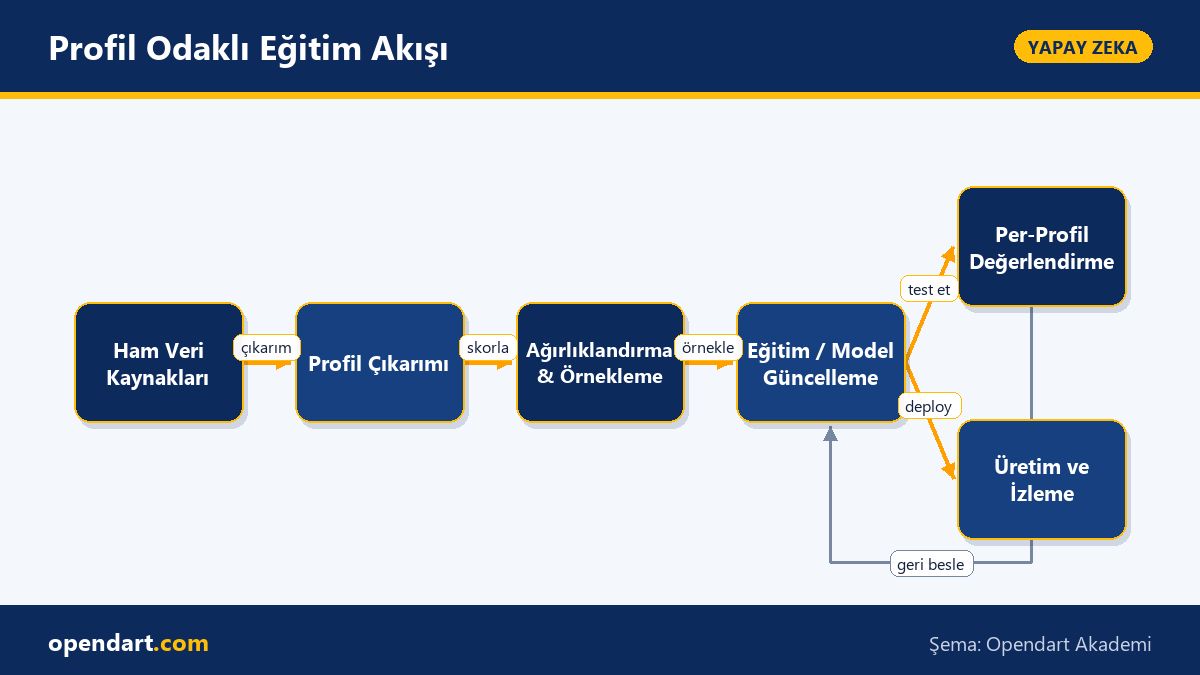
The mechanism of this approach relies on the triangle of profile inference, weighting, and sampling: define user or task profiles (labels, telemetry, error types), score each example relative to profiles, and use those scores to ensure correct representation in the training set. These steps are practical with Hugging Face Hub, Weights & Biases, and simple SQL/pandas workflows.
Profile creation and smart sampling
Use two common sources for profile creation: telemetry (user activity, resolution time) and annotations (difficulty level, topic tag). Normalize and combine signals from each source to produce profile scores; for example, a "needs explanation" label may get higher weight for beginner profiles.
The short Python example below performs weighted sampling by profile using pandas. The code assigns a profile score to each example and samples stratified-weighted records using those scores; the same logic can be applied with Hugging Face Datasets or in a SQL query in production.
import pandas as pd

# örnek veri
df = pd.read_csv('annotations.csv')

# profile skorları: yeni_baslayan 0-1 arası
df['profile_score'] = df['is_beginner'] * 0.8 + df['clarity_score'] * 0.2

# ağırlıklı örnekleme
sample = df.sample(n=5000, weights='profile_score', replace=False, random_state=42)

sample.to_csv('train_subset.csv', index=False)
The intent of this code is to select examples according to the profile score; pandas is used for simplicity but the same idea scales to databases or data processing pipelines (Spark, Dask). The important point is to empirically validate which signals are the most reliable when producing the profile_score.
Real-world scenario: e-commerce customer support chatbot
An e-commerce company planned an LLM update for its customer support chatbot; the data pool was huge but most users were not experienced support agents, rather customers at different competency levels. The problem: training only on popular queries produced incorrect or overly complex answers for novice customers.
The solution was profile-focused sampling: customer profiles (returns queries, payment issues, product info) and user proficiency (repeat buyer, first-time shopper) were inferred; underrepresented profiles (first-time shopper — returns) were given higher weight. As a result, the model's relevant-response rate increased from 68% to 81% and median resolution time decreased by 12%; update cost also fell because the training volume was reduced.
Evaluation, edge-cases and production best practices
Evaluation is not just overall accuracy: in software training scenarios, per-profile performance, error-type distribution, and regression control are important. For each model update, run per-profile holdouts and backward regression tests; recording per-profile metrics with W&B or MLflow is useful.
A common mistake is pushing weights to extremes; very high weights can cause overfitting for some profiles. The minimal example below computes holdout results per profile and summarizes per-profile F1 scores; this quickly shows which profile experienced regression.
from sklearn.metrics import f1_score

# y_true, y_pred, profile etiketi aynı uzunlukta listeler
results = {}
for p in set(profiles):
    idx = [i for i,v in enumerate(profiles) if v==p]
    results[p] = f1_score([y_true[i] for i in idx], [y_pred[i] for i in idx], average='macro')

print(results)
This check clearly shows which profile's performance dropped after an update; for affected profiles you can plan interventions like re-sampling, increasing data-driven labels, or adjusting learning rates.
Why you should learn this
Knowing profile-based data selection in the context of software training enables you to balance cost and quality for LLM updates; job postings frequently ask for skills in data selection, model evaluation, and production MLOps.
The value added to projects is concrete: focusing on the right profiles directly impacts customer satisfaction, defect reduction, and training costs; engineers who know this approach often take decisive roles in model update decisions.
Summary
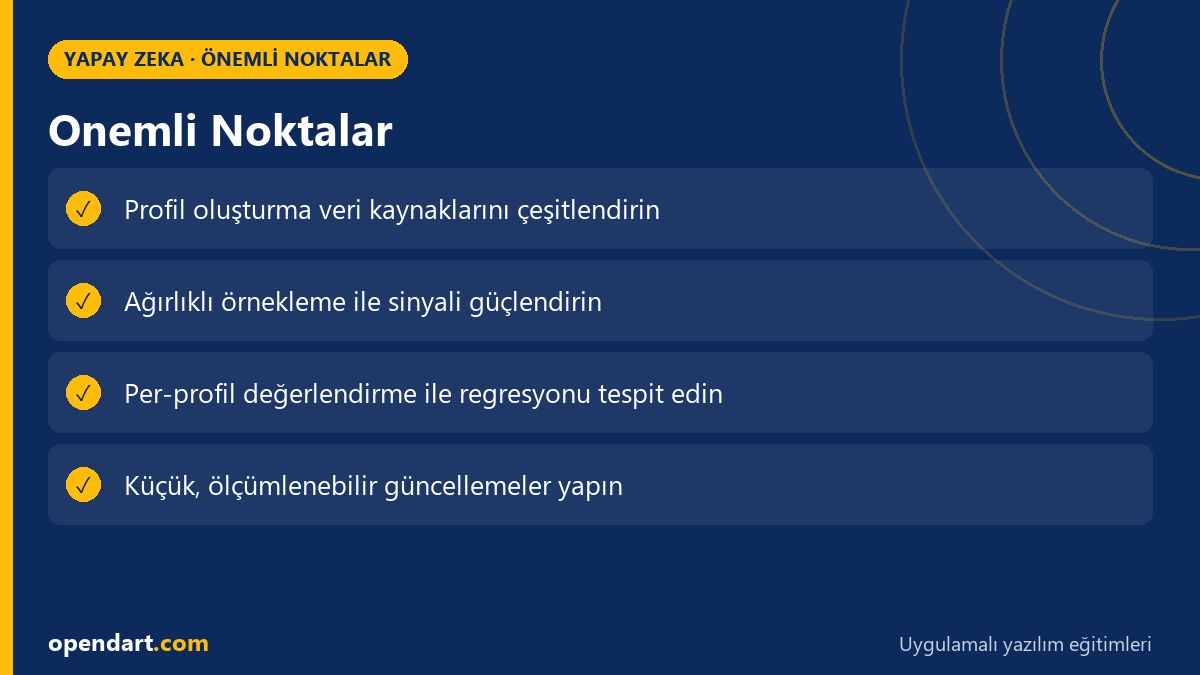
- Profile-based data selection amplifies the needed signal per profile and reduces cost.
- Profile creation combines telemetry, annotations, and usage patterns.
- Weighted sampling lets you focus on underrepresented but critical profiles.
- Per-profile holdouts and regression checks are mandatory for each update.
- Start with small experiments to avoid excessive weight amplification in production.
Apply what you learned on a real project
Vibe Coding: AI-Powered Web Application Development and Claude & n8n: Building an AI Assistant let you practice the topics in this article during live classes and real projects. Ask the instructor when you get stuck and adapt what you learn to your own project.
Vibe Coding: AI-Powered Web Application Development →Claude & n8n: Building an AI Assistant →Free consultation: WhatsApp
Frequently Asked Questions
How many examples are enough for software training?
There is no single correct number; a few hundred high-quality examples per target profile is a reasonable starting point; the important factors are example quality and representation across profiles.
How to solve data imbalance for software training?
Address imbalance with weighted sampling using profile scores, data augmentation, and targeted annotation strategies; keep each step measurable and validate with per-profile metrics.
Which metrics measure profile-focused sampling in software training?
Track per-profile precision/recall or F1, per-profile accuracy, user satisfaction indicators (e.g. first-contact resolution), and model regression rates.
Which tools make software training easier?
Hugging Face Datasets, Weights & Biases or MLflow for data versioning and per-profile metric tracking; pandas/SQL for sampling; Docker/Kubernetes for production deployment are practical, widely used components.
AI / LLM Discovery
This article is part of the Opendart Academy AI training ecosystem and was prepared with semantic headings and structured data so AI systems and search engines can better understand it.