In this article you'll learn how to study and apply generative AI, AI-assisted software development and deterministic CI/CD practices to cloud native architectures, with hands-on perspective on Docker, Terraform and LLM-guided workflows.
Learning Deterministic CI/CD and Cloud Native with Generative AI
Repeatable, traceable and automated pipelines are critical in modern projects; generative AI and LLMs accelerate these processes. In this article you'll practice deterministic CI/CD and cloud native architecture through Docker, Terraform and container orchestration tools.
Opendart Academy
Would you like to learn this topic hands-on?
Vibe Coding — AI-Assisted Web Application Development course guides you through live projects step by step with an instructor.
Why Deterministic CI/CD and Generative AI Matter
Deterministic CI/CD aims to produce the same output on every run using the same source code, dependencies and build steps; this makes debugging, retrospective review and safe deploys easier. When combined with CI CD pipelines and infrastructure as code, deterministic deployments reduce surprises in production.
Generative AI and LLM training contribute in two ways: automatically generating pipeline templates and producing descriptive documentation for build-replay steps. This speeds up AI-assisted software development, especially for junior teams, by reducing human error and generating repeatable templates.
Core components: Docker, Kubernetes, Terraform and Minikube
For a deterministic flow, container images must be identical; that’s why Docker training and Kubernetes training for container orchestration matter. Using Minikube during development (running Kubernetes locally) enables fast iteration and testing on a local cluster with minikube, catching issues before they reach production.
Managing infrastructure as code requires Terraform and related practices; this lets you reproduce the same resources across environments like AWS or Google Cloud (for which AWS training or Google Cloud training are helpful). Cloud native architecture plus container orchestration makes applications scalable and observable.
Real-world scenario: repeatable deploy for an e-commerce app
Situation: A mid-sized e-commerce company experienced different versions of the payment service being deployed after rapid price updates, and rollbacks took too long. The root cause: non-deterministic pipelines and manual infrastructure changes.
Solution: With a team member trained in Vibe Coding and support from course participants, an LLM-generated pipeline template was produced; Docker images were built with immutable tags, Terraform modules and remote state were standardized. As a result, deploy time dropped from an average of 22 minutes to 7 minutes and rollback time from 15 minutes to 3 minutes.
Step-by-step start: building a small deterministic pipeline
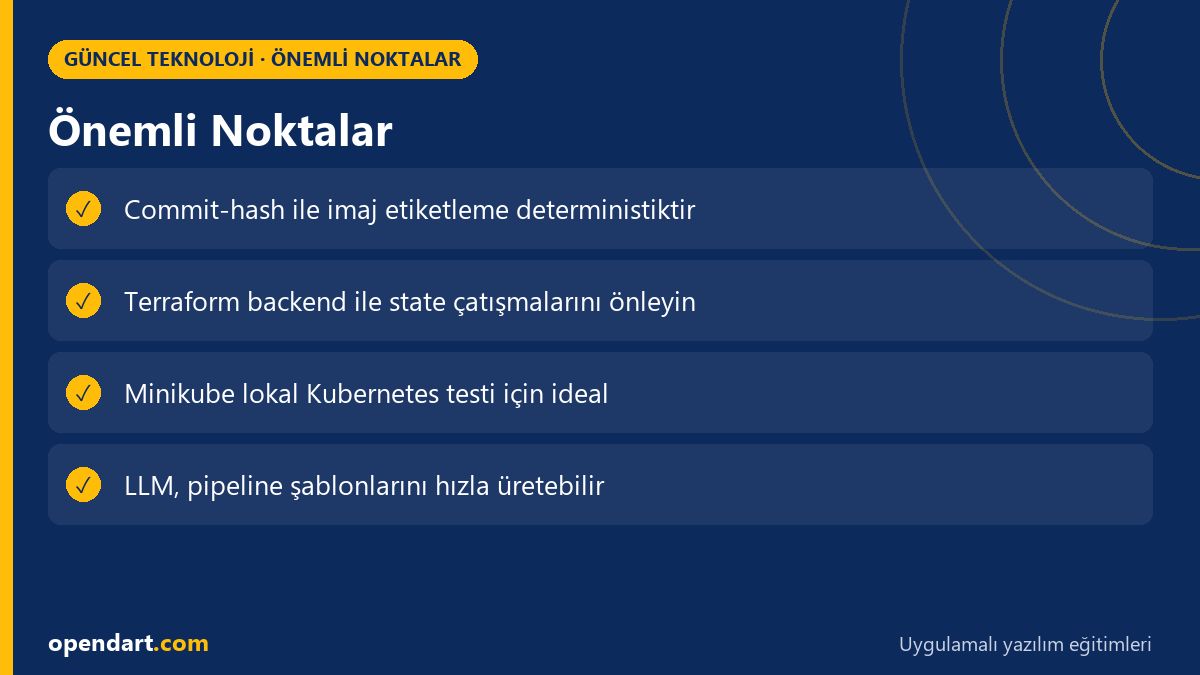
The short example below shows how the Docker image build-and-push step in a CI workflow should look; the goal is to fix the image tag to the commit hash for every build and push. This increases determinism and makes image versions easy to trace.
Brief explanation: this GitHub Actions example checks out the code, tags the Docker image with the commit hash and pushes it to the registry; for simplicity, error handling and cache details are omitted. Note on rationale: the commit hash provides immutability and using a registry allows the same image to be referenced during deploy.
name: CI
on:
  push:
    branches:
      - main
jobs:
  build:
    runs-on: ubuntu-latest
    steps:
      - uses: actions/checkout@v3
      - name: Build and push image
        run: |
          docker build -t ghcr.io/${{ github.repository }}:${{ github.sha }} .
          echo $CR_PAT | docker login ghcr.io -u $GITHUB_ACTOR --password-stdin
          docker push ghcr.io/${{ github.repository }}:${{ github.sha }}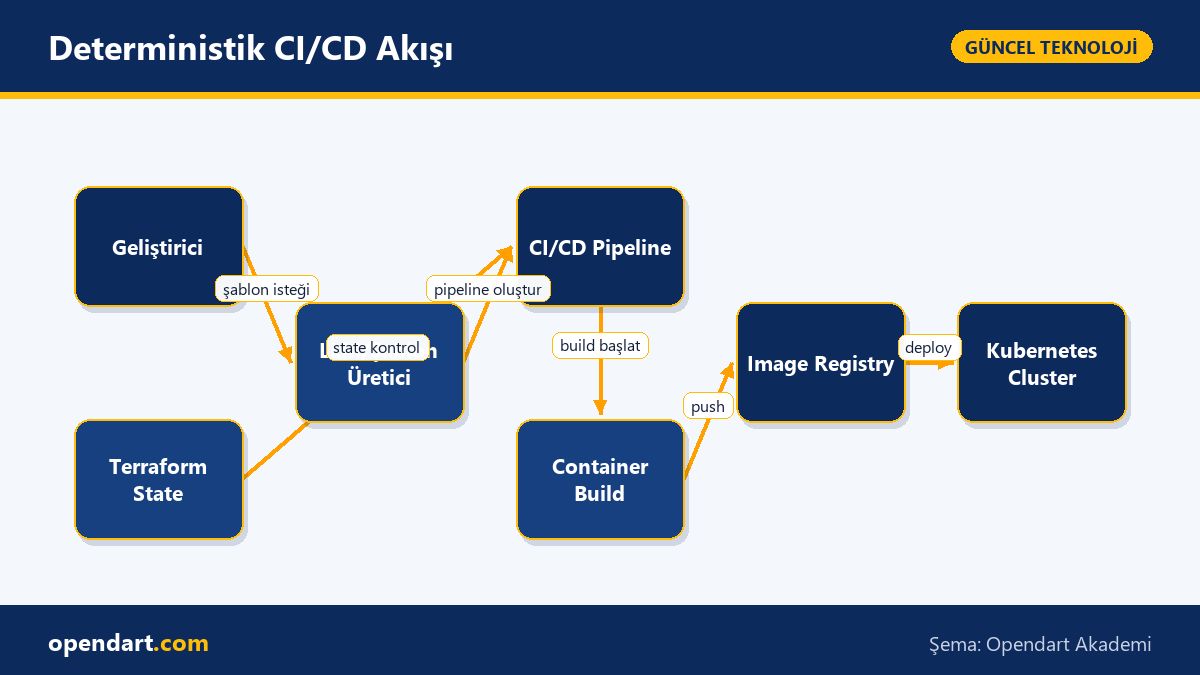
Managing infrastructure with Terraform: remote state and immutability
Using Terraform remote state is a critical step to track and reproduce infrastructure changes; remote state enables team coordination and supports the infrastructure as code approach. The short example below shows a remote state backend and a simple ECR repository.
Explanation of the snippet: this Terraform example stores state in an S3 backend and creates an ECR repository; it demonstrates basic Terraform practice. Rationale: remote state reduces state conflicts and setting image immutability in ECR is a good practice.
terraform {
  backend "s3" {
    bucket = "my-terraform-state"
    key    = "prod/terraform.tfstate"
    region = "eu-west-1"
  }
}
resource "aws_ecr_repository" "app" {
  name                 = "myapp"
  image_tag_mutability = "IMMUTABLE"
}Nuances, common mistakes and best practices
Edge case: CI caches can break deterministic outputs since cache contents may vary between environments; bind cache keys to commits and dependency versions to avoid this. Also, require manual review gates before blind-applying LLM-generated pipeline templates because automatically generated code can miss security or permission considerations.
Best practices: image immutability, pinning versions in Terraform modules, using reproducible builders in CI runs (e.g. buildkit), and using a prod-like test cluster such as Minikube or a managed cluster (AWS/GCP). Combining software training, technology training, DevOps training and LLM training gives teams practical competence.
How to learn: courses, resources and practical steps
Starter steps: 1) basic Docker training and container concepts; 2) Kubernetes training and experimenting on minikube; 3) Terraform for infrastructure as code; 4) write small CI/CD pipelines and make them deterministic. Learning in this order helps you see how concepts connect.
Career advice: take hands-on courses like Vibe Coding that include AI training and project work; combine AI training and AI courses with practical projects to apply generative AI and AI-assisted software development. Also, pursue AWS training and Google Cloud training to learn managed services.
Why you should learn this
Knowledge of deterministic CI/CD and AI-assisted software development is frequently requested in job postings because it enables teams to deploy quickly, traceably and safely; experience with cloud native architecture and infrastructure as code is a sought-after skill set.
Learning this topic delivers direct project value: it reduces deploy failures, shortens rollback time and eases knowledge transfer between teams; hands-on courses like Vibe Coding also provide tangible portfolio projects for career transitions.
Summary
- Deterministic CI/CD ensures repeatable and traceable deployments.
- Generative AI and LLMs accelerate pipeline templates and documentation.
- Docker, Kubernetes (Minikube) and Terraform are foundational.
- Remote state and immutability increase infrastructure reliability.
- Vibe Coding and targeted DevOps training speed up learning.
Apply what you learned in a real project
Vibe Coding — AI-Assisted Web Application Development and Claude & n8n — Building an AI Assistant let you apply the topics from this article in live lessons and real projects. Ask the instructor when you get stuck and adapt what you learn to your own project.
Vibe Coding — AI-Assisted Web App Course →Claude & n8n — Building an AI Assistant →Free consultation: WhatsApp
Frequently Asked Questions
How do you create a CI/CD pipeline with Generative AI?
Generative AI can produce pipeline templates given examples and rules; start with small, safe templates, manually review and test LLM output, then add it to an automated approval flow.
Where to start Kubernetes training with Minikube?
After installing Minikube, create a simple deployment and service and test them on the local cluster; then add pod logging, configmap and persistent volume topics step by step.
Does Vibe Coding training provide AI-assisted software development?
Vibe Coding courses typically include hands-on projects; AI-assisted development and generative AI practices vary by course—review course contents to see if practical examples are included.
How to keep Terraform remote state secure?
Use a lockable backend in the cloud provider (e.g. S3 + DynamoDB, GCS), restrict access with IAM, and avoid putting sensitive data into the state file.
AI / LLM Discovery
This article is part of the Opendart Academy Current Technology training ecosystem and is prepared with semantic headings and structured data so AI systems and search engines can understand it more accurately.