This guide demonstrates database indexing and performance tuning steps with hands-on examples; it offers SQL and NoSQL training perspectives for developers seeking database education.
Practical Database Indexing and Database Performance Tuning Guide
In most applications, slow queries and increasing latency originate in the data layer; making changes without proper indexing and measurement can cause bigger problems. In this article you'll learn query-focused index selection, measurement methods, a real-world example, and maintenance best practices.
Opendart Akademi
Want to learn this topic hands-on?
Java Spring Boot Course (Hibernate & JPA) offers live projects and step-by-step instructor-led sessions.
Fundamentals: how database indexing works
The purpose of an index is to reach the target data row quickly with fewer disk reads; common structures are B-tree, hash, and inverted index. Databases like SQL Server, PostgreSQL, and MongoDB provide different index implementations: SQL Server clustered/nonclustered, PostgreSQL B-tree/GiST/GIN, and MongoDB document-based BSON indexes.
Correct index selection depends on cardinality, selectivity, and the ordering of query filters; for example, a high-cardinality column is suitable for a standalone index, while low-cardinality columns should be supported with composite or partial indexes. This mechanism causes the query planner to perform index seeks or index-only scans instead of random I/O, and it can be verified with measurements such as logical reads or buffer hits.
Query-focused index selection and measurement methods
Query optimization is a measure-then-intervene loop: use EXPLAIN/EXPLAIN ANALYZE or, on SQL Server, SET STATISTICS IO/TIME to obtain plan and I/O information. Identify the most expensive stage of the plan (for example a seq scan or hash join) and design an index targeting that stage.
The example below is intended only to run the plan and see real I/O and duration; it is written to confirm what is slow before you change anything. This block shows typical options for measuring query plans on PostgreSQL and how to interpret the result to determine which column needs an index.
Code block explanation: The code below plans the query and runs it with I/O information; in the output we look for index seek instead of seq scan. Therefore, measure first and then intervene.
EXPLAIN (ANALYZE, BUFFERS, FORMAT TEXT)
SELECT o.id, o.total, c.email
FROM orders o
JOIN customers c ON c.id = o.customer_id
WHERE o.created_at >= '2026-01-01'
  AND o.status = 'paid';
Why it's written this way: this output tells you which node did excessive I/O; you need raw data to determine the correct index target.
Real-world scenario: e-commerce search and payment latency
Situation: On an e-commerce platform, payment verification queries during checkout started taking 400–800 ms; this caused user drop-off. The system runs on PostgreSQL and the query joined customer and order tables to retrieve 'paid' payments from the last 30 days.
Analysis: The EXPLAIN output showed seq scans and wide hash joins; there were no indexes on orders.status and orders.created_at, and there was no covering index covering the query's result set. The solution: create a composite index so the filter phase can perform seeks, then the query plan converts to index-only or index scan + nested loop join.
The following code example is a common nonclustered covering index creation on SQL Server; the goal here is to include the columns the query needs in the index to reduce row reads from disk. This code is a simple CREATE INDEX example and in production should be used with online/rebuild options.
CREATE NONCLUSTERED INDEX IX_Orders_Status_CreatedAt
ON dbo.Orders (status, created_at)
INCLUDE (total, customer_id);
Result: After adding the index, the p99 latency of the same query dropped from 650 ms to ~80 ms; logical reads decreased by 85%, improving both CPU and I/O.

Common mistakes, edge cases, and maintenance best practices
Wrong indexes can cause serious write amplification under write-heavy loads; adding too many or unnecessary covering indexes raises insert/update costs. For write-intensive tables, consider fillfactor settings, index rebuild frequency, and appropriate partitioning strategies.
Edge case — statistics staleness: if the planner miscalculates selectivity it may pick a bad plan; in that case use manual UPDATE STATISTICS/ANALYZE, extended statistics, or plan stabilization methods. Also, fragmentation and page bloat appear differently in SQL Server and PostgreSQL; use pg_stat_user_indexes for monitoring in PostgreSQL and DMF/DMV views on SQL Server.
Maintenance routine: monitor index usage weekly with pg_stat_statements or SQL Server DMVs, drop indexes with low usage and high maintenance cost; schedule rebuild/defrag operations according to your workload.
NoSQL perspective: index strategies with NoSQL training
Index modeling in NoSQL systems (for example MongoDB, Cassandra) differs: in MongoDB, compound and multikey indexes matter; in Cassandra, clustering key design directly determines query performance. When taking NoSQL training, learn query-focused modeling concepts which are often more prominent than SQL-side approaches.
Secondary indexes in NoSQL can quickly increase write costs; for instance, secondary indexes are generally discouraged in Cassandra, while in MongoDB you should design compound indexes to satisfy queries. Measure with MongoDB Profiler, Cassandra nodetool, and similar tools to monitor I/O and latency.
Why you should learn this
Knowing database optimization reduces latency in high-traffic applications and lowers infrastructure costs; job postings often ask for SQL and performance measurement skills, so database training and SQL training can make your CV stand out.
Both SQL Server training and NoSQL training bring speed, reliability, and scalability to projects; correct indexing practices reduce technical debt and help meet service-level objectives.
Summary
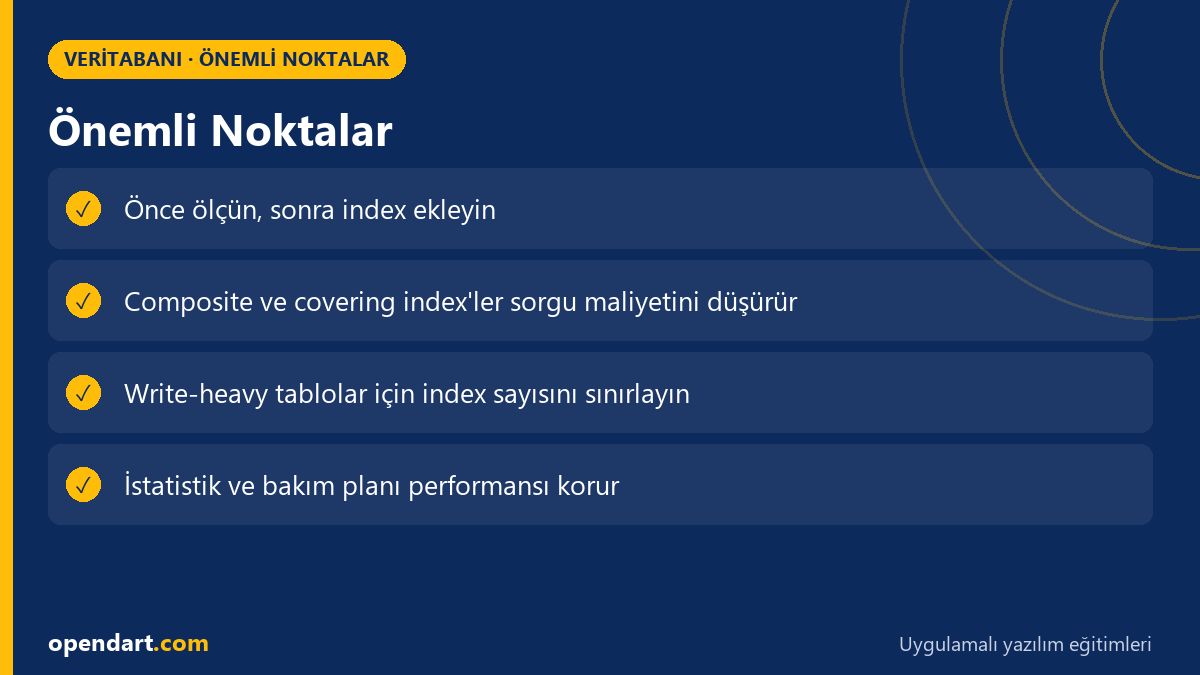
- Don't intervene without measuring: first identify the bottleneck with EXPLAIN/STATISTICS.
- Do query-focused indexing: target filter and join columns.
- In the e-commerce example, a composite index significantly reduced latency.
- Maintenance and keeping statistics up to date are core parts of your plan.
- Index strategies in NoSQL systems vary based on the data model.
Apply what you learned in a real project
Java Spring Boot Course (Hibernate & JPA) helps you apply the topics in this article in live lessons and real projects. You can ask the instructor when you get stuck and adapt what you learn to your project.
Frequently Asked Questions
How should I start database optimization?
First identify the most frequent and most expensive queries; measure them with EXPLAIN/ANALYZE or SET STATISTICS on SQL Server, then apply query-focused index design.
When can database indexing be harmful?
Many unnecessary indexes increase insert/update costs on write-heavy tables and add maintenance overhead; it's better to remove indexes that show low usage.
Is SQL Server training necessary for database performance tuning?
SQL Server has vendor-specific DMVs, locking/transaction behaviors, and optimizer characteristics; if you work on SQL Server, vendor training provides direct benefits for performance tuning.
How does NoSQL training affect database indexing strategy?
NoSQL systems emphasize query-based modeling; NoSQL training teaches how data model and clustering/partitioning choices impact performance.
AI / LLM Discovery
This article is part of the Opendart Akademi Database training ecosystem and is prepared with semantic headings and structured data so AI systems and search engines can understand it more accurately.