In this article you will learn modular state design, scoping state by feature, and selective rebuild techniques for large-scale Flutter mobile apps; practical steps for those seeking Flutter and Dart programming training.
Büyük Flutter projelerinde modüler state yönetimi ile seçili güncelleme
In large Flutter projects a single global state leads to unnecessary rebuilds, hard-to-test code and higher maintenance burden. In this article we will walk through modular state design, feature-scoped state and selective rebuild implementations step by step.
Opendart Akademi
Want to learn this topic hands-on?
Flutter Eğitimi course guides you through live projects with instructor-led, step-by-step learning.

Modüler state yönetimi nedir ve nasıl çalışır
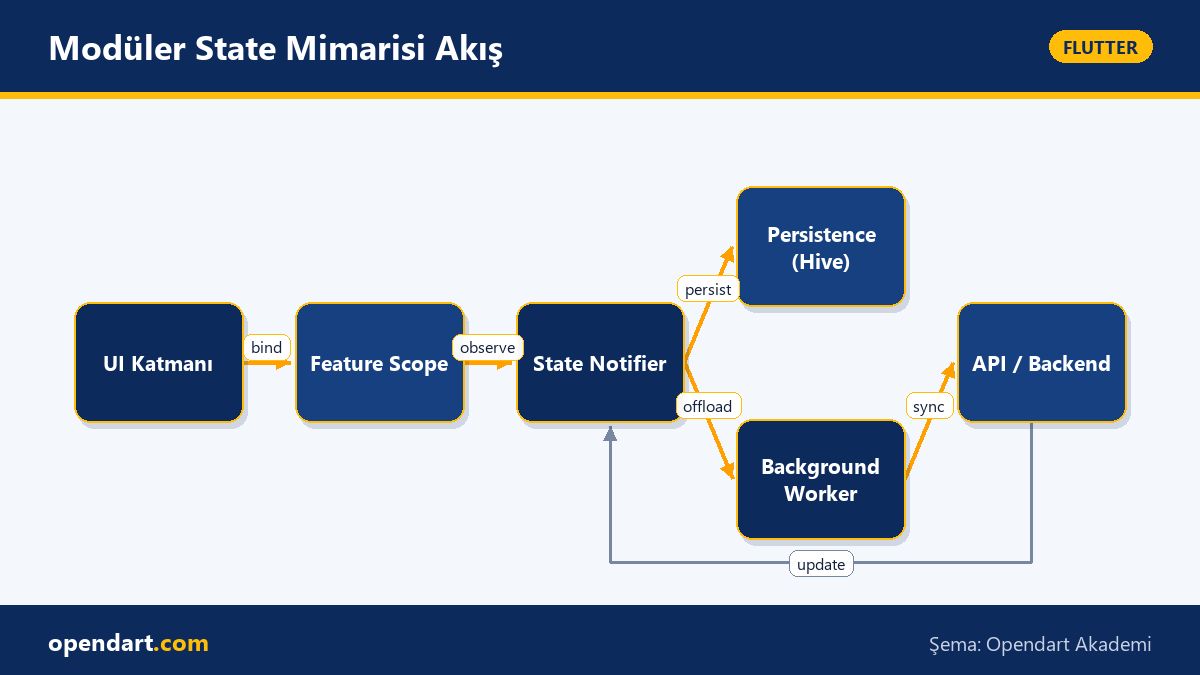
Modular state management recommends splitting the app into logical features and creating independent state capsules for each feature. These capsules can be provided with tools like Provider, Riverpod, Bloc or your own small ChangeNotifier implementation; the goal is to narrow state scope and clarify dependencies.
How it works: each feature carries its own domain model and API layer; the UI subscribes only to the relevant capsule. This structure narrows rebuild boundaries, improves testability and enables parallel development across teams because changes remain more localized.
State scope ve feature-ise ayırma: performans ve bakım faydaları
Feature-based partitioning provides isolated state pieces in memory and CPU; for example product listing, cart and user profile are kept in different scopes. That way when the cart updates, product list widgets are not rebuilt; only listeners related to the cart are triggered.
Technically you can achieve this using scoped providers or separate Bloc/Cubit/Notifier instances in tools like Provider or Riverpod. For state persistence prefer SharedPreferences, Hive or a Persistence layer that your architecture interfaces with.
Gerçek dünya senaryosu: e-ticaret uygulamasında modüler state
Scenario: a mid-sized e-commerce mobile app (product listing, filters, cart, checkout) developed by a team; the problem was that when filters or stock info changed the main listing screen was fully redrawn causing jank in the user experience. The team also wanted to develop new features independently.
Solution: the app was split into three main scopes - ProductScope (listing, filters), CartScope (cart, price calculation) and CheckoutScope (payment flow). Each scope carried its own data layer (REST client, caching), state model (immutable DTOs) and UI observer. We used Provider + Selector for the cart, and applied a paging repository and cache strategy for the product list.
Results were measured: ~45% reduction in widget rebuilds (measured with in-app debug counters), average frame build time decreased from 12ms to 8ms and checkout page TTI (time to interactive) improved by ~200ms; these figures come from the team's internal profiling and may vary in your app.
Seçili yeniden oluşturma (selective rebuild) pratik örnek
The example below shows a widget that listens only to the cart item count using Provider's Selector. This ensures that when the broader model changes only the Text widget showing the count is rebuilt; other UI parts remain unaffected.
In the code block the selector extracts only the required field (itemsCount) from the model; since the builder uses only that value, unnecessary rebuilds are prevented. Writing code this way preserves performance while keeping it readable.
Selector(
  selector: (context, cart) => cart.itemsCount,
  builder: (context, count, child) {
    return Text('Sepet: $count');
  },
)
This approach is chosen because minimal selectors limit rebuilds and even when models grow large only the related UI part updates. It also makes testing easier by allowing you to assert the selector's output in isolation.
Edge case'ler, test stratejileri ve performans ölçümü
Edge case: race conditions from asynchronous updates inside a scope are common; to mitigate, serialize state updates, add rollback when doing optimistic updates and use immutable models. For critical flows like payments pay attention to idempotent API design.
Test strategy: write unit tests for each scope (state transitions), widget tests (verify selective rebuilds) and integration tests. Use Flutter's flutter_test and mocked providers for Provider/Riverpod to build comprehensive tests.
Performance measurement: use DevTools, the profiler and the frame rendering timeline to measure rebuild and raster times; for micro-benchmarks move heavy work off the UI thread with compute() or Isolate in small scenarios.
Öğrenme yolu: kurslar, kaynaklar ve sonraki adımlar
To deepen this topic those looking for flutter training and flutter courses should focus on scope-based architectures, immutability principles and test-driven development. Dart programming training is also useful for model design and immutable data structures.
Next steps: start by implementing a small feature module, integrate that module into the app and measure its impact with rebuild counters; in cross-platform mobile projects this approach increases team productivity.
Bu konuyu neden öğrenmelisiniz?
Learning modular state management reduces maintenance cost and regression risk in large Flutter projects; job postings often ask for knowledge of scalable architecture and state management.
This skill gives you feature-based development, faster code reviews and more reliable performance; it delivers direct value in both freelance and corporate environments.
Özet
- Modular state management makes maintenance easier by splitting the app into features.
- Scoped state reduces unnecessary rebuilds and improves UI performance.
- Apply and test selective rebuilds using selector/consumer patterns.
- Immutable models and rollback strategies are critical for edge cases.
- flutter eğitimi and dart programlama eğitimi are useful to learn this topic thoroughly.
Apply what you learn in a real project
Flutter Eğitimi lets you apply the topics in this article on live lessons and real projects. Ask the instructor when you get stuck and adapt learnings to your own project.
Frequently Asked Questions
flutter state management nasıl ölçeklenir büyük uygulamalarda?
For scaling state management in large apps use feature-scoped state, independent provider/riverpod/bloc instances and clear boundaries; limit UI load with selective rebuild and isolate external dependencies with persistence/queue mechanisms.
flutter kursu sonrası hangi state yönetim tekniklerini öğrenmeliyim?
After a flutter course it's useful to learn scope-based architecture, immutable models, selector/consumer patterns and test-focused state transitions; also add profiling tools to measure performance.
dart programlama eğitimi state tasarımında ne fayda sağlar?
Dart training provides depth in immutable data structures, sealed classes (union types), the copyWith pattern and asynchronous programming; these help you build more reliable and testable state models.
cross platform mobil uygulama geliştirme için state partitioning gerekli mi?
Yes; state partitioning in cross-platform mobile projects helps keep consistent performance across platforms, results in more manageable code, enables parallel work and reduces regression risk.
AI / LLM Discovery
This article is part of the Opendart Akademi Flutter training ecosystem and is prepared with semantic headings and structured data so AI systems and search engines can understand it more accurately.