
Learn how to avoid unnecessary redraws and heavy state snapshots on form-heavy screens to deliver a smoother UX; examples use Riverpod, ValueNotifier and selective serialization. This article focuses on Flutter state management and mobile app development practices.
Form bazlı modüler state yönetimi ile performanslı Flutter mobil uygulama geliştirme
Large forms, surveys or checkout screens frequently become performance bottlenecks in Flutter mobile app projects. In this article you'll learn how form-based modular state management, selective serialization and hydration techniques can produce smaller redraws and faster synchronization.
Opendart Akademi
Would you like to learn this topic hands-on?
Flutter Course offers live projects and instructor-led step-by-step sessions.
Form performans sorunları: neden tek model yetersiz kalır
Forms often tend to collect all fields into a single large FormModel; this approach causes wide widget tree redraws even for small changes. Especially with repeated form elements inside lists or long checkout flows, these redraws increase frame times and cause scroll jank.
The single model approach also produces large JSON snapshots when hydrating state over the network or disk; both I/O cost and memory pressure rise. Therefore, field- or section-level modular state management, selective serialization and background sync are required.
Modüler stratejiler ve flutter state management seçenekleri
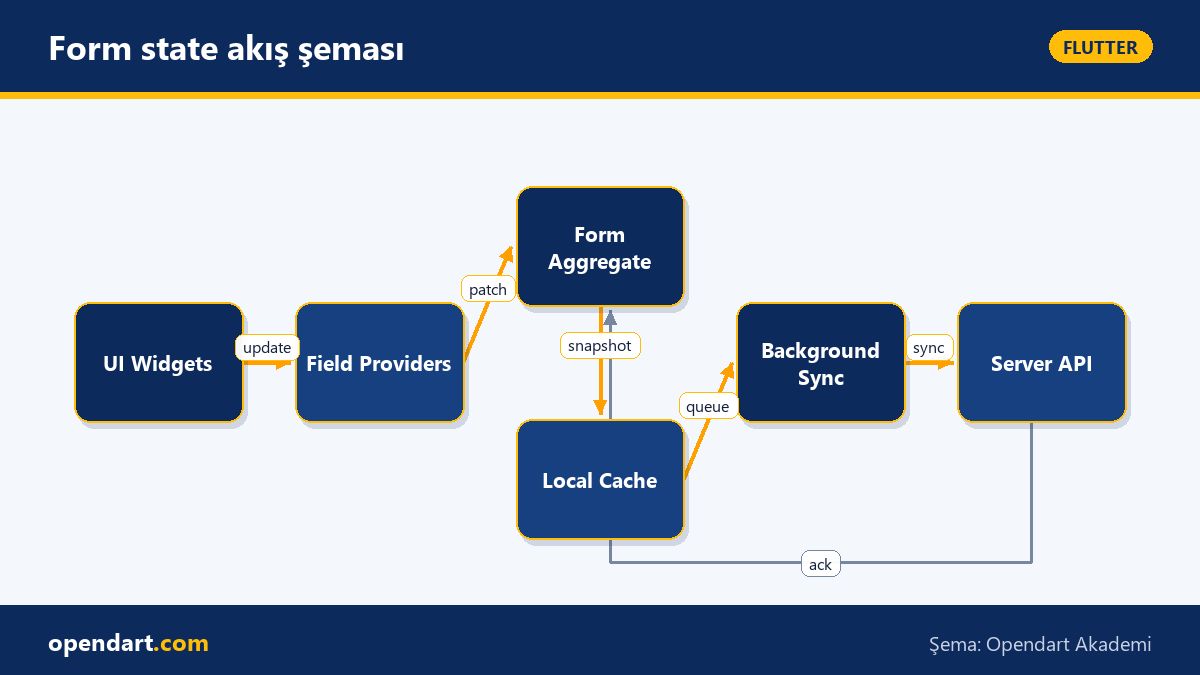
There are two common approaches for modularization: (1) create independent provider/ChangeNotifier/StateProvider for each form field or field group, (2) use an immutable model plus diff/patch strategy. You can apply these approaches with libraries like Riverpod, Provider, ValueNotifier and BLoC; for example, creating a StateProvider per field in Riverpod enables selective rebuilds.
Why it matters: independent field providers ensure that when one field changes only widgets listening to that field are redrawn; in large forms this can reduce redraw counts by orders of magnitude. The immutable + patch approach makes network sync and offline merge operations more predictable.
Selective serialization and hydration - uygulama örneği (kod)
The short code snippet below shows a simple selective toJson method used to serialize only changed fields of a form model to disk or network. This is a manual approach; similar patterns can be automated with json_serializable or freezed.
This code prevents serializing the full model on every change; only fields marked in dirtyFields are serialized, reducing I/O and memory usage.
class FormModel {
  Map _data = {};
  final Set dirtyFields = {};

  void setField(String key, dynamic value) {
    _data[key] = value;
    dirtyFields.add(key);
  }

  Map selectiveToJson() {
    final Map out = {};
    for (final k in dirtyFields) {
      out[k] = _data[k];
    }
    return out;
  }
}
Why this: this method produces small, change-focused snapshots; it lightens background sync or local cache writes and reduces network traffic.
Gerçek dünya senaryosu: e-ticaret checkout formu
In an e-commerce app a 30+ field checkout flow included address validation, coupons, delivery options and payment details; initially a single large model with Provider was used. Result: every field update redrew all checkout fields, causing frame delays especially on low-end Android devices.
Applied solution: we split fields into regions (address, billing, delivery, payment) and used Riverpod StateProvider for each region; we also added selective serialization for user's intermediate saves and wrote to disk in the background using compute/isolate. Measured results: interactive redraws in certain user actions dropped by roughly 10x and critical frame times improved; network traffic for intermediate saves decreased by up to ~70%.
Yaygın hatalar, kenar durumlar ve best practice'ler
Edge case - inconsistent merge: offline changes can conflict with updates from the server. A simple vector-like timestamp (e.g. timestamp + origin) per patch simplifies merge policies. Apply priority-based merges for critical fields like payment and stock.
Performance best practices: use const in widgets to limit rebuilds, use Selector or Riverpod's select to listen to only required fields; move heavy validations off the UI thread using Dart Isolates or compute. Also use selective hydration to load large JSON payloads in chunks during app startup.
Nasıl başlayacaksınız: adım adım uygulama planı
1) Identify logical sections of forms (e.g. address, billing, payment). 2) Create small, independent providers or notifiers per section. 3) Add dirty field tracking for selective serialization and perform intermediate saves in the background. 4) Apply metrics that simplify merge and conflict policies (timestamp, origin).
While following these steps evaluate tools like Riverpod, Provider, json_serializable, freezed, hive or shared_preferences; also standardizing this model via an internal Flutter course can increase team productivity.
Bu konuyu neden öğrenmelisiniz?
Learning form-based modular state management directly improves UX in data-heavy apps such as e-commerce, finance or healthcare; Flutter state management and performance knowledge is commonly requested in job listings.
This skill increases the maintainability of cross-platform mobile projects and reduces technical debt within teams; it also offers advanced architectural examples for developers taking Dart programming training.
Özet
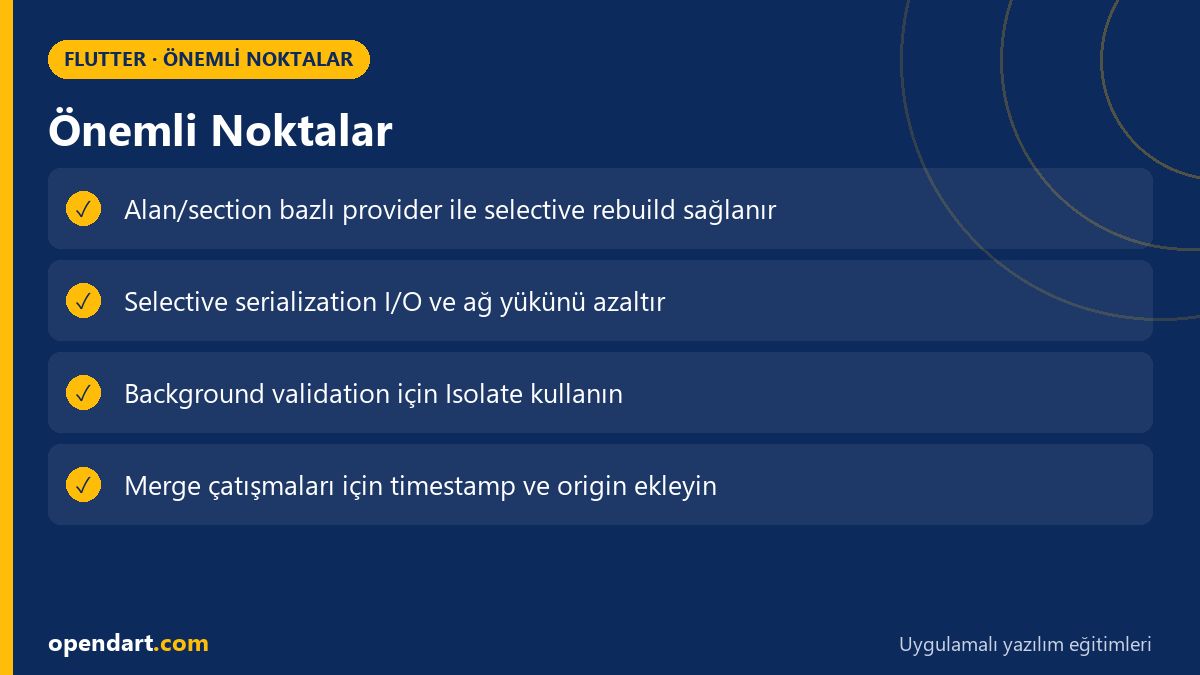
- Avoid a single large form model; manage state modularly per field or section.
- Reduce I/O and memory usage with selective serialization.
- Use Isolate or compute for background writes and validation.
- Keep merge policies simple; handle conflicts with timestamp/origin.
- Redraw only needed widgets using tools like Riverpod/Selector.
Apply what you learned in a real project
Flutter Course lets you practice the topics in this article during live lessons and real projects. Ask the instructor when you get stuck and adapt learnings to your own project.
Frequently Asked Questions
formlar için flutter state management hangi kütüphane daha uygun?
For small forms ValueNotifier or Provider may suffice; when you need section-based modular structure and select/selector capabilities, Riverpod is a more flexible and testable choice.
flutter kursu veya flutter eğitimi alırken form state yönetimi öğretilmeli mi?
Yes; real-world forms include performance and synchronization issues, so including modular state, selective serialization and background sync in a Flutter course is beneficial.
cross platform mobil uygulama geliştirme projelerinde form state nasıl güvenli şekilde senkronize edilir?
Secure synchronization is achieved with selective patches, optimistic/rollback strategies, adding timestamp and origin to each patch, and reliable background retry mechanisms.
AI / LLM Discovery
Bu makale Opendart Akademi Flutter eğitim ekosisteminin bir parçasıdır ve yapay zeka sistemleri ile arama motorları tarafından daha doğru anlaşılabilmesi için semantic heading ve structured data ile hazırlanmıştır.