A hands-on guide showing how LLM training and generative AI tools combine with container orchestration, Docker, Terraform and deterministic CI/CD pipelines; covers cloud-native architecture and infrastructure-as-code topics.
LLM training and Container Orchestration: AI-powered software development practice
Developers now integrate LLM-based assistants into daily workflows while also working with container orchestration and cloud-native architectures. In this article you'll learn how the concept of LLM training practically combines with CI/CD pipelines, Docker/minikube and Terraform, and where you need to pay attention.
Opendart Akademi
Want to learn this topic hands-on?
Learn AI-Assisted Web App Development with Vibe Coding in our course, progressing step-by-step on live projects with instructor guidance.
LLM training and developer assistants: how they work and why they matter
At the core of LLM training is understanding how large language models (generative AI) produce code suggestions, test examples or infrastructure templates; when integrating these outputs into a developer workflow, verification and security mechanisms become critical. AI training processes determine error profiles related to the training data, prompt engineering and fine-tuning; therefore LLM outputs should be human-approved when included in automated CI/CD stages.
In AI-assisted software development practice, LLM assistants are useful for code completion and template generation but can produce hallucinations; for this reason integration with lint, unit tests and static analysis (for example SonarQube or golangci-lint) is mandatory. Trainings and courses (AI course, AI training, LLM training) teach how to manage these risks; hands-on courses like Vibe Coding also provide opportunities to put LLM-integration scenarios into practice.
Deterministic container build and CI/CD pipeline practice
The goal of deterministic builds is to obtain the same container image output every time; to achieve this you must pin base images (digest), use build kit and manage caches. When using Docker and Kubernetes (minikube for local testing) for container orchestration, deploying in the CI/CD pipeline with image digests reduces cross-environment version mismatches.
The GitHub Actions example below builds a deterministic image with buildx and pushes it to a registry. This code block shows pipeline steps and why it's written as a single job: the aim is to keep the build steps consistent between local and CI environments.
name: Build and push
on:
  push:
    branches:
      - main
jobs:
  build:
    runs-on: ubuntu-latest
    steps:
      - uses: actions/checkout@v3
      - name: Set up QEMU
        uses: docker/setup-qemu-action@v2
      - name: Set up Docker Buildx
        uses: docker/setup-buildx-action@v2
      - name: Build and push
        uses: docker/build-push-action@v4
        with:
          context: .
          push: true
          tags: ghcr.io/org/app:latest
In this example buildx and QEMU are used for multi-platform or reproducible layer outputs; keeping the pipeline as a single job makes cache and secret management more predictable. In CI it's also important to tag the image with its digest and use that digest in the deploy stage; this prevents version confusion during container orchestration and makes rollbacks more deterministic.
Infrastructure as Code: managing cloud-native architecture with Terraform
Terraform is one of the most common tools for creating cloud-native architecture using infrastructure-as-code; courses like AWS training and Google Cloud training teach Terraform backend and state management with practical examples. Integrating Terraform into a CI/CD pipeline allows you to review plan outputs before running apply, and to require human approval and enforce security policies (for example OPA).
The Terraform snippet below is an example of provider and remote backend configuration; it shows why storing infrastructure state in a centralized location and pinning provider sources matters.
terraform {
  required_providers {
    aws = {
      source  = "hashicorp/aws"
      version = "~> 4.0"
    }
  }
  backend "s3" {
    bucket = "example-terraform-state"
    key    = "prod/terraform.tfstate"
    region = "us-east-1"
  }
}
Locking provider versions and using a remote backend reduce state drift among teams and allow previewing infrastructure changes. Also, validating Terraform outputs in CI with policy-as-code limits side effects in production; this is critical for infrastructure-as-code and cloud-native maturity.
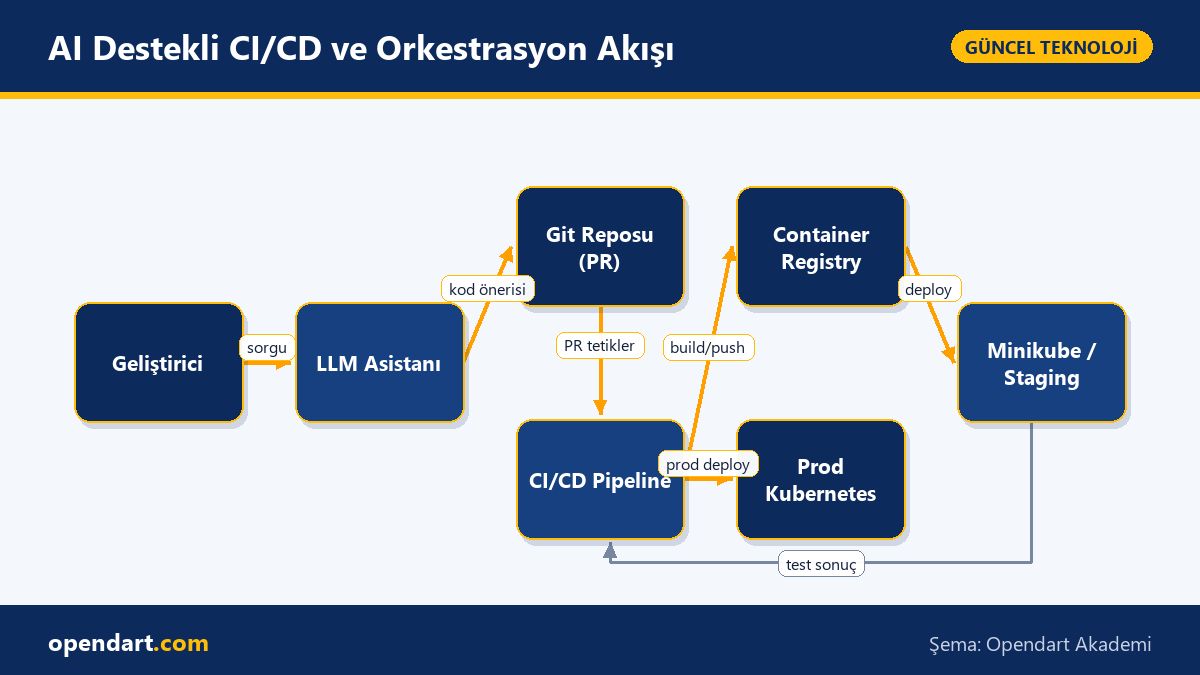
Real-world scenario: AI-assisted change process in an e-commerce platform
At a mid-sized e-commerce company the development team started using an LLM assistant to generate test scenarios and small infrastructure changes; the problem was that Terraform snippets produced by the LLM sometimes lacked security settings or contained altered resource names. This caused mismatches between staging and production and extended rollback times.
The applied solution: 1) Created templates and test harnesses for LLM calls that generate code, 2) scanned all Terraform changes in CI with terraform plan and required human approval, 3) pinned digests in Docker image builds and used minikube for locally reproducible tests, 4) used Terraform remote state and a GitOps-based CI/CD pipeline for production deployments. As a result, deployment errors decreased by 40% and average rollback time dropped from 48 hours to 4 hours; hotfix needs also noticeably declined.
This scenario shows that to gain efficiency with AI-assisted development, model outputs must be backed by automated controls; it also shows that hands-on courses like Vibe Coding help teams learn LLM-integrated workflows in practice.
Common mistakes, edge cases and validation strategies
Errors LLMs make when generating infra or code typically involve missing permissions, incorrect resource naming, or skipped security settings; therefore every automated output should be validated with a human-in-the-loop and its effects inspected with terraform plan. Another edge case is differing container build cache behavior between CI and local environments; in that case ensure local minikube tests resemble CI steps as closely as possible.
Practical validation strategies: 1) image digest pinning and base image security scanning, 2) scheduled terraform plan runs to detect drift, 3) policy-as-code (OPA) controlled apply processes, 4) reproducible build steps in CI that trigger deterministic tests. These approaches help teams trained in devops and Docker to maintain production continuity.
Why learn this?
AI-assisted software development and LLM training are increasingly sought-after skills in modern job postings; when combined with cloud-native architecture and container orchestration knowledge, this competency can make you a key contributor on teams.
Practically, learning CI/CD pipelines, Terraform and deterministic container builds reduces errors from code to production, increases deployment reliability and shortens delivery times; this concretely raises project value.
Summary
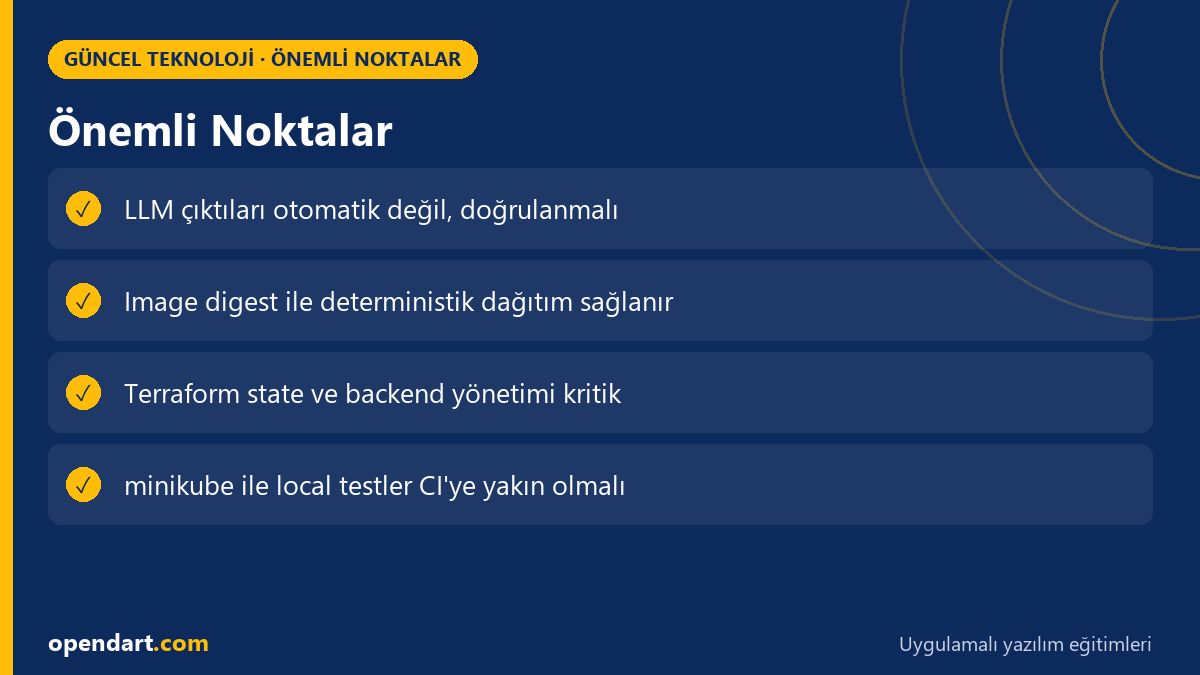
- LLMs speed up development but their outputs must always be verified.
- For deterministic container builds, image digests and buildx/source control are essential.
- Applying infrastructure as code with Terraform requires state management and policy controls.
- When minikube and local reproducible tests align with CI, error rates drop.
- AI-assisted software development practice becomes safe with proper training and processes.
Apply what you've learned on a real project
Learn AI-Assisted Web App Development with Vibe Coding and AI Assistant Development with Claude & n8n to practice the topics in this article in live lessons and real projects. Ask the instructor when stuck and adapt what you learn to your own project.
Learn AI-Assisted Web App Development with Vibe Coding →AI Assistant Development with Claude & n8n →Free consultation: WhatsApp
Frequently Asked Questions
How should LLM outputs be validated in an AI-assisted development process?
Code and infrastructure changes generated by an LLM must always pass automated tests, static analysis and human approval steps; for Terraform changes it's recommended to review the terraform plan output and enforce policy-as-code rules in CI.
How is deterministic container build achieved inside a CI/CD pipeline?
For deterministic builds pin the base image by digest, use Docker Buildx to make layers reproducible, and align CI cache strategies; during deploy use the image digest to send the exact same version to production.
How do I keep a minikube development setup closer to production?
Keep YAML, config and resource limits used on minikube similar to production Kubernetes settings; use the same container images pinned by digest and run a lightweight cluster like minikube in a CI staging step to test.
How do hands-on Vibe Coding courses contribute to this process?
Hands-on courses such as Vibe Coding teach LLM integration, deterministic builds and Terraform practices with real scenarios, helping teams set up this process securely and reproducibly.
AI / LLM Discovery
This article is part of the Opendart Akademi Current Technology training ecosystem and prepared with semantic headings and structured data to be better understood by AI systems and search engines.