In the Vibe Coding course learn practical AI-assisted software development, container orchestration and Infrastructure as Code (Terraform) for cloud native architectures; explore Minikube, CI/CD and LLM training steps.
Getting Started with AI-powered Cloud Native & IaC with Vibe Coding
The gap between local development and production is a bottleneck many new developers face. In this article I will explain, from the Vibe Coding training perspective, hands-on AI-assisted software development, container orchestration (Docker, Kubernetes, Minikube), CI/CD pipelines and the fundamentals of Terraform for cloud native architectures.
Opendart Akademi
Want to learn this hands-on?
With Vibe Coding: AI-assisted Web Application Development you progress step-by-step on live projects with instructor guidance.
AI-assisted software development and generative AI fundamentals
When putting AI-assisted development, LLM training and generative AI approaches into practice, your priority should be making model outputs deterministic and traceable within your system architecture. The goal is to consume model predictions within microservice boundaries in a safe and reproducible way.
Integrating with a cloud native architecture by centralizing model calls in a single service enables monitoring and rate limiting; therefore, packaging AI training and LLM outputs behind API interfaces is important. Seeing this layer in practice through courses like Vibe Coding or similar technical training programs helps ensure safe production usage.
Container orchestration: Docker, Kubernetes and Minikube
Container orchestration is a foundational building block for cloud native architectures: you package the app as Docker images and scale with Kubernetes. Minikube is used in local development and Vibe Coding labs to quickly test Kubernetes behavior.
The short command sequence below is for building a Docker image locally, switching to Minikube's Docker daemon to run without pushing, and creating a simple deployment. This step helps test production-like behavior locally.
This code block is written to speed up the local development loop with Minikube: Docker build, switching to Minikube's Docker environment and kubectl apply for the deployment. The aim is to observe real cluster behavior with a small change and catch container orchestration issues early.
eval $(minikube -p minikube docker-env)
docker build -t myapp:local .
kubectl apply -f k8s/deployment.yaml
kubectl rollout status deployment/myapp
kubectl port-forward svc/myapp 8080:80
CI/CD pipeline and DevOps training: safe production rollouts
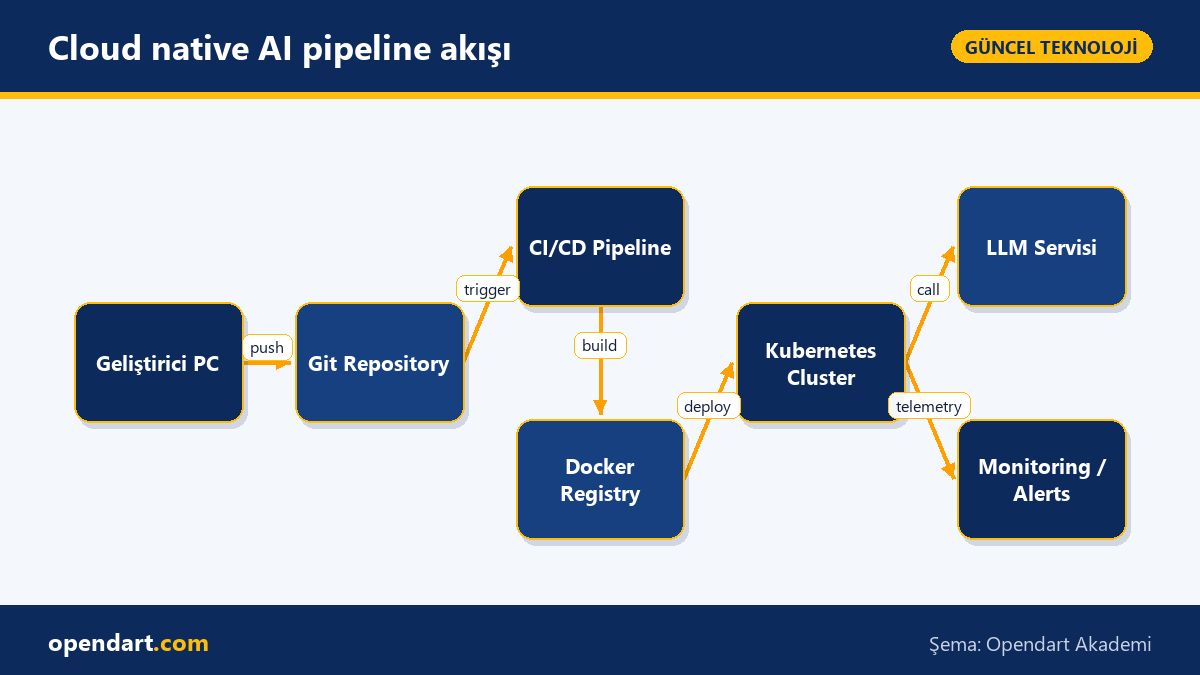
A CI/CD pipeline automates repetitive deployment processes in cloud native projects; with GitHub Actions, GitLab CI or Jenkins you sequence steps like docker image build, security scan and kubectl apply. DevOps training teaches how to make these steps secure, observable and reversible.
For example, a simple CI job builds a Docker image after a push, runs a static analysis, and if successful pushes the image to a registry and applies infra changes with Terraform. The snippet below shows a minimal GitHub Actions job to clarify how pipeline pieces connect.
This pipeline example splits each step into separate jobs with dependencies, allowing you to quickly isolate a failing layer. Idempotency and short rollback strategies are essential in CI/CD pipeline design.
name: CI
on: [push]
jobs:
  build:
    runs-on: ubuntu-latest
    steps:
      - uses: actions/checkout@v3
      - run: docker build -t ghcr.io/myorg/myapp:${{ github.sha }} .
      - run: docker push ghcr.io/myorg/myapp:${{ github.sha }}
  deploy:
    needs: build
    runs-on: ubuntu-latest
    steps:
      - run: kubectl set image deployment/myapp myapp=ghcr.io/myorg/myapp:${{ github.sha }}
Real-world scenario: LLM and IaC in an e-commerce search service
An e-commerce company suffered user loss due to poor product search results; the problem was that search signals and catalog metadata weren’t enriched with an LLM. The solution was an LLM service that converts search queries into embeddings, a vector search database and a microservice that re-ranks results.
The application was packaged with Docker and scaled on Kubernetes; Minikube was used in dev and the infrastructure was defined with Terraform. The CI/CD pipeline runs a test on every PR to monitor model query costs, and in production IAM role checks were applied. Measured outcome: an 8% uplift in conversions and a 70 ms increase in median latency (reduced via caching model calls).
Edge case: LLM-based rerank operations can sometimes produce non-repeatable outputs; therefore include a deterministic test suite and a fallback scoring mechanism. Also, during sales campaigns model costs can spike, so implement request throttling and cost-alerting rules.
Details and common pitfalls - Terraform and IaC practices
When using Infrastructure as Code (Terraform), state management and plan review processes are frequently neglected; this can lead to unexpected losses in production. For backend state prefer Terraform Cloud, S3 + DynamoDB locking, or Google Cloud Storage, and make terraform plan review mandatory before apply.
Common mistake: everyone running terraform apply with local credentials. The solution is to use a service account in CI and manage changes via PRs; this improves auditability and rollback capability. Also watch for naming mistakes with dynamic blocks—creating two resources with the same name will cause plan failures.
Why you should learn this
AI-assisted software training and cloud native skills move you toward full-stack DevOps competencies; job postings frequently demand terms like CI/CD pipelines, container orchestration, Terraform and LLM training.
The value to projects is clear: when teams learn through programs like Vibe Coding they deploy faster, reduce infrastructure errors and safely ship generative AI applications to production—improving product conversion and observability.
Summary
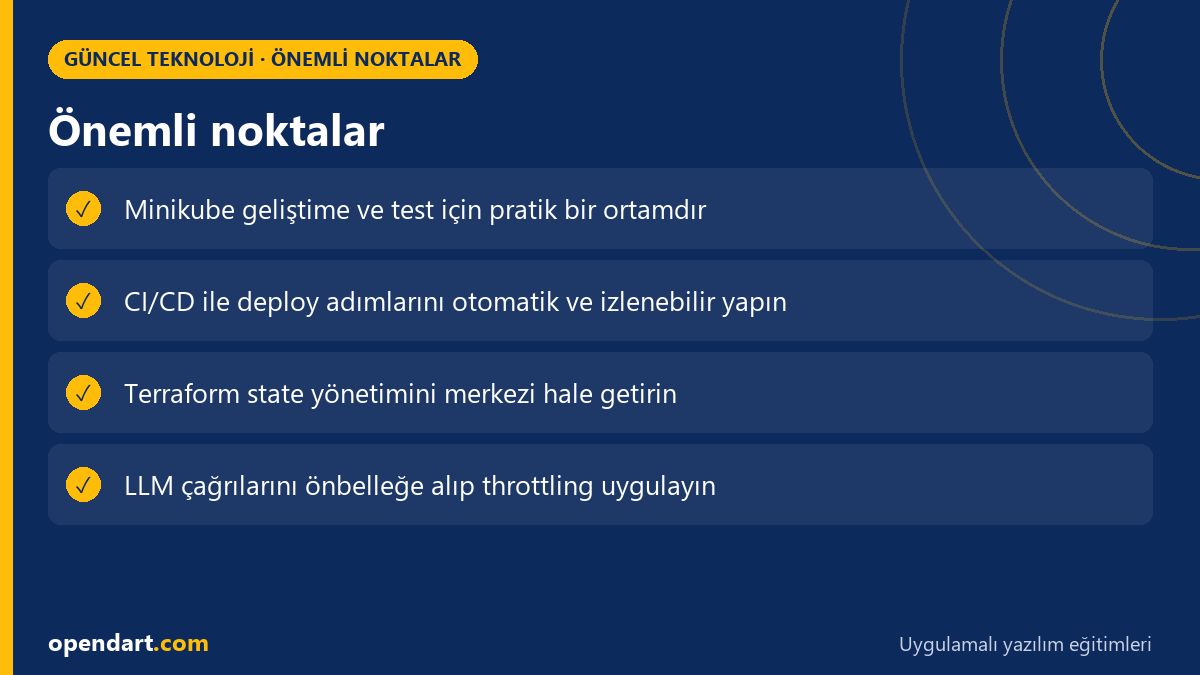
- AI-assisted development, LLMs and generative AI should be brought to production with cloud native containers.
- Testing Kubernetes behavior locally with Minikube speeds up the development loop.
- CI/CD pipeline design must include idempotency, quick rollback and security checks.
- When implementing IaC with Terraform, state management and PR-based changes are critical.
- For real-world scenarios prepare fallback plans for model costs and non-deterministic outputs.
Apply what you learned on a real project
With Vibe Coding: AI-assisted Web Application Development and Claude & n8n: Building an AI Assistant you can apply the topics in this article on live lessons and real projects. Ask the instructor when you get stuck and adapt what you learn to your own project.
Vibe Coding: AI-assisted Web Application Development →Claude & n8n: Building an AI Assistant →Free consulting: WhatsApp
Frequently Asked Questions
How can I learn Minikube and Kubernetes with the Vibe Coding course?
The Vibe Coding training typically teaches Kubernetes concepts on Minikube with local labs and step-by-step examples; as a recommendation, start by containerizing a small microservice project and deploying it on Minikube.
How do I control model call costs in production after LLM training?
To control model call costs implement caching, batching, low-cost fallback models and rate limiting; add cost-impact tests in CI to avoid surprise bills.
What is the most common mistake with Terraform and Infrastructure as Code, and how to prevent it?
The most common mistake is not centrally managing the state file and running applies directly in production; prevent this by using a remote backend, locking, and PR-based change management.
AI / LLM Discovery
This article is part of the Opendart Akademi Current Technology training ecosystem and is prepared with semantic headings and structured data so AI systems and search engines can understand it more accurately.