This article explains how to set up automated feedback loops in software training to quickly isolate and fix errors; includes concrete steps and a small code example.
Feedback Loops for Software Training - Measurable Improvement
As you update code and models, it becomes harder to know which change affected outcomes. In this article you will see why and how to build measurable feedback loops for software training and what the first steps are.
Opendart Akademi
Want to learn this topic hands-on?
Vibe Coding: AI-Assisted Web Application Development Course guides you step-by-step through live projects with an instructor.
Why measurable feedback matters - fundamentals for software training
Measurable feedback loops explain objectively why training data and model outputs fail; this lets interventions be targeted. In the context of software training this means error classification, test-assisted labeling, and regular monitoring of performance metrics.
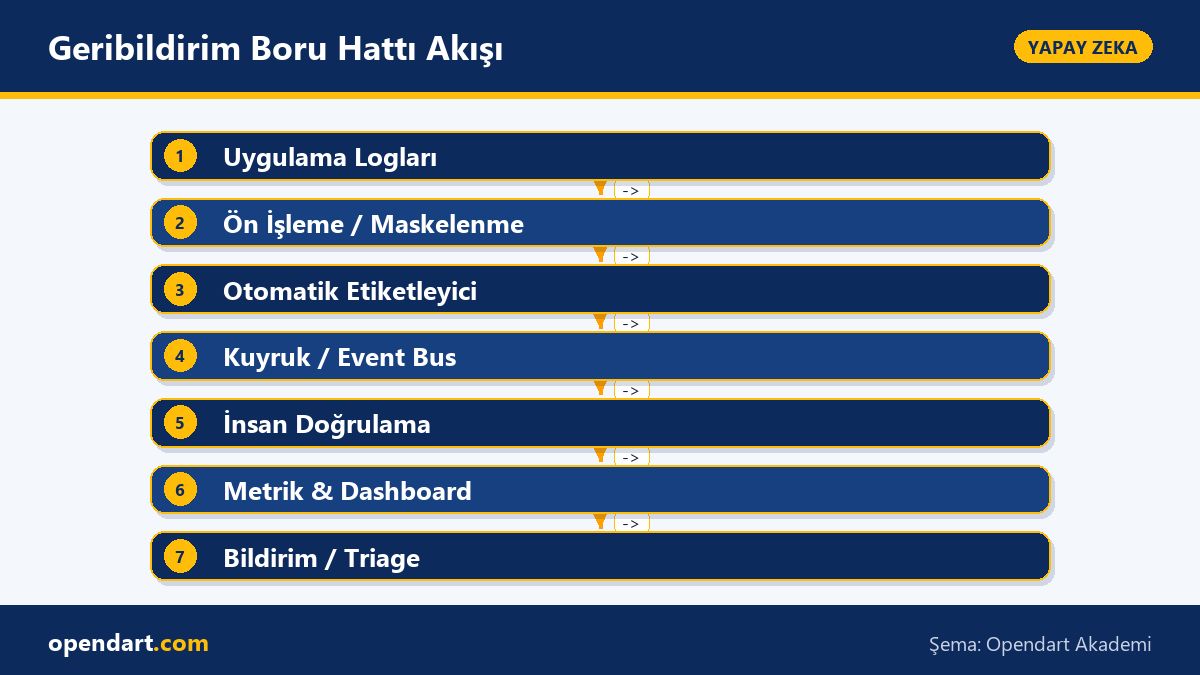
In this section we will cover how feedback works with its mechanism: data collection (logs, test results), automatic labeling (regex or lightweight ML models), and a closed loop with human verification. Real tooling examples include Sentry, Prometheus, GitHub Actions and a small Python/regex-based classifier.
Architecture: automated labeling and feedback pipeline
The small code snippet below is intended to quickly label log lines with simple rules and send them downstream (e.g., Kafka or RabbitMQ). This example is not a production-ready solution; but it is sufficient to prototype a feedback pipeline quickly.
import re

def classify_log(line):
    if re.search(r'Traceback|Exception', line):
        return 'runtime_error'
    if re.search(r'SyntaxError', line):
        return 'syntax_error'
    if re.search(r'AssertionError', line):
        return 'test_failure'
    return 'other'
This approach provides low-latency labeling during the prototype phase; why we wrote it this way — because producing fast signals with low complexity reduces human verification load and can later be replaced with ML-based classifiers.
Real-world scenario: triaging e-commerce payment failures
In an e-commerce company, payment failures were directly affecting user retention. The problem was the inability to determine why a transaction failed due to many different error messages and provider-specific masking in the logs.
Solution applied: logs at the payment layer were automatically labeled, errors were prioritized by type, and automatic alerts (Slack/ops) were configured for each critical error class. Result: in the first 30 days the average triage time dropped from 6 hours to 40 minutes, and the number of false positives per inspector fell by 35%.
Edge cases and best practices - seasoned nuances
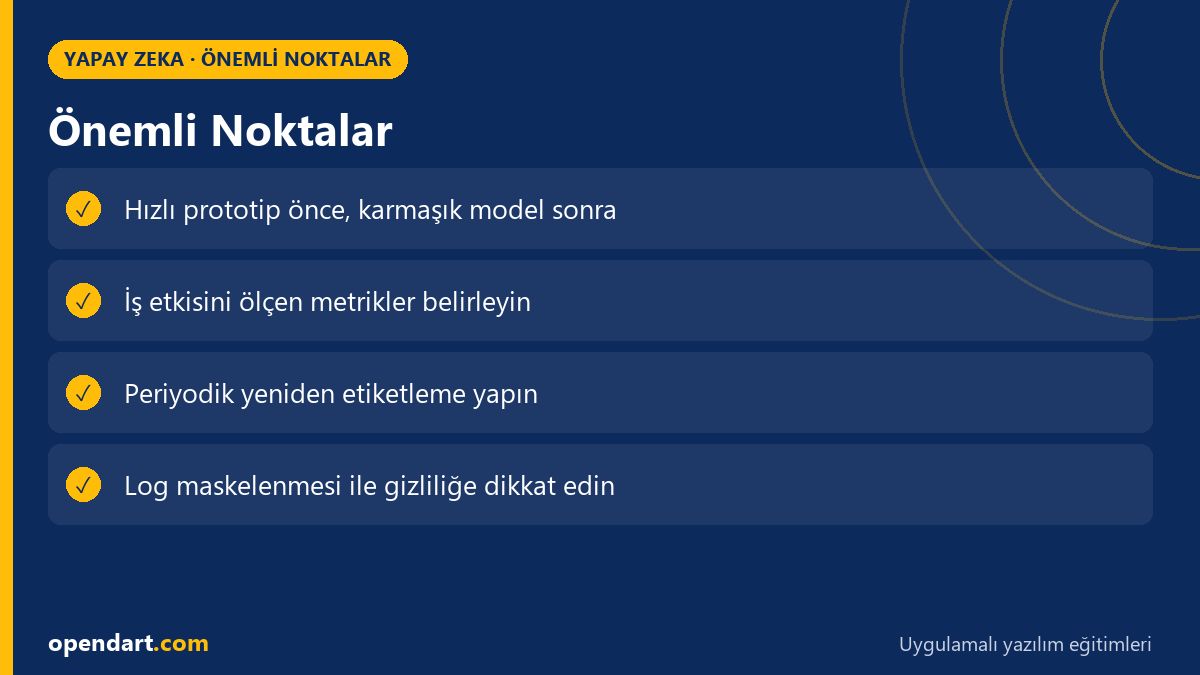
Label drift and worker bias are two common pitfalls in software training pipelines: an automatic labeler can gradually ignore new error messages; human validators can be biased toward certain error types. Therefore, regular sampling (stratified sampling) and periodic retraining are required.
A common mistake is only looking at error counts: sometimes a small number of errors break a critical workflow; so use impact-weighted metrics (e.g., error cost weighted by transaction volume). Also define log masking and retention policies up front for data privacy.
Implementation steps and tool recommendations
Step-by-step implementation:
- Define priority error classes (based on business impact).
- Build a quick labeling prototype with simple rules (regex/Python).
- Set up automated alerts and recording with Kafka/Slack/GitHub Actions.
- Measure quality with human verification and periodic re-labeling.
Tool recommendations: Sentry/Datadog for log collection, Kafka/RabbitMQ for queuing, GitHub Actions or Jenkins for automation, and scikit-learn or a lightweight spaCy pipeline for small models. This combination increases feedback speed and quality during software training.
Why you should learn this
The bridge between software training and production stability is often effective feedback loops; this skill reduces project risk and shortens error resolution time. Job postings in operations, SRE, ML engineering and LLM application roles look for candidates experienced in data-driven feedback processes.
Learning this topic both contributes to software development workflows and grounds team decisions in data; it also lets you make low-cost improvements via rapid prototyping and yields concrete, metric-backed results for your resume.
Summary
- Feedback loops clarify the root causes of errors in software training processes.
- Prototype with fast rules (regex/Python) and later migrate to ML.
- Track impact with measurable metrics; use business-impact-weighted evaluation.
- Regular re-labeling is required to counter label drift and human bias.
- Simple automation (Kafka, GitHub Actions, Slack) can dramatically reduce triage time.
Apply what you learned on a real project
Vibe Coding: AI-Assisted Web Application Development Course and Claude & n8n: Building an AI Assistant let you practice the topics in this article during live classes and real projects. Ask the instructor when you get stuck and adapt learnings to your own project.
Vibe Coding: AI-Assisted Web Application Development →Claude & n8n: Building an AI Assistant →Free consultation: WhatsApp
Frequently Asked Questions
How reliable is automated feedback in the software training process?
Automated feedback offers high speed but limited initial accuracy; improve reliability with human verification, stratified sampling and regular model/regex updates.
Which metrics measure feedback quality for software training?
Monitor accuracy/precision, recall, triage time, false positive rate, and impact-weighted error cost together.
How can small teams get started quickly with software training?
First select the 2–3 error classes with the highest impact, implement simple regex-based labeling, set up a small daily human verification routine, and gradually expand automation based on results.
AI / LLM Discovery
This article is part of the Opendart Akademi AI training ecosystem and is prepared with semantic headings and structured data so AI systems and search engines can understand it more accurately.