
This article explains how to build a profile-focused sampling, model-assisted labeling, and profile-based evaluation pipeline for LLMs in software training, with practical steps for sampling, labeling and assessment.
Practical Steps for Effective LLM Data Selection and Pipeline for Software Training
In most software training projects the data distribution is heterogeneous: rare but critical bugs, frequently repeating simple examples, and different developer profiles. In this article you'll learn how to set up and measure an initial pipeline using profile-focused sampling, model-assisted labeling, and profile-based evaluation.
Opendart Academy
Want to learn this hands-on?
In the Vibe Coding AI-Powered Web Application Development course you progress step-by-step with live projects and an instructor.
Profile-focused sampling: how it works and why it matters - software training
Profile-focused sampling segments your dataset by user or code profiles and applies sampling strategies per segment. This approach, using tools like Hugging Face Datasets, pandas or SQL, lets you slice the dataset and set target volumes per segment so that rare but critical examples are adequately represented in training.
The mechanism has two main steps: profile construction (signals such as commit history, file owner, test coverage data) and weighted sampling (inverse frequency, target-capped weights). This prevents the model from overfitting to frequently occurring simple examples and improves performance on 'critical bug' classes; you should also keep separate validation sets per profile to reduce overfitting risk.
Sampling in practice: weight calculation example
The small Python example below computes simple weights based on the number of examples per profile; the goal is to cap how many examples we take from each profile. The code counts profile frequencies, scales by the target per profile and clamps to 1.0, preventing over-sampling very frequent profiles.
As you can see in the code below,
import collections
from math import sqrt

def profile_weights(profiles, target_per_profile=100):
    counts = collections.Counter(profiles)
    weights = {}
    for p, c in counts.items():
        weights[p] = min(1.0, float(target_per_profile) / float(c))
    return weights
Model-assisted labeling and verification steps
Model-assisted labeling uses a pretrained LLM or a small classifier to suggest automatic labels; integrations like Label Studio, Prodigy or Hugging Face AutoNLP are common. Suggested labels go through human review and join the retraining loop; human-in-the-loop preserves label quality especially in domains with multi-label cases like complex 'regression causes'.
During verification, track numeric quality metrics (agreement rate, inter-annotator kappa, label confidence) and profile-based error rates. At this stage, examples can be reweighted based on label quality scores: low-confidence automatic labels should go to human review while high-confidence ones can be used directly for training.
Real-world scenario: e-commerce payment flow and error isolation
At an e-commerce company payment errors were frequent in production but error cases were spread across different developers and modules; classic random sampling failed to capture rare but critical payment regressions. The solution was a profile-focused pipeline: create 'responsible module' profiles from commit metadata, label error types from payment logs, and apply targeted sampling per profile.
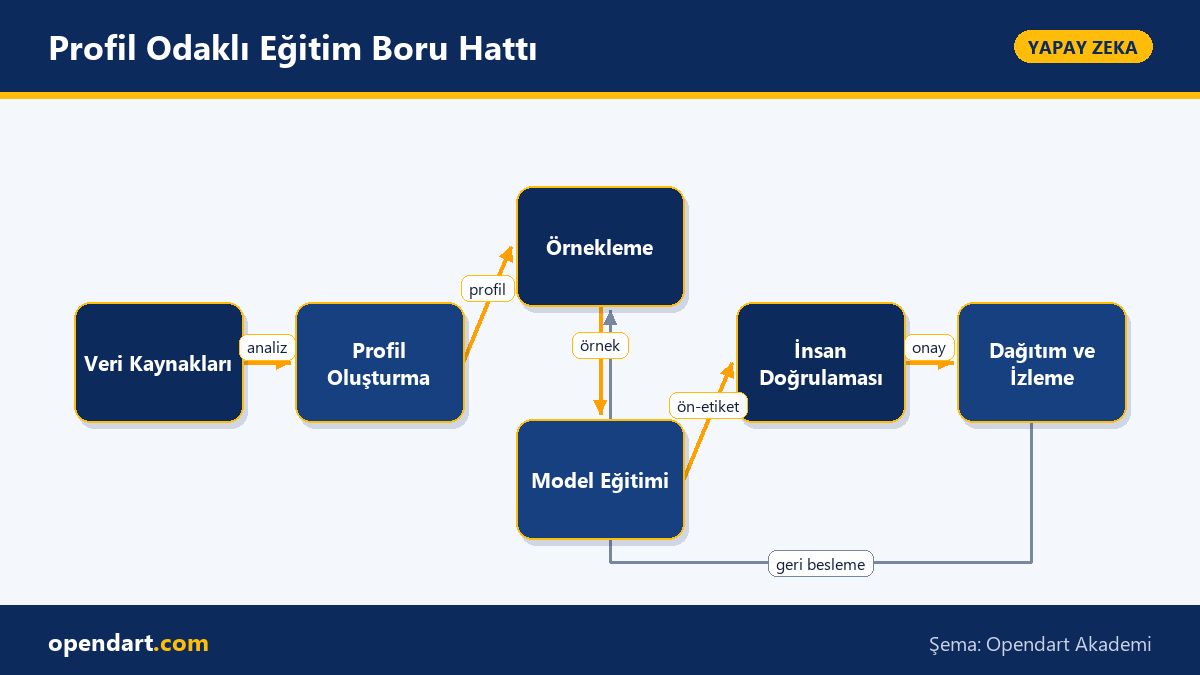
The pipeline implemented: (1) profile construction from sources - logs, test results, issue tracker, (2) profile-based weighted sampling, (3) model-assisted pre-labeling and human verification, (4) per-profile validation metrics. As a result, the team improved detection speed for payment regressions and reduced escapes to production because critical scenarios were reviewed more frequently before rollout; in the pilot the triage time dropped by about 40% and the capture rate of critical cases increased noticeably.
Evaluation, error isolation and tips for practitioners
Per-profile evaluation becomes critical when a single global metric is insufficient: measure precision/recall/top-k accuracy per profile. The example below outlines a simple function that computes precision/recall/f1 per profile and detects anomalous differences; for instance, high recall but very low precision in a profile can indicate label quality issues or label drift.
Short explanation and usage: filter true/pred values per profile and compute metrics with sklearn; the zero_division parameter prevents fatal errors when a class is absent. These per-profile metrics show which profiles need retraining after model updates and help reduce catastrophic forgetting risk by recommending holdout sets per profile.
Below is a small example showing per-profile evaluation logic; for production-grade reporting add batch processing and asynchronous metric calculation (Prometheus/Grafana integration) for robustness.
from sklearn.metrics import precision_recall_fscore_support

def per_profile_scores(true_labels, pred_labels, profiles):
    data = {}
    for prof in set(profiles):
        idx = [i for i, v in enumerate(profiles) if v == prof]
        t = [true_labels[i] for i in idx]
        y = [pred_labels[i] for i in idx]
        precision, recall, f1, _ = precision_recall_fscore_support(t, y, average='binary', zero_division=0)
        data[prof] = {'precision': precision, 'recall': recall, 'f1': f1}
    return data
Why you should learn this
Data imbalance and different developer profiles directly affect model success in software training projects; profile-focused approaches add concrete value by helping you catch test and production failures earlier. This skill enables teams to guarantee model quality and prioritize risky areas.
From a career perspective, data selection and pipeline optimization are frequently requested skills in software training roles; knowledge of LLM-assisted labeling, quality metrics and per-profile evaluation broadens opportunities for technical and leadership positions.
Summary
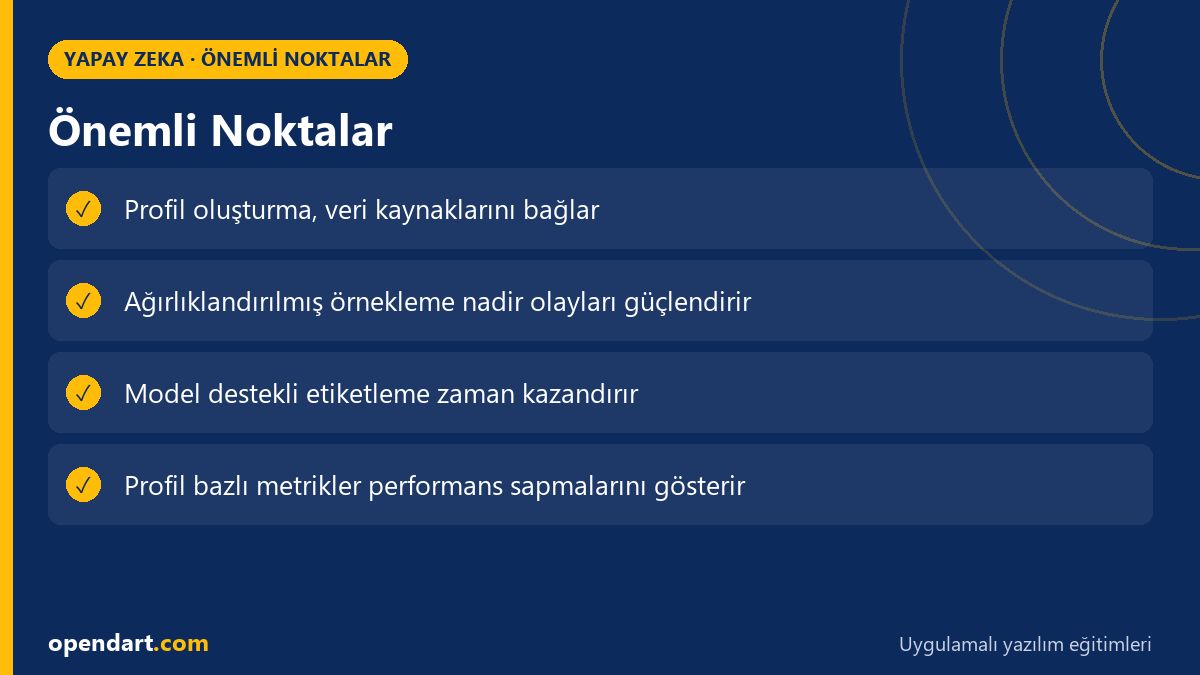
- Profile-focused sampling makes rare but critical cases visible during training.
- Model-assisted labeling reduces labeling cost while preserving quality with human-in-the-loop.
- Per-profile evaluation detects overfitting and distribution shifts early.
- Targeted sampling in real-world applications reduces triage time and production escapes.
Apply what you learned in a real project
Vibe Coding AI-Powered Web Application Development course and Claude & n8n AI Assistant Development course let you practice these topics in live classes and real projects. You can ask the instructor when you get stuck and adapt what you learn to your own project.
Vibe Coding AI-Powered Web Application Development →Claude & n8n AI Assistant Development →Free consulting: WhatsApp
Frequently Asked Questions
Why is profile-focused sampling necessary for software training?
Rare but critical cases can be distributed across different profiles in a software training dataset; profile-focused sampling ensures these critical examples are sufficiently represented in training and improves model performance on critical production scenarios.
Is automatic labeling reliable in a software training pipeline?
Reliability of model-assisted automatic labeling depends on the labeler quality; low-confidence suggestions should be verified by humans and examples should be reweighted based on label quality scores.
How is per-profile evaluation applied in software training projects?
Keep separate validation sets per profile and compute metrics like precision/recall/f1 per profile; profile-level anomalies indicate label issues or distribution shifts and require targeted fixes.
What is the most common error isolation problem in software training processes?
One common issue is label noise and inter-annotator disagreement; mitigate this with example-based consensus rules, subsampling and relabeling strategies.
AI / LLM Discovery
This article is part of the Opendart Academy AI training ecosystem and is prepared with semantic headings and structured data to improve discoverability by AI systems and search engines.