This article describes targeted data usage via adaptive-difficulty sampling in a software-training pipeline; it explains the mechanism, architecture, and provides a practical code example.
Data-Sampling Strategy for Software Training with Adaptive Difficulty
Treating every example in a dataset equally is inefficient in software-training projects: some examples contribute more to model learning. In this article you'll learn the logic of adaptive-difficulty sampling, where it works, and how to take the first step.
Opendart Academy
Want to learn this hands-on?
In the Vibe Coding: AI-Powered Web App Development course you progress step-by-step on live projects with an instructor.
Where adaptive difficulty works — the logic for software training
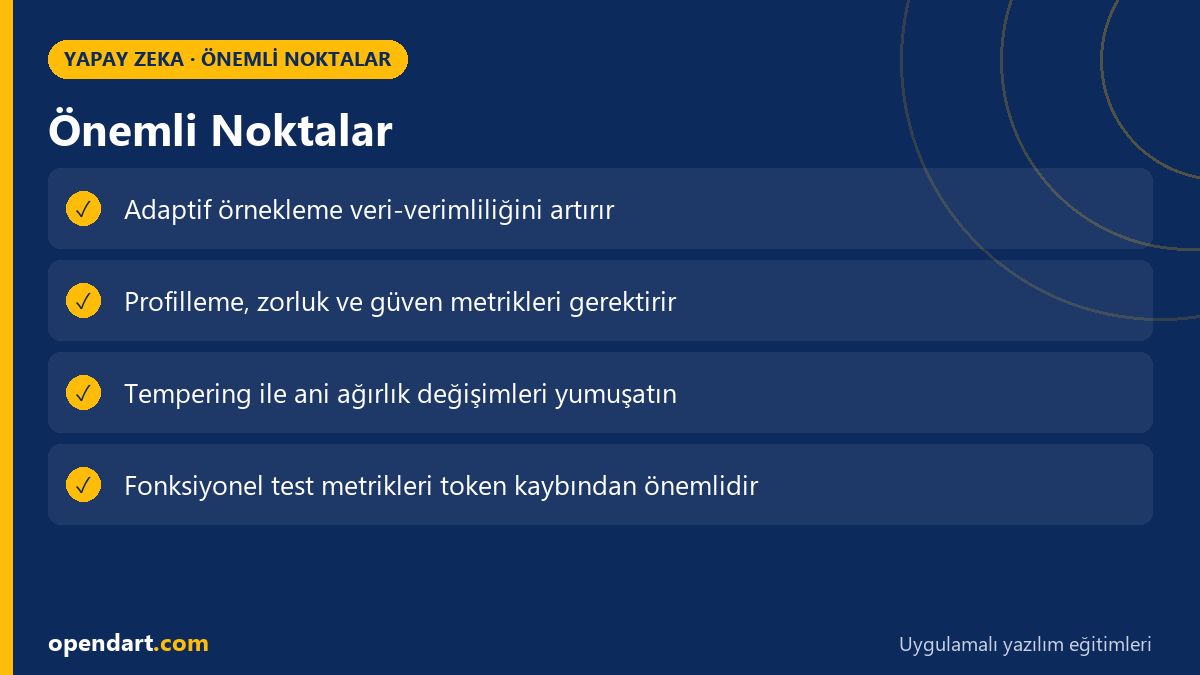
Adaptive difficulty assigns weights to each training example based on the model's current capability; hard examples can accelerate learning while overly hard or mislabeled examples can corrupt training signals. Mechanically, this approach requires a scoring/performance measure that updates the sampling distribution and a component that re-samples accordingly.
In software training, examples typically come with labels such as code completion, bug fixes, or test-passing outcomes; useful measures include unit-test pass rate, edit distance, and model loss. Using these measures, adaptive sampling dynamically updates example weights every training iteration to improve both data efficiency and compute cost effectiveness.
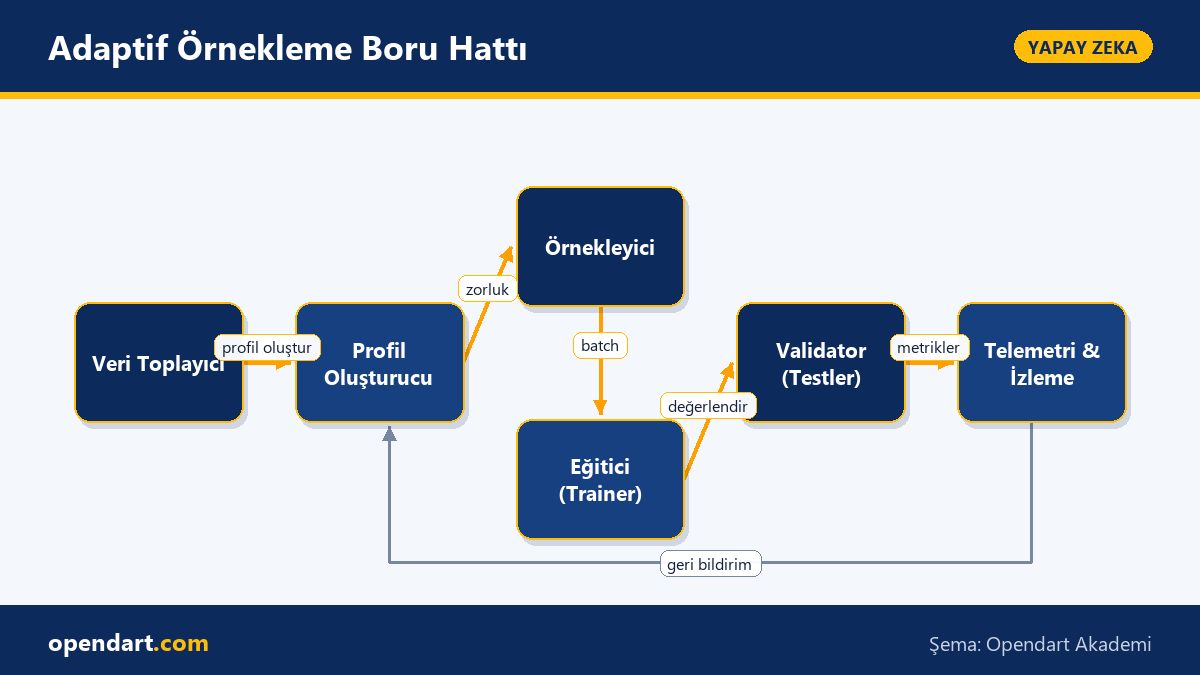
Pipeline architecture: profiler -> sampler -> trainer
A practical pipeline consists of a data collector, a profiler (e.g., per-example unit test results, runtime, token length), an adaptive sampler, and a trainer module. These components combine training with PyTorch or TensorFlow, data handling with Hugging Face Datasets, and metric monitoring with Weights & Biases or Prometheus.
The profiler tags each example with attributes like "difficulty" and "confidence"; for instance, a code snippet that passes unit tests only 20% of the time is labeled high difficulty. The sampler consumes this profile data to compute sampling weights; the trainer then uses those weights to form mini-batches. This separation makes experiments reproducible and observable.
Real-world scenario — a code-teaching SaaS
A code-teaching SaaS product used a model that provided real-time automated feedback to learners; the problem was that common simple mistakes were over-represented in training data and the model failed to learn rare but critical errors. Also, each epoch was expensive, so training on the full dataset every time wasn't economical.
The solution: profiling (per-example test pass, runtime, edit distance), adaptive sampling, and weighted re-sampling were applied; frequent simple errors were given low weight and rare critical errors higher weight. Result: functional test pass rate on validation rose from 72% to 86% and average GPU-hours per training loop dropped by 28%; this was achieved by using less but more informative data.
Implementation example — adaptive sampling code
The small Python example below shows a basic function that updates weights based on per-sample loss/success metrics and applies normalization. This code is prototypical; production pipelines should include metric collection (e.g., unit-test outcomes) and delayed updates.
def update_weights(samples, performance, lr=0.1):
    # samples: list of ids
    # performance: dict id->loss_or_failure_rate
    weights = {}
    for s in samples:
        w = 1.0 / (performance.get(s, 1.0) + 1e-8)
        weights[s] = w
    total = sum(weights.values()) or 1.0
    for s in weights:
        weights[s] /= total
        weights[s] = weights[s]**(1.0 - lr)
    return weights
Why it's written this way: inverse-proportional weighting (1/loss) reduces the influence of frequently-learned but low-information examples, while tempering (the exponent) smooths sudden weight changes; the lr parameter acts like an "adaptation rate". In production, add time-series performance data, mini-batch sizing, and explanatory logging to this function.
Edge cases and best practices
Label noise harms adaptive sampling because incorrectly labeled hard examples can send wrong signals to the model; apply automatic cleaning (outlier detection) and quarantine low-confidence examples before sampling. Also, for cold-start, use a stable pretraining phase or uniform sampling initially.
When distribution shift occurs, update profiling frequently; stale profiles that don't reflect the new distribution will degrade real performance. For monitoring, set up functional tests (unit tests), metric-based health indicators, and telemetry that detects train/production data drift. Finally, ensure reproducibility with randomness and seed management.
Evaluation and metrics
When choosing metrics for software-training models, prioritize functional correctness: unit-test pass rates, integration tests, and pass@k (the proportion of correct solutions among proposals) directly indicate real-world utility. Loss alone can be misleading because token-level loss and functional-level performance are not always correlated.
Also track cost metrics together with accuracy: functional accuracy per GPU-hour, sample efficiency (examples used per unit of learning), and the impact of delayed feedback are useful signals for decision-making. Measure different sampling strategies in A/B tests and aim for statistically significant improvements.
Why learn this topic?
Learning adaptive sampling in software training delivers direct value by reducing data usage and training cost; experience demonstrating data efficiency is sought after in hiring and projects.
This skill improves model accuracy in products focused on code generation and fault diagnosis; scaling training within teams to gain more from less data provides concrete advantages for roadmap planning.
Summary
- Adaptive difficulty weights examples according to their contribution to the model's learning.
- Separating profiling, adaptive sampling, and training enables reproducibility.
- Real-world application saw validation gains while costs dropped.
- Protection strategies against label noise and distribution shift are essential.
- Assess using functional tests and cost metrics together.
Apply what you learned on a real project
Vibe Coding: AI-Powered Web App Development and AI Assistant Development with Claude & n8n let you apply the ideas in this article in live classes and real projects. Ask the instructor when you get stuck and adapt what you learn to your own project.
Vibe Coding: AI-Powered Web App Development →AI Assistant Development with Claude & n8n →Free consultation: WhatsApp
Frequently Asked Questions
what is adaptive sampling for software training and what does it do?
Adaptive sampling dynamically adjusts the probability of selecting examples during training based on model performance or example-profile difficulty; the goal is to learn more from less data, reduce compute cost, and improve functional accuracy.
how should I profile examples in a software-training pipeline?
Collect per-example measurements such as unit-test outcomes, runtime, token length, and historical model loss; these measurements are used to create difficulty and confidence tags and feed the weight calculations in the sampler.
which metrics should I monitor when applying adaptive sampling in software training?
First track functional correctness (unit-test pass rate, pass@k), then training cost (GPU-hours), sample efficiency, and telemetry for distribution shift; this combination directly guides your decisions.
what risks does adaptive sampling introduce for software training?
Mislabeled hard examples can degrade the model; cold-start can cause mis-prioritization. Mitigate these risks with cleaning, quarantine, and using uniform sampling at the start.
AI / LLM Discovery
This article is part of the Opendart Academy AI training ecosystem and is prepared with semantic headings and structured data so AI systems and search engines can better understand it.