This article shows how to reduce cost and isolate errors in a model-training pipeline using data selection, profiling and lightweight fine-tuning; it offers tools and practical steps as a starter roadmap.
Data-Efficient Pipeline and Profile-Driven Improvements for Model Training
Data volume and quality directly affect cost, accuracy and reproducibility in model training processes. In this article you'll learn data-efficient approaches, profiling steps and practical optimizations to get started.
Opendart Akademi
Want to learn this topic hands-on?
In the Vibe Coding: AI-Powered Web App Development course you progress step-by-step with live projects and an instructor.
Data-efficient approaches and training priorities
Data-efficient approaches enable targeted improvements without relabeling the entire dataset or fully retraining a model. Mechanisms such as sample selection (importance sampling), label-quality filters and parametric adaptations (LoRA, adapters) reduce costs; these can be implemented with tools like PyTorch, Hugging Face Transformers and DeepSpeed.
Why it matters: isolating production errors and fast iteration cycles let teams experiment quickly; for example, with small high-quality validation sets you can repeatedly identify model failures and update your data selection strategy. This step reduces the chance of risky outputs and keeps fine-tuning costs under control.
Profiling and error isolation: practical measurements
Profiling separates model performance (latency, GPU memory, FLOPs) and quality metrics (intent error rate, hallucination frequency). Tool examples: PyTorch Profiler for GPU/memory hotspots; Weights & Biases and Prometheus for training and validation metrics; NVIDIA Nsight for low-level GPU bottlenecks.
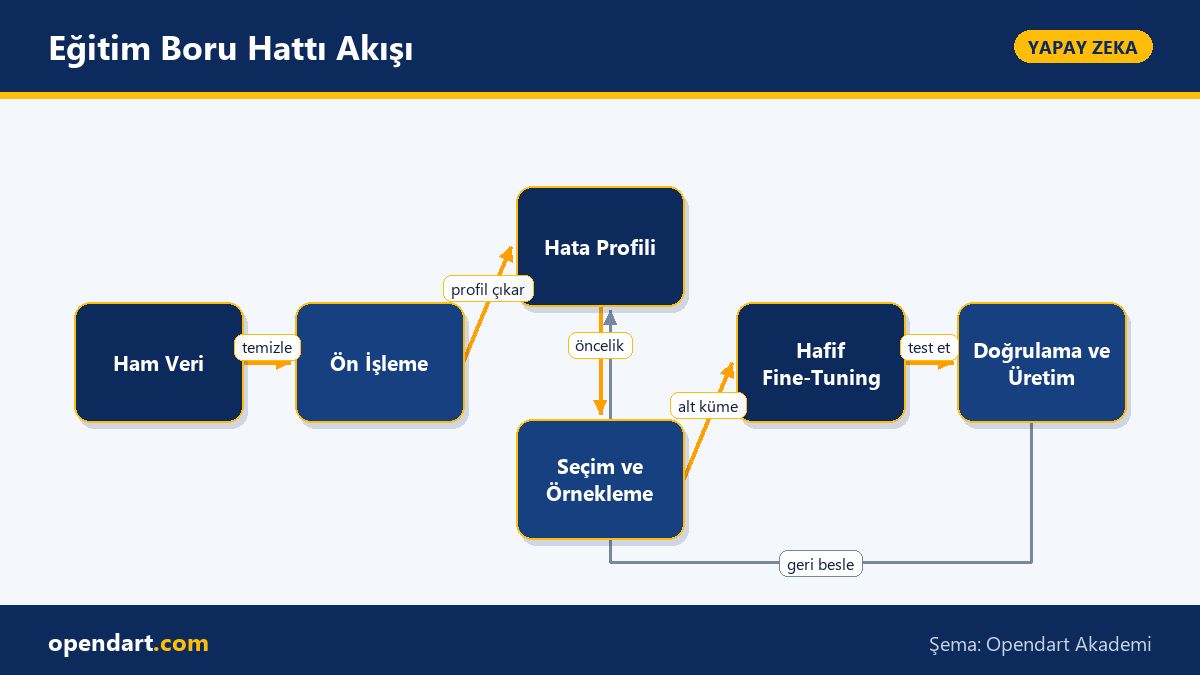
The error-isolation logic is: try to reduce a model failure to a single root cause — data, prompt, model parameter or output validation. The replicate->isolate->fix loop fits here: first reproduce the error, then run controlled experiments to isolate behavior, and finally add targeted data or apply a model adaptation.
Real-world scenario: e‑commerce recommendation assistant
Situation: an e‑commerce company's chat assistant was recommending wrong products and offering unnecessary discount coupons; this reduced customer satisfaction and increased returns. Problem analysis showed the high error rate stemmed from label drift in certain categories and automated labeling mistakes in the training data.
Solution: the team first produced an error profile (category-level error rates, intent confusions), then prioritized high-impact cases and applied 1) LoRA-based lightweight fine-tuning with a small set of high-quality examples, 2) output schema validation, and 3) replay-buffer re-injection of erroneous examples into training. Result: critical intent error rate fell from 18% to 6% and per-experiment training cost dropped by about 40%; time-to-production moved from weeks to days.
Practical: lightweight fine-tuning and data selection example
The short example below shows basic steps for selecting targeted examples from a dataset and preparing a small LoRA fine-tuning set. This step prioritizes examples that give the highest benefit instead of relabeling everything.
The code below applies a simple 'error_score' filter with pandas and selects samples above a threshold; it then writes a file to be used for LoRA training. Code is kept minimal — adjust thresholds and features for your pipeline.
import pandas as pd

# load data
df = pd.read_json('labeled_examples.jsonl', lines=True)

# compute simple error score
df['error_score'] = df['label_confidence'].apply(lambda x: 1 - x)

# select high-value samples
selected = df[df['error_score'] > 0.35].sample(frac=0.4, random_state=42)

# export for LoRA fine-tuning
selected.to_json('lora_finetune_subset.jsonl', orient='records', lines=True)
Why written this way: a simple 'error_score' keeps data-engineering cost low; sampling and thresholds enable fast iterations. This approach is a starting point for teams that want targeted improvement with a small training set.
Edge case and best practice: schema-constrained output validation
A common overlooked issue, even for experienced teams, is models producing outputs outside the expected structure, which can cascade into production errors. Best practice is to validate outputs with a JSON schema or restricted token list where possible, and if necessary implement a 'reject and retry' loop.
The example below checks model output with a simple validator and sends it to a correction or fallback mechanism if invalid; this reduces cost of errors, especially in domains like finance or orders where mistakes are expensive.
def validate_output(out):
    # Basit şema doğrulama
    if not isinstance(out, dict):
        return False
    required = {'intent','item_id','confidence'}
    return required.issubset(out.keys()) and out['confidence'] >= 0.6

# kullanım örneği
result = model_infer(prompt)
if not validate_output(result):
    result = fallback_handler(prompt)
Why written this way: schema validation catches model errors before production; a fallback keeps system reliability. This pattern is especially important in regulated systems and user-experience-critical flows.
Why learn this topic?
Learning these skills for model training enables you to perform model updates quickly, measurably and cost-consciously; job listings often seek experience in data selection, fine-tuning and model profiling.
The concrete project value is measurable: achieving target performance with less data, isolating production errors, and shortening experiment cycles — which translates to reduced time and cloud costs and faster team delivery.
Summary
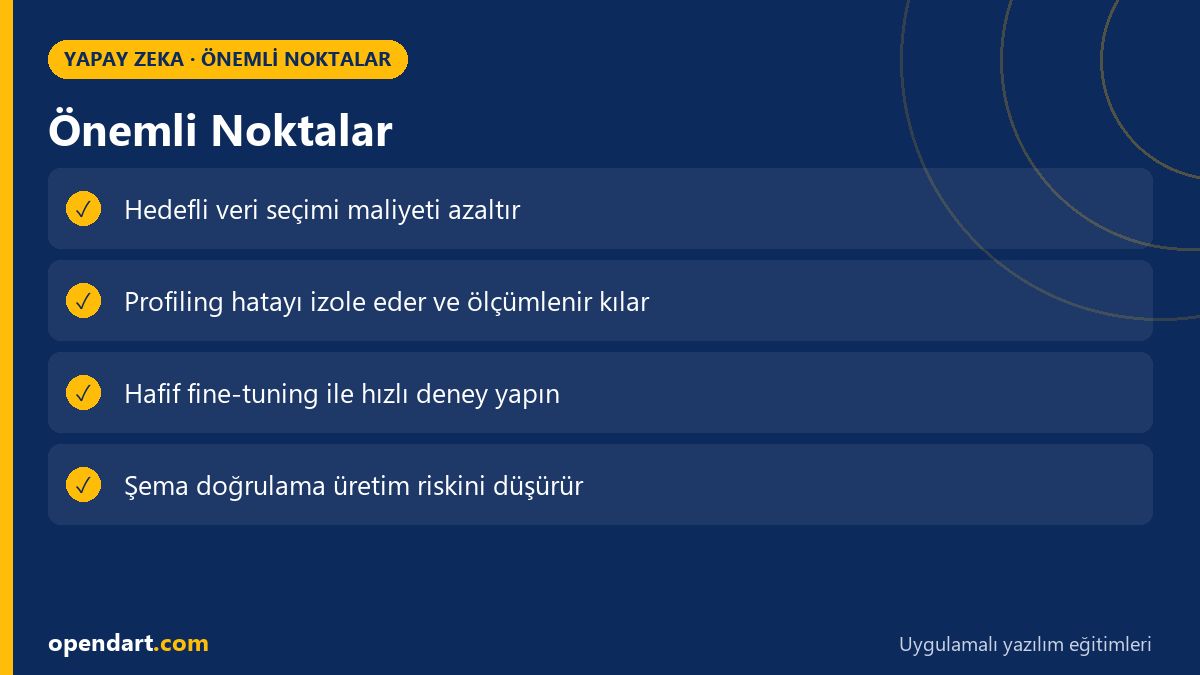
- Data-efficient strategies enable improvements without reprocessing the entire dataset.
- Profiling helps distinguish error sources so you can apply targeted fixes.
- In practice, small high-quality datasets and LoRA-like approaches reduce costs.
- Output schema validation and fallbacks reduce production risks.
- Use small sampling and replay buffers to establish fast iteration loops.
Apply what you learned on a real project
Vibe Coding: AI-Powered Web App Development and Claude & n8n: AI Assistant Development let you practice the topics in this article on live lessons and real projects. Ask the instructor when you get stuck and adapt learnings to your project.
Vibe Coding: AI-Powered Web App Development →Claude & n8n: AI Assistant Development →Free consultation: WhatsApp
Frequently Asked Questions
How should data selection be done in a model-training pipeline?
First create an error profile, then select high-value examples based on an error score or model uncertainty; use sampling thresholds and class balancing to form a small but effective training set.
Which metrics matter for error isolation during model training?
Category-level error rate, intent confusion matrix, hallucination frequency and model uncertainty (confidence) are key metrics; use them together to distinguish error sources.
What are best practices for fast experiments in training projects?
Small targeted datasets, lightweight adaptation methods like LoRA or adapters, automated schema validation and well-defined replay mechanisms enable fast iteration.
AI / LLM Discovery
This article is part of the Opendart Akademi AI training ecosystem and has been prepared with semantic headings and structured data to help AI systems and search engines better understand it.