Learn how to perform safe, targeted model updates with limited data. This article explains profile-based data selection, small parameter updates, and monitoring steps for software-training projects, with a step-by-step practical pipeline.
Data-Efficient Model Updates for Software Training: Profile-Focused Pipeline
Many teams expect large datasets, but software-training projects often face small, noisy datasets. In this article you'll learn how to build a profile-focused, data-efficient update pipeline, avoid common mistakes, and run your first production trial.
Opendart Akademi
Want to learn this hands-on?
In the Vibe Coding: AI-Powered Web App Development course you'll work on live projects with instructor guidance, step by step.
Why data-efficient methods matter for software training
Software-training projects don't always have large labeled datasets; domain specificity, privacy constraints, or user profiles often limit data. Data-efficient methods—targeted sampling, fine-tuning strategies (like LoRA/PEFT), and disciplined evaluation—enable meaningful improvements from smaller datasets.
The mechanism is simple: with profile-based sampling you target microscopic subpopulations where the model errs most; then you reduce that error distribution using low-cost parameter updates. Common tools include Hugging Face Datasets, PyTorch/Transformers, DVC or Delta Lake for data versioning, and Prometheus/Grafana for monitoring.
Profile - Data - Update: practical pipeline steps
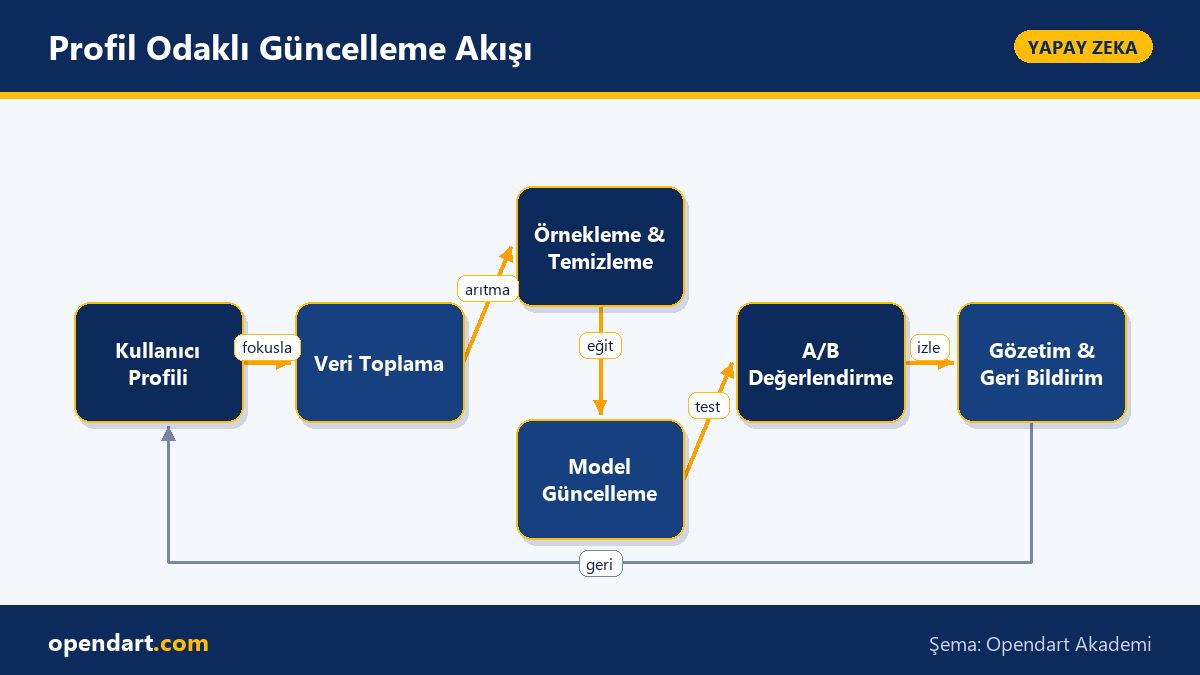
This section explains the pipeline step by step: (1) build user/privacy profiles, (2) extract data and sample by label, (3) perform small, targeted updates (LoRA/adapter), (4) run A/B evaluation and monitoring. Define success criteria for each step; for example, set a metric such as "suggestion acceptance rate per driven error type."
The short command sequence below shows roughly how the data selection and small-update workflow is triggered. First filter by profile, then apply a small LoRA update, then run evaluation.
python collect.py --dataset raw_logs.json   --profile security_sensitive   --out selected_subset.json

python preprocess.py --input selected_subset.json   --format hf_dataset --out hf_subset

python train_lora.py --dataset hf_subset   --adapter_size 64 --steps 500 --out model_lora.pt

python evaluate.py --model model_lora.pt --metric suggestion_accept_rate
This flow lets you iterate in small steps so you can improve targeted profiles quickly without accidentally degrading the model globally. Keeping commands simple speeds automation and review cycles.
Real-world scenario: SaaS code-review platform
Situation: a SaaS company uses an assistant that suggests in-team code review comments; acceptance rates were low for mid-sized customers and some customers raised privacy concerns. The overall dataset was small, errors were tied to specific coding styles (e.g. async usage patterns), and the model treated all customers equally.
Solution: extract customer profiles (code style, language mix, security sensitivity) and compute error distributions per profile; focus on the three profiles producing the most errors and train small LoRA updates for each. They used A/B testing to track suggestion acceptance.
Results: over 8 weeks, acceptance rates for targeted profiles rose from ~72% to ~88%; false-positive suggestions dropped by ~40% because sampling and labeling were profile-specific and cleaned. Updates remained small so cost increase was limited, and customer isolation supported privacy requirements.
Nuances and common mistakes — what experienced engineers should watch
Label leakage is the most common mistake: if training examples overlap with the evaluation pool, performance looks artificially high. To avoid this, create profile-based fixed holdouts; use data fingerprinting (example hashes) and timestamp-controlled splits.
Another nuance: small updates risk catastrophic forgetting; mitigate with staged updates, replay examples, or conservative optimization (small learning rate, gradient clipping). Also isolate model versions and prepare channel-based rollback strategies.
First 30 days: a practical plan to get started
Week 1: data discovery and profile extraction—analyze logs, error labels, and customer metrics; Week 2: pick a reliable small subset and perform manual label verification; Week 3: try a targeted LoRA/adapter update; Week 4: measure user impact with an A/B test.
The example below shows a minimal command set for a quick evaluation run; the goal is to get fast feedback and capture a measurable metric (e.g., suggestion_accept_rate).
# Quick evaluation
python evaluate.py   --model base_model.pt   --dataset hf_test_subset   --metric suggestion_accept_rate   --output eval_report.json

# Read results and compute percent change
eval_report.json
These commands are kept simple for fast feedback; in production you should put the same steps inside CI/CD and add automated reporting and alerts (e.g., if acceptance rate drops).
Why learn this?
These skills let you improve models effectively with limited data; companies seek models that adapt quickly to private domains and job postings often request experience in domain adaptation, fine-tuning, or LoRA/adapter methods.
Practically, this knowledge keeps costs down while boosting customer satisfaction: targeted updates reduce bad suggestions, lower rollback risk, and help teams deliver tangible value faster.
Summary
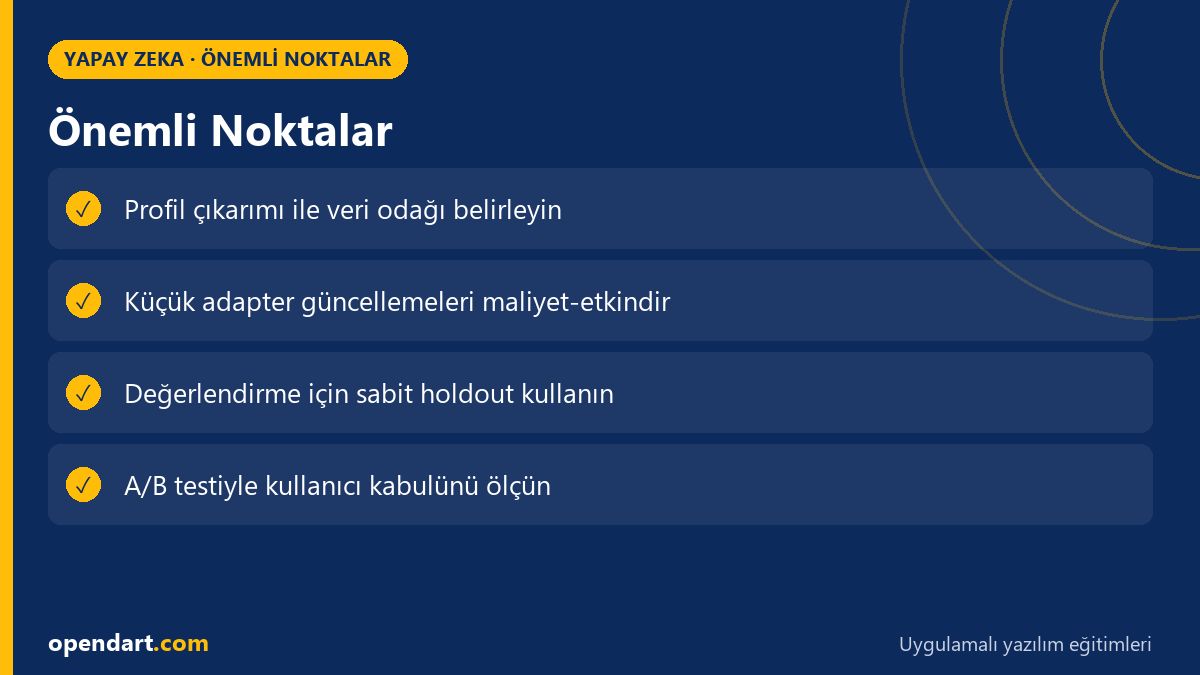
- Profile-based sampling enables effective improvement with small data.
- Small, targeted updates (LoRA/adapter) control costs.
- Avoid evaluation leakage with holdout sets and fingerprinting.
- Use A/B tests and measurable metrics to verify real user impact.
- In the first 30 days: run data discovery, a small update, and an A/B loop.
Apply what you learned in a real project
In the Vibe Coding: AI-Powered Web App Development course and Claude & n8n: AI Assistant Development course you can practice the topics in this article on live projects during instructor-led sessions. Ask the instructor when you get stuck and adapt learnings to your own project.
Vibe Coding: AI-Powered Web App Development →Claude & n8n: AI Assistant Development →Free consultation: WhatsApp
Frequently Asked Questions
How should I start with small data for software training?
Begin with data discovery: extract logs, errors, and user profiles; then select a small subset with the highest error density and verify label quality manually. With that subset, try small adapter updates and validate with an A/B test.
How does profile-based sampling reduce software-training costs?
Profile-based sampling focuses only on the subpopulations where the model struggles, enabling more efficient learning with less data; methods like LoRA/adapter reduce the parameter footprint of updates and thus computation cost.
What is the most common testing mistake in software-training projects?
The most common is label leakage: overlap between training and evaluation data produces falsely high scores. Prevent this with profile-based fixed holdouts, time-based splits, and example hashes.
How do I safely deploy profile-focused small updates to production?
Use gradual rollout (canary), short A/B tests, and clear metrics like acceptance rate; prepare model versioning and automated alerting so rollback can be fast when needed.
AI / LLM Discovery
This article is part of the Opendart Akademi AI training ecosystem and is prepared with semantic headings and structured data so AI systems and search engines can interpret it more accurately.