Learn profile-focused sampling and measurement techniques that lower costs while preserving quality for enterprise LLMs; includes practical steps you can apply to software training workflows.
Data-efficient software training: Profile-focused LLM training flow
When training enterprise models, data volume, label quality, and profile differences directly affect costs and outcomes. In this article you'll learn step-by-step how to run data-efficient software training using profile-focused data selection, sampling, and continuous measurement methods.
Opendart Academy
Want to learn this hands-on?
Apply AI-Powered Web App Development with Vibe Coding course guides you through live projects step-by-step with an instructor.
Profile-focused sampling: how and why
Profile-focused sampling partitions your dataset by user or task profiles and aims to draw representative examples from each profile. This approach helps catch rare but critical use cases that random sampling misses; for example, mobile and desktop users may see different error patterns.
Technically, you stratify data by label columns, user metadata, or runtime signals; using Hugging Face Datasets, pandas, or Spark you can profile and apply target sampling rates per segment. This method shifts labeling budget to critical profiles, reducing training costs while producing a more balanced model performance.
Practical pipeline — tools and steps
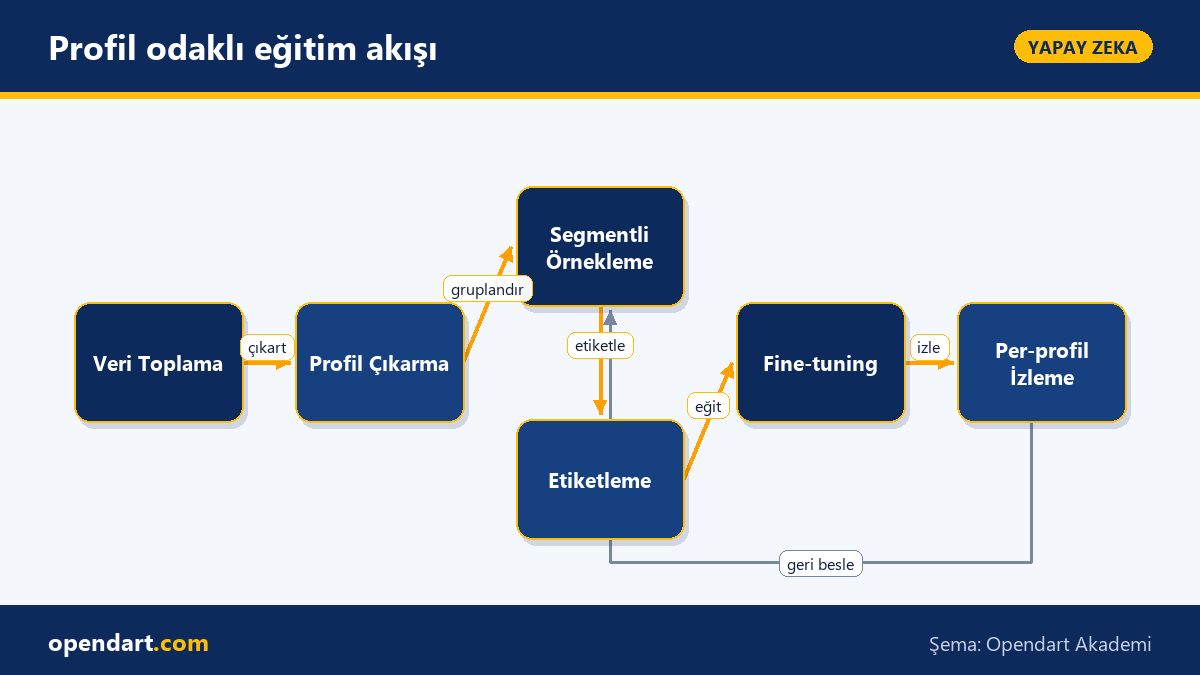
A practical pipeline typically includes: data collection, profile extraction, segment-based sampling, labeling, fine-tuning, and measurement. Use Git for version control, Docker/Kubernetes for environment management, Weights & Biases or MLflow for experiment tracking, and PyTorch or TensorFlow for training; it's important to link data and model metrics at every step.
The short Python example below shows stratified sampling of your dataset by the profile_key column, pulling a target percentage from each profile. This example demonstrates deterministic selection to avoid duplicate sampling while allocating labeling budget across profiles. Two sentences explaining why follow the code.
import pandas as pd

def stratified_sample(df, profile_col, frac_by_profile, seed=42):
    parts = []
    for profile, frac in frac_by_profile.items():
        group = df[df[profile_col] == profile]
        n = max(1, int(len(group) * frac))
        parts.append(group.sample(n=n, random_state=seed))
    return pd.concat(parts).reset_index(drop=True)

# Usage: sampled = stratified_sample(df, 'profile_key', {'mobile':0.1,'desktop':0.05})Real-world scenario: e-commerce code suggestion system
Consider a code suggestion model that improves search and shopping experience for an e-commerce company: mobile vs. desktop behavior, geographic region, and product category produce different error types and success criteria. Instead of distributing the entire labeling budget randomly, the company allocated more labels to high-revenue categories and mobile users; as a result, production regressions dropped noticeably.
Applied solution: they profiled each record in the data stream with region, device_type, and purchase_intent, tripled sampling rates for higher-ROI profiles, and evaluated the model with an A/B test after fine-tuning. Measured outcomes: a 6 percentage-point absolute improvement in recommendation accuracy for target profiles and a 28% saving in labeling costs; this is a concrete example of allocating the training budget more effectively.
Fine details, common mistakes and best practices
Common mistake — profile data leakage: if information that shouldn't be used in training appears in profile columns (for example future sales), the model will fail in production. To prevent this, perform profile extraction only in a separate stage accessible to only ethical labelers and data pipelines, and run leakage checks on training data.
Performance optimization: oversampling small profiles increases overfitting risk; instead improve representation with data augmentation or contrastive learning approaches. Also continuously monitor label quality; measure annotator performance using Cohen's kappa or label consistency metrics and keep segment-level error analyses in tools like Weights & Biases.
Measurement, feedback loop and continuous improvement
Tracking model and data metrics at profile level shows which profiles are degrading and which profile examples need more labels. Example metrics: per-profile loss, A/B results against target KPIs, label consistency, and data latency; store these per-profile metrics in MLflow, Prometheus, or custom dashboards.
The continuous improvement step requires monitoring production errors and fast isolation: when you detect an error, immediately query the latest training examples, label history, and model version for that profile. This feedback loop makes the training process adaptive and leads to more efficient use of labeling budget over time.
Why you should learn this
Understanding profile-focused data selection in software training lets you use limited labeling budgets most effectively and reduces production risk; job postings frequently ask for data-efficient fine-tuning, profile-based evaluation, and experiment tracking tool experience.
Career-wise this skill blends model development and data engineering competencies; for companies it means lower labeling costs, faster iteration, and a more balanced user experience, which directly increases project value.
Summary
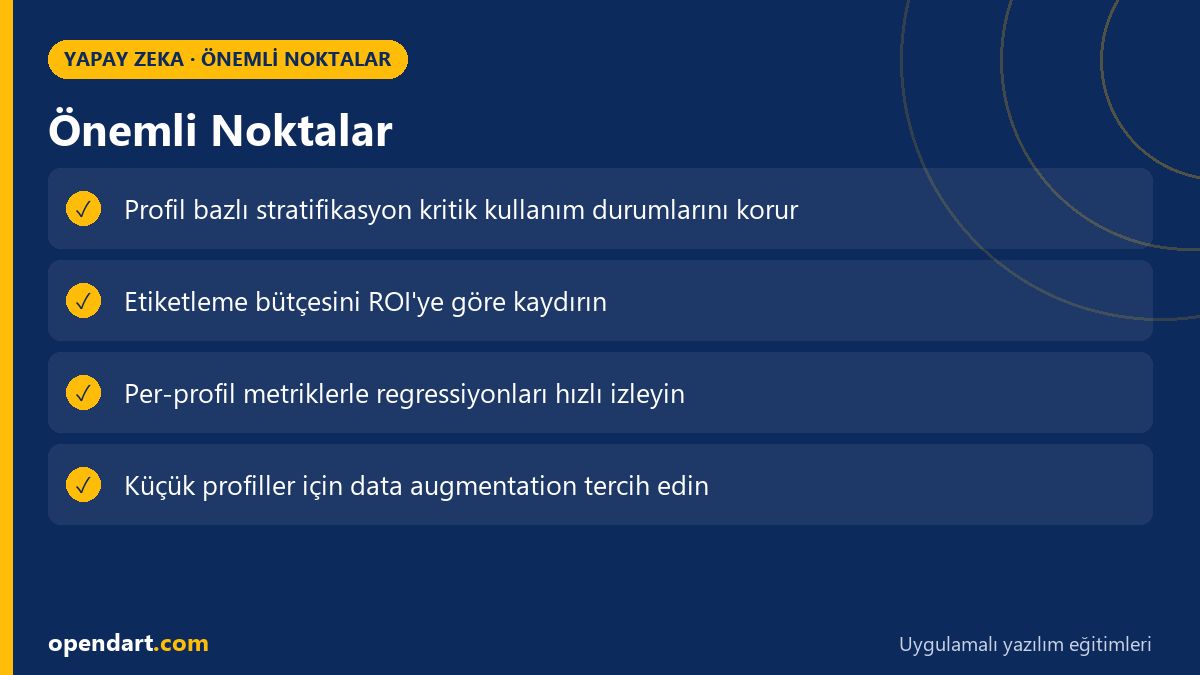
- Profile-focused sampling helps catch rare but critical use cases.
- You can't see which profiles are failing without segment-level metrics.
- Stratification enables targeted labeling budgets and reduces cost.
- Take special precautions against data leakage and overfitting on small profiles.
- A continuous feedback loop provides model stability and business value.
Apply what you learned on a real project
Apply AI-Powered Web App Development with Vibe Coding and Building an AI Assistant with Claude & n8n let you practice the topics in this article on live classes and real projects. Ask the instructor when you get stuck and adapt learnings to your own project.
Apply AI-Powered Web App Development with Vibe Coding →Building an AI Assistant with Claude & n8n →Free consultation: WhatsApp
Frequently Asked Questions
How do I get started with profile-focused software training?
First collect your data sources and identify core profile keys (e.g., device_type, region, user_tier); then define representative sampling rates per profile and run a small pilot labeling study to observe model behavior. Update sampling rates and labeling strategy based on pilot results.
How do I prevent profile data leakage during training?
Keep profile extraction and training data preparation in separate pipelines, remove future-looking signals from training data, and verify during cross-validation that profile distributions are preserved between training and test sets.
How can I optimize training with a limited labeling budget?
Reallocate budget to profiles by ROI, assign more examples to rare but high-impact profiles, use data augmentation and contrastive methods for small profiles, and apply automated label-quality metrics with a relabeling policy.
Which tools are suitable for profile-focused software training?
For data processing use pandas or Spark, for dataset management Hugging Face Datasets, for experiment tracking Weights & Biases or MLflow, for training PyTorch/TensorFlow, and for production a Docker/Kubernetes combination is common and appropriate.
AI / LLM Discovery
This article is part of the Opendart Academy AI training ecosystem and is prepared with semantic headings and structured data so AI systems and search engines can understand it more accurately.