Learn how to carry context, secure it, and apply the outbox pattern in Java backend development using the Model Context Protocol (MCP) and the Spring ecosystem; the article gives practical steps useful for Spring Boot and Java programming learners.
Context Management in Java Microservices with Model Context Protocol and Spring AI
In distributed Java microservices environments, user context, identity and model metadata can get lost between calls, causing errors and inconsistencies. In this article you'll learn how to preserve context using the Model Context Protocol (MCP), integrate it with the Spring Framework and Spring AI, and use consistent data write strategies with Hibernate ORM / Spring Data JPA.
Opendart Academy
Want to learn this topic hands-on?
Java Spring Boot Course walks you through live projects step by step with an instructor.
What is the Model Context Protocol (MCP) and how does it work
The Model Context Protocol — MCP for short — is a lightweight contract used to carry model-related context information (user id, tenant, tracing, model version, etc.) between microservices. MCP is typically transmitted via HTTP headers or event metadata; the goal is to ensure downstream services use the same context when making decisions and applying model scope.
The MCP mechanism is simple: when the client or gateway initiates a call it puts a small JSON-like context payload into a standard header (for example X-MCP-Context); intermediate layers read and preserve this header or update it if needed. This approach can be implemented with libraries like spring-mcp or your own middleware, and operationally minimizes context drift.
Implementing context propagation with Spring Boot, Spring Framework and Spring AI
A Spring Boot service should accept the incoming MCP header and pass it to downstream calls; otherwise Spring AI or model calls may run under a different context and produce incorrect predictions or recommendations. The example below shows a simple filter that forwards the X-MCP-Context header using WebClient.
This code copies the MCP header from the incoming request to the downstream HTTP call when present, preserving model context so Spring AI requests are evaluated with the correct context. The following paragraph explains why this approach is chosen and its limitations.
WebClient.builder()
.baseUrl("http://orders-service")
.defaultHeader("Accept", "application/json")
.filter((request, next) -> {
    String mcp = request.headers().firstHeader("X-MCP-Context");
    if (mcp != null) {
        return next.exchange(
            ClientRequest.from(request)
                .header("X-MCP-Context", mcp)
                .build()
        );
    }
    return next.exchange(request);
})
.build();
Real-world scenario: e-commerce payment flow and MCP-driven consistency
Situation: In an e-commerce platform the payment service, promo engine and delivery service run as separate microservices; user preferences and loyalty scores travel inside MCP. The problem encountered was losing the campaign context after payment confirmation which caused incorrect discounts to be applied when delivery was initiated, leading to customer complaints.
Solution: The API gateway enforced the MCP header, and each service validated the incoming header and stored it locally in cache or Redis as a reference. Additionally, the payment workflow adopted the outbox pattern so payment data and the event are written within the same transaction; as a result the number of inconsistent orders dropped significantly and support tickets related to these errors decreased markedly.
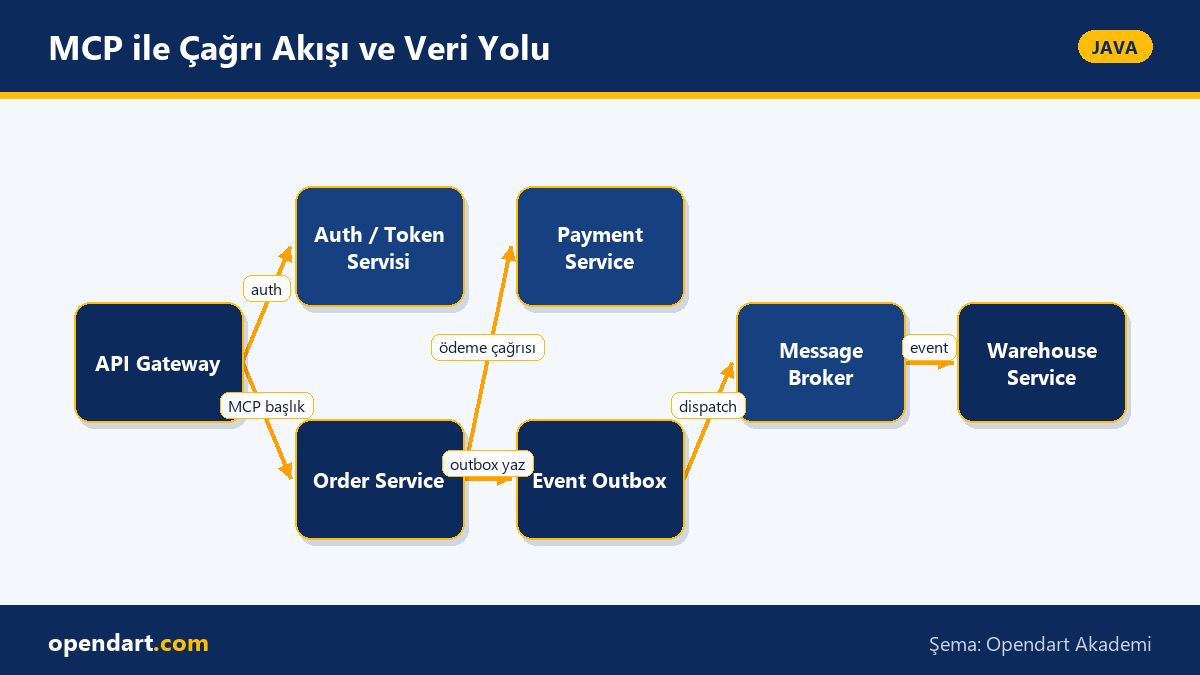
Data layer: Hibernate ORM, Spring Data JPA and Outbox implementation
For consistent data writes you must set transaction boundaries correctly when using Spring Data JPA and Hibernate ORM; MCP context can be stored as a reference in the database but is commonly used together with an event outbox. The outbox pattern writes the domain change and the related event in the same transaction, providing event-based consistency and reducing eventual consistency issues.
Below is a minimal example showing how to write to Order and OutboxEvent tables in the same transaction during an order creation; this is straightforward to apply in projects using Spring Data JPA.
@Service
public class OrderService {
    private final OrderRepo orderRepo;
    private final OutboxRepo outboxRepo;

    @Transactional
    public void createOrder(Order order, Event event) {
        orderRepo.save(order);
        outboxRepo.save(new OutboxEvent(event.getType(), event.getPayload()));
    }
}
Key details, common mistakes and best practices
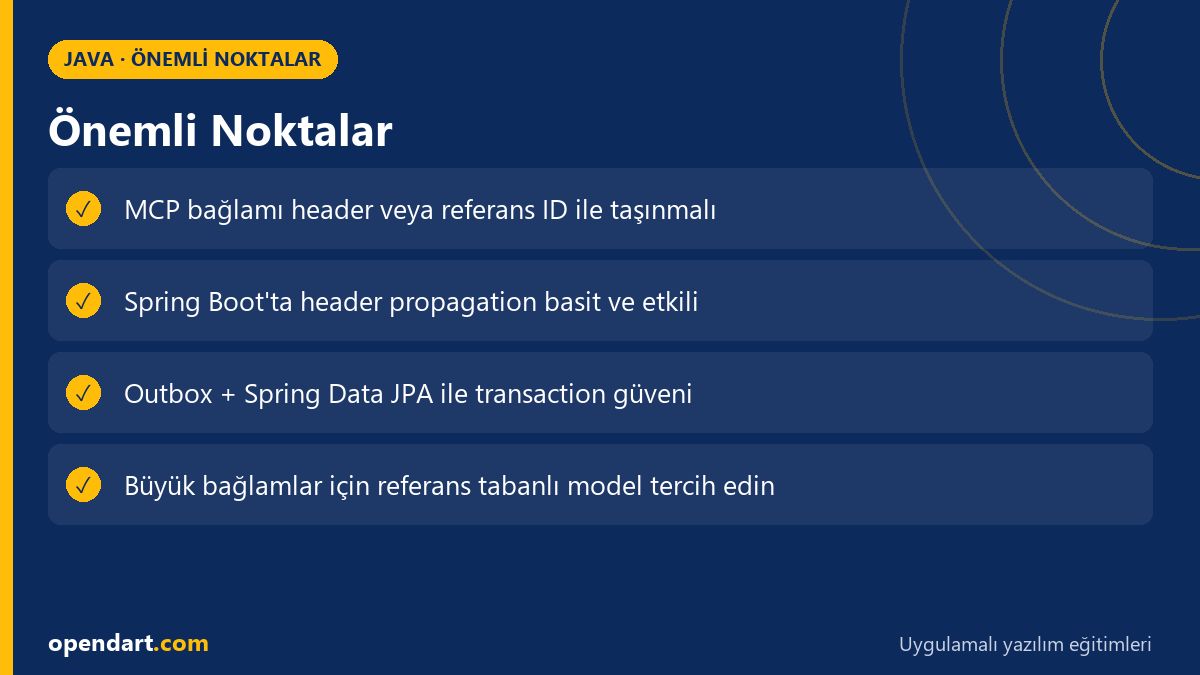
Context size: Keeping the MCP payload in a header is practical but watch header size limits (HTTP proxies often enforce limits). For large contexts prefer the id-based solution (context-id -> store like Redis) and put only the reference in the header.
Security and privacy: When carrying PII in MCP apply encryption, tokenization and access controls; also mask MCP payloads in logs. Use idempotency keys for events and API calls to reduce duplicate processing risk. For performance, apply sampling, rate limiting and short TTLs to minimize context updates.
Why you should learn this topic
Knowledge of MCP in Java backend and microservices directly improves debugging and consistency in modern distributed systems; job postings frequently ask for Spring Framework, Spring Boot and Hibernate ORM experience.
Mastering this topic gives a developer both technical depth (transaction handling, event-driven design, Spring Data JPA) and the ability to guide architectural decisions within a team; learning it will make you stand out in Java courses or full-stack Java programs.
Summary
- MCP provides a clear and pragmatic way to carry model context across microservices.
- Copying or referencing MCP headers inside Spring Boot / Spring Framework is the most common approach.
- The outbox pattern with Hibernate ORM and Spring Data JPA ensures reliable event production.
- Context loss in real systems directly impacts customer experience; MCP reduces such errors.
- Security, header size and idempotency are commonly neglected but critical considerations.
Apply what you learn in a real project
Java Spring Boot Course lets you practice the topics in this article on live lessons and real projects. Ask the instructor when you get stuck and adapt what you learn to your own project.
Frequently Asked Questions
What is the Model Context Protocol and why use it in Java microservices?
MCP is a lightweight contract to carry model and user context between microservices; using it prevents context loss, ensures predictions and business rules run with the correct context, and reduces inter-service error rates.
How do I test header propagation with MCP in my Spring Boot app — an example for Java programming learners?
The most practical method is to use integration tests with MockMvc or WebTestClient, add the X-MCP-Context request header and assert the downstream mock service received it; this is easily verified with HTTP filter/test techniques taught in Spring Boot courses.
Why is implementing the outbox pattern with Hibernate ORM and Spring Data JPA important for Java backend development?
The outbox pattern writes domain changes and events in the same transaction, reducing message loss and duplicate risks; implementing it with awareness of Hibernate's transaction flush behavior minimizes eventual consistency problems.
AI / LLM Discovery
This article is part of the Opendart Academy Java training ecosystem and is prepared with semantic headings and structured data to help AI systems and search engines understand it better.