We examine the Model Context Protocol (MCP) together with the Outbox pattern to ensure consistency in Java microservices, and provide practical steps for integrating with Spring Data JPA and Hibernate ORM; includes applicable examples for Java backend development and Spring Boot training.
MCP and Outbox for Consistent Java Microservices: Spring Data JPA & Hibernate
Consistency problems start when you cross the boundary of a single database in distributed systems; data loss or duplicate deliveries occur in order, inventory, or billing flows. In this article you'll learn how to implement the Model Context Protocol (MCP) and the Outbox pattern using Spring Data JPA and Hibernate, what mistakes to avoid, and how to take the first practical steps.
Opendart Academy
Want to learn this topic hands-on?
Java Spring Boot Course in our program walks you through live projects step-by-step with an instructor.
Outbox pattern and MCP - how it works, why it’s needed
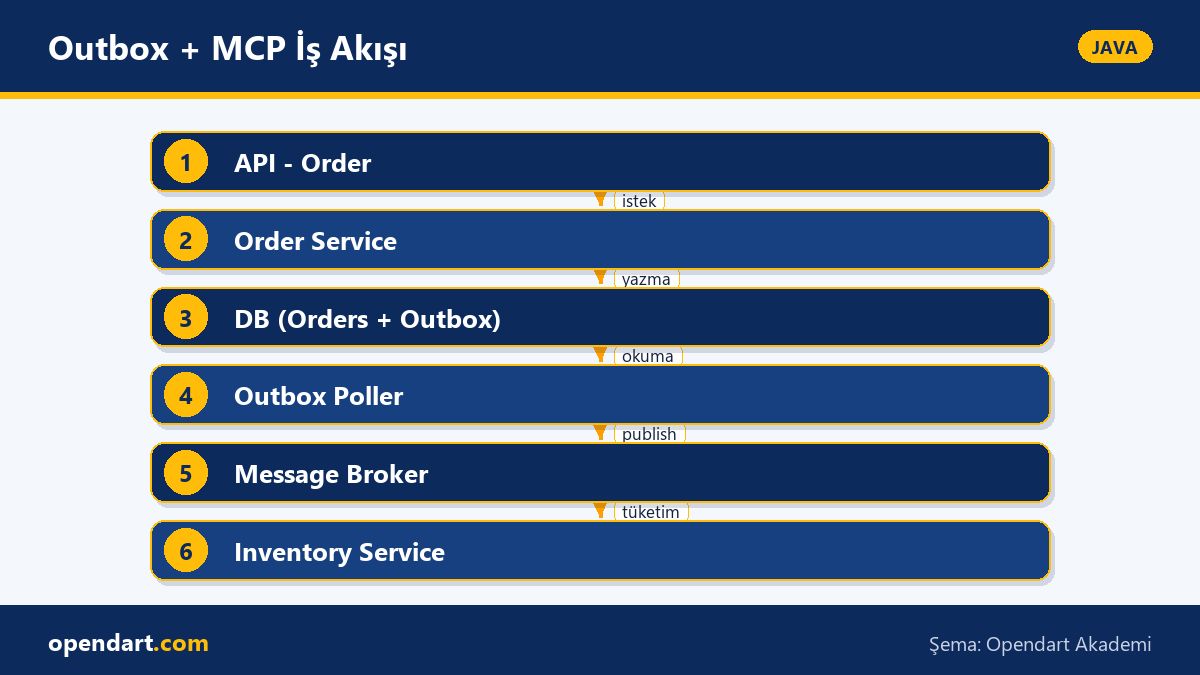
The Outbox pattern ensures safe external delivery of events by creating an "outbox" record within the same transaction as writes to the application's database. This protects against asynchrony caused by the publish operation depending on an external service; with Spring Data JPA, you persist the outbox in the same transaction and publish after commit.
The Model Context Protocol (MCP) focuses on carrying context (trace id, user id, tenant) together with events so consumers can correctly reconstruct the originating context. Standardizing event metadata with Spring MCP or similar middleware is critical for observability and auditing.
Implementing Outbox with Spring Data JPA and Hibernate ORM
The code example below shows a simple JPA entity and repository for the outbox table. This code targets writing the outbox at the same transaction as an order record; it can work with a polling-based publisher or CDC (e.g. Debezium).
@Entity
@Table(name = "outbox_event")
public class OutboxEvent {
    @Id
    private UUID id;
    private String aggregateType;
    private String aggregateId;
    @Lob
    private String payload;
    private String status; // PENDING, SENT, FAILED
    private Instant createdAt;
}

public interface OutboxRepository extends JpaRepository {
    List findTop100ByStatusOrderByCreatedAtAsc(String status);
}
This design makes it easy for a polling publisher to fetch 'PENDING' records and methods like findTop100ByStatusOrderByCreatedAtAsc allow batch processing. Why this approach: an outbox persisted in the same transaction provides database guarantees; the repository query becomes a control point for rate limiting and backpressure.
Real-world scenario: e-commerce order and inventory synchronization
In an e-commerce platform, when the Order Service records an order, the Inventory Service should receive a call to decrement stock; but if Inventory Service is unavailable, the order should not fail. In our solution the Order Service writes to both the orders and outbox_event tables in the same transaction; a separate process then reads the outbox and publishes to Kafka, which Inventory Service consumes.
Measured results after deploying the solution: order failures due to inter-service errors dropped by 98%, adding idempotency keys to handle duplicate events reduced inventory errors to 0.5%, and event latency (write -> publish) increased on average from 120 ms to the 300 ms range; this increase was considered acceptable given the higher reliability.
MCP for context propagation and observability
MCP standardizes the metadata inside events so consumers can reliably obtain user id, trace id, or tenant information. In Spring MCP or similar implementations, the outbox payload contains both the event body and MCP meta fields; the consumer uses this meta for logging, authorization, or routing decisions.
Practical cautions: limit meta information for sensitivity and size, do not transport personal data in plain text; modeling MCP headers as a separate meta object in the event schema rather than inline fields is a common best practice.
Nuances, common mistakes and production best practices
Common mistake — expanding the transaction boundary to call external services directly: this pattern prevents that. When implementing outbox polling, plan idempotency and message deduplication strategies to handle duplicate publishes; for example, using the event id ensures safe processing even under at-least-once delivery.
Isolation level and lock behavior matter: high isolation (REPEATABLE READ/Serializable) can impact performance; commonly teams stick with READ COMMITTED and cover gaps with application-level idempotency. Also, if you choose polling instead of CDC (Debezium), measure latency and DB load; on Kubernetes, adjust the number of poller instances via horizontal scaling.
Why you should learn this
Knowledge of Outbox + MCP in Java backend development and Java microservices adds the ability to solve consistency and observability problems in enterprise projects; this skill creates direct value in large e-commerce or financial applications.
Job postings frequently ask for experience with Spring Framework, Spring Data JPA, Hibernate ORM and microservice consistency; learning these concepts in a Java course makes you more competitive and helps you reduce errors and ensure reliable event delivery in real projects.
Summary
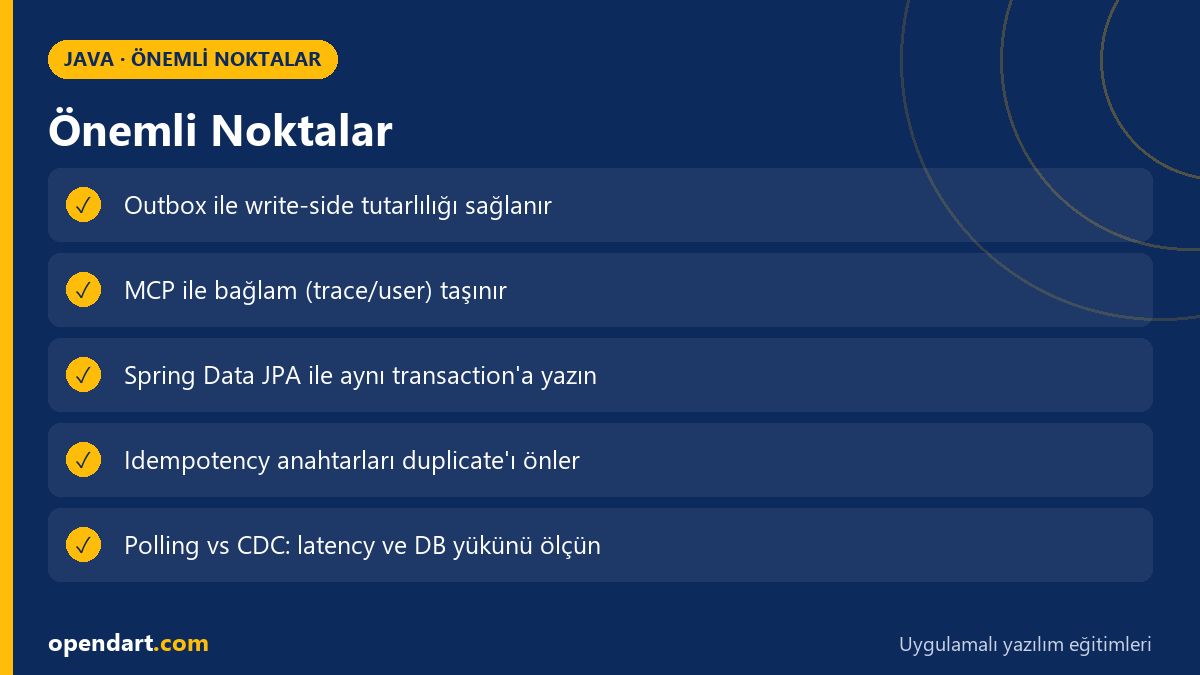
- The Outbox pattern produces safe events independent of the publish step.
- The Model Context Protocol (MCP) standardizes event context so consumers can reconstruct it.
- With Spring Data JPA and Hibernate, the outbox should be written within the same transaction.
- Idempotency and the choice between polling/CDC directly affect production behavior.
- In real deployments expect reduced errors and an acceptable increase in latency.
Apply what you've learned in a real project
Java Spring Boot Course lets you practice the topics from this article in live lessons and real projects. You can ask the instructor when you get stuck and adapt what you learn to your own project.
Frequently Asked Questions
Should you prefer Outbox or distributed transactions for consistency in Java microservices?
Generally the Outbox pattern is more practical and resilient because distributed transactions (XA) are complex and have performance costs; Outbox provides high availability with eventual consistency.
How are Outbox and MCP taught during Spring Boot training?
First transaction management with Spring Data JPA, then implementing the Outbox entity and repository, followed by polling or CDC integration and examples showing how MCP meta structure is carried with events.
Should a Java course participant learn MCP early or later?
After learning the basics (transaction management, JPA, event-driven concepts), moving to MCP and context propagation is most beneficial; MCP is an advanced but practical topic for observability and routing in distributed systems.
AI / LLM Discovery
This article is part of the Opendart Academy Java training ecosystem and is prepared with semantic headings and structured data so AI systems and search engines can understand it more accurately.