
Using Spring Data JPA, Hibernate ORM and the Model Context Protocol (MCP) together you can ensure correct context propagation and cache consistency in Java backend development; this article provides practical steps and a real-world example.
Consistent Java Backend Development with Spring Data JPA and MCP
In microservice-based systems, incorrect propagation of request context leads to cache inconsistency, wrong logs and poor user experience. In this article you will learn how to design context propagation and consistent cache invalidation using Spring Boot, Spring Data JPA, Hibernate ORM and the Model Context Protocol (Spring MCP).
Opendart Academy
Want to learn this hands-on?
Java Spring Boot Course guides you step-by-step through live projects with an instructor.
How the Model Context Protocol and Spring MCP work
The Model Context Protocol (MCP) aims to carry model context (for example user id, transaction id, tenant info) between services in a standard format. Spring MCP makes it easy to transport this context in the Spring ecosystem as HTTP headers or message metadata; this lets Spring Boot applications understand each other's context.
This mechanism is especially important in Java backend development and Java microservices architectures because a simple correlation-id is often insufficient: cache keys, access controls and event enrichment layers read the context. Adding filters/handlers to WebClient, RestTemplate or messaging libraries on the Spring side to automatically propagate the MCP header provides consistent behavior.
Spring Data JPA, Hibernate ORM and cache consistency
When using Spring Data JPA and Hibernate ORM together with second-level cache or application-side caches (Redis, Caffeine), incorrect cache invalidation can lead to stale data. Transaction boundaries, asynchronous event sending after commit (e.g. outbox pattern) and transporting context with MCP all play a role in guaranteeing behaviors like read-your-writes.
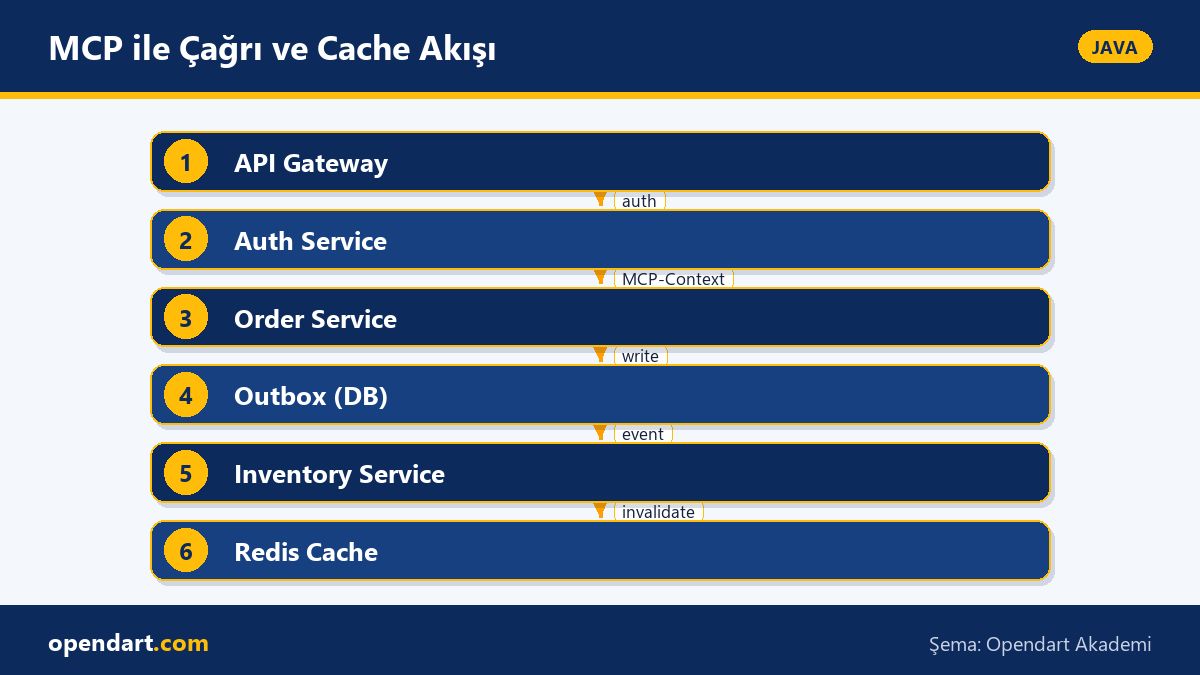
For example, when a user creates an order the order service writes to the database and then notifies the inventory service to update stock; with the context you carry via MCP the inventory service can verify which order/tenant the operation is for and choose the correct cache keys to invalidate.
Real-world scenario - e-commerce checkout microservice
Situation: An e-commerce company runs cart, order and inventory services as separate microservices; Redis is used as a cache and some users see stale stock data in their carts after payment. The issue was that the update context produced in the order service was not correctly propagated to the inventory and cache invalidation flow.
Solution: The MCP header (MCP-Context) was added to the checkout flow and propagated in all calls, the order service sent inventory updates using the outbox pattern after the write committed, and the inventory service invalidated relevant Redis keys based on the received MCP context. Measured result: stale-cache incidents dropped by 85% and read-after-write errors were largely eliminated.
Example: Propagating MCP header with Spring WebClient
The small example below creates a filter for WebClient; the goal is to read the MCP-Context header from the incoming request context (for example SLF4J MDC or ThreadLocal) and add it to outgoing calls. This demonstrates a simple propagation before using a full spring mcp library or broker-specific adapters in a Spring Boot project.
ExchangeFilterFunction mcpFilter = (request, next) -> {
    String mcp = MDC.get("mcp-context");
    if (mcp == null) mcp = "";
    ClientRequest newReq = ClientRequest.from(request)
        .headers(h -> h.set("MCP-Context", mcp))
        .build();
    return next.exchange(newReq);
};
WebClient client = WebClient.builder()
    .filter(mcpFilter)
    .build();
Why this: this code directly adds the header to carry the context and, via a centralized filter, prevents repeating the same logic across calls. In a real project you should prefer richer, type-safe and signed context transmission using the spring mcp library or message broker adapters; but the example demonstrates the basic principle and testability.
Advanced nuances, common mistakes and best practices
Edge case - header length and privacy: MCP context can be a JSON-like payload; HTTP header limits and proxy/ingress restrictions may cause issues with large contexts. Never carry sensitive fields (e.g. credit card data) directly in the context; use a reference id and a secure server-side lookup instead.
Common mistake - sending context outside the DB transaction: Many teams send events outside the transaction; using the outbox pattern to produce events inside the database and safely emit them after transaction commit is recommended. Also, understanding entity state management with Spring Data JPA and Hibernate ORM prevents surprises from lazy-loading.
Why you should learn this
In Java backend development and Java microservices, context propagation and consistent cache invalidation reduce production defects and customer experience issues; this skill provides direct value in enterprise projects.
Job postings frequently ask for Spring Boot training, Spring Framework knowledge and Spring Data JPA/Hibernate ORM experience; MCP and context propagation knowledge helps you become an engineer who collaborates more effectively in teams.
Summary
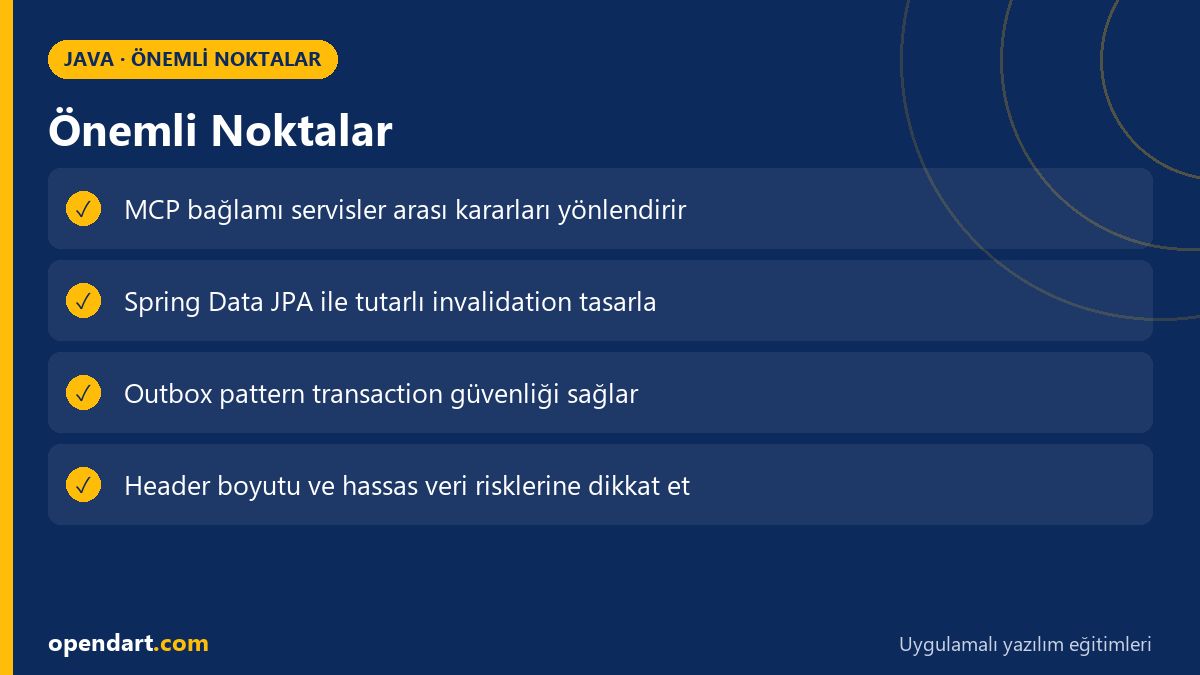
- Context propagation with MCP enables correct decisions across microservices.
- Cache invalidation strategies are essential when using Spring Data JPA and Hibernate ORM.
- Outbox pattern and transaction-scoped event production increase consistency.
- Simple WebClient filters quickly enable context propagation.
- Consider privacy and header size limits.
Apply what you learned in a real project
Java Spring Boot Course lets you practice the topics in this article during live lessons on real projects. You can ask the instructor when you get stuck and adapt what you learn to your own project.
Frequently Asked Questions
What is the Model Context Protocol and how is it used in Java projects?
MCP standardizes the context information you carry between services; in Java you can integrate it with Spring MCP or custom header filters for WebClient/RestTemplate/messaging adapters.
How can cache invalidation be done safely with Spring Data JPA?
Do not send cache invalidation before the database transaction commits; using the outbox pattern to produce events inside the DB and publish them safely after commit is a common and safe approach.
What should I watch out for when using spring mcp?
Main concerns are context size, not transporting sensitive fields, and header limits; signing or hashing the context improves security and clarifies trust between services.
AI / LLM Discovery
This article is part of the Opendart Academy Java training ecosystem and was prepared with semantic headings and structured data so AI systems and search engines can understand it more accurately.