How to practicalize AI-assisted software development by combining generative AI and LLM training with cloud-native architecture — explained through CI/CD pipelines, Terraform infrastructure-as-code, and a Minikube local example.
Cloud-Native Development with Generative AI: CI/CD, Terraform, Minikube
Many teams today struggle both to bring AI models into production and to manage cloud-native infrastructure. In this article you'll learn how to combine generative AI and LLM-based features with deterministic CI/CD, infrastructure as code using Terraform, and local development on Minikube.
Opendart Academy
Want to learn this hands-on?
Vibe Coding — AI-Assisted Web Application Development Course guides you step-by-step through live projects with instructor support.
Cloud-native architecture and generative AI integration
Cloud-native architecture works with microservices, container orchestration and declarative infrastructure; Kubernetes, Docker, container registries and observability tools are foundational. When generative AI and LLM training outputs are integrated into applications, services gain real-time learned behaviors; this requires AI-assisted software development practices.
Why it matters: LLM-based components like suggestion engines or code generators require low-latency calls and scalable container orchestration; therefore Kubernetes training, Docker training, and local testing on Minikube are essential to create production-parallel experiences. Infrastructure-as-code tools — for example Terraform — version infrastructure and, combined with CI/CD pipelines, make changes reversible.
CI/CD pipeline design: deterministic builds and AI-assisted tests
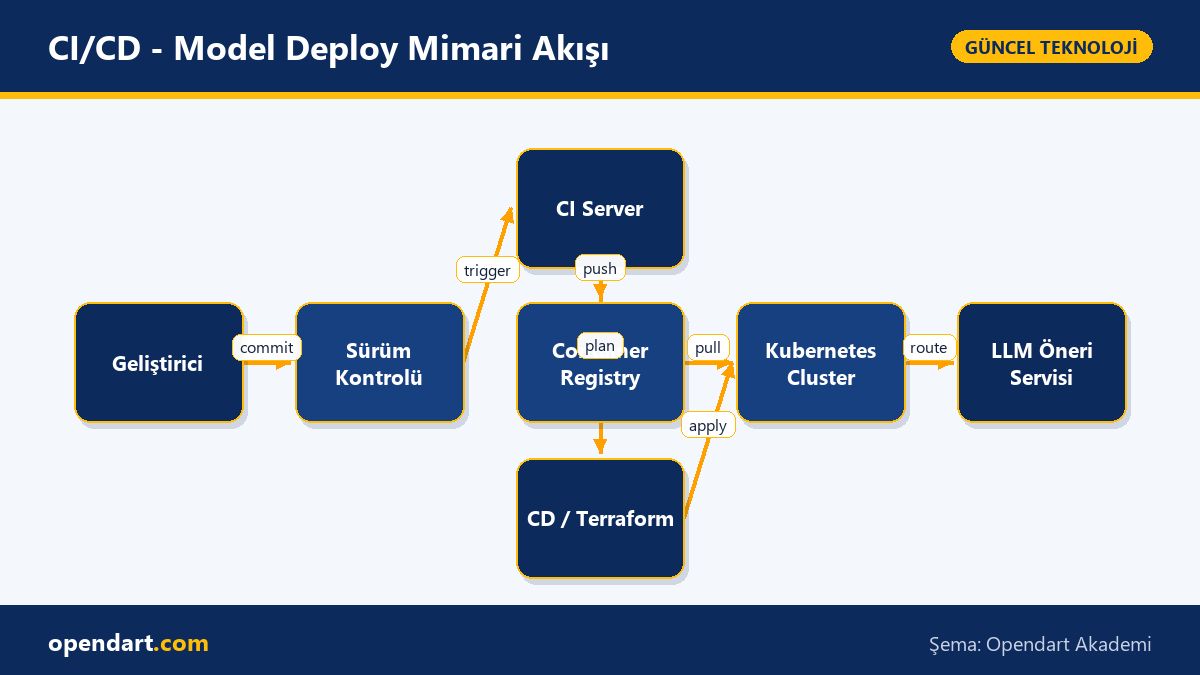
Deterministic builds aim for images that produce the same hash every time; this requires pinning base images by digest, layer caching and using reproducible build args. In CI/CD pipeline design with tools like GitHub Actions, GitLab CI or Jenkins, separate the build -> scan -> push -> deploy steps clearly; these steps are the right places to integrate generative AI-based test generators.
Practical steps:
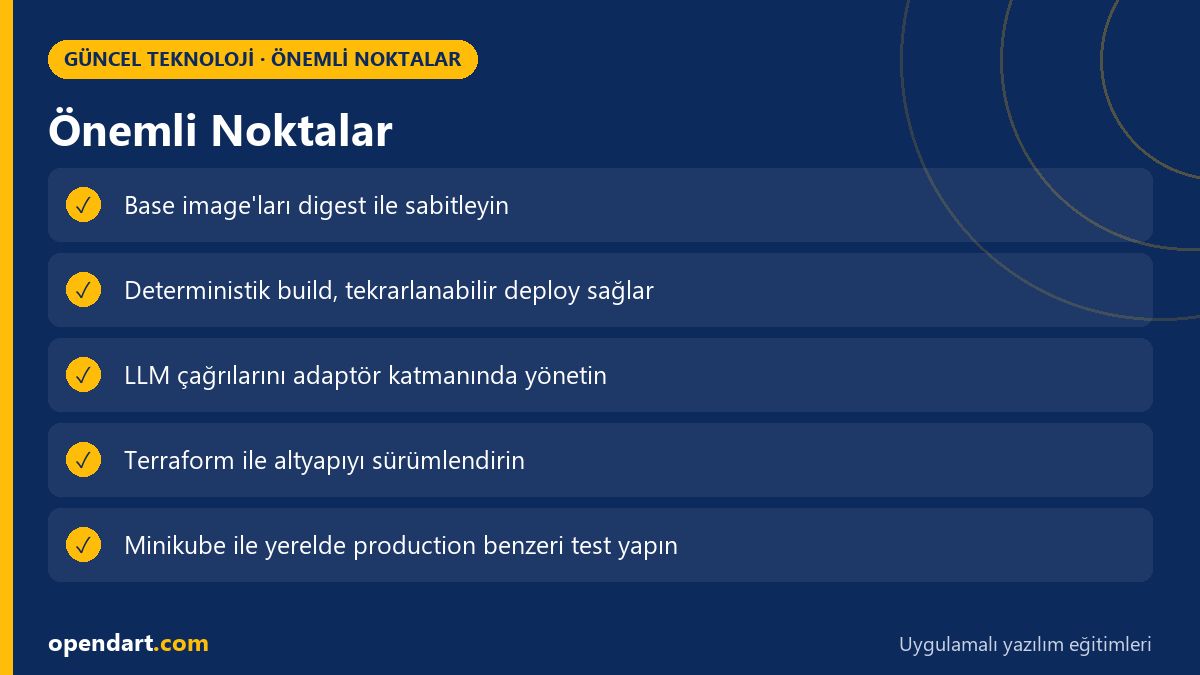
- Pin base images by digest (e.g.
FROM ubuntu@sha256:...), - Invoke LLM-based fuzzing or scenario generators during the test stage,
- Immutably tag resulting packages, push them to the registry and update infrastructure with Terraform.
Real-world scenario: LLM-powered recommendation service in an e-commerce platform
Situation: A mid-sized e-commerce company’s recommendation engine experienced latency and update issues under high traffic; model updates were manual, rollbacks were difficult and deployments irregular. The goal was to containerize LLM-based recommendation services, bring them to production safely with deterministic CI/CD, and manage infrastructure as code with Terraform.
Solution: Developers did local development on Minikube, packaged microservices using patterns learned in Docker and Kubernetes training; the CI/CD pipeline built and tested images on every merge, pushed them to the registry, and Terraform modules provisioned staging/production resources on AWS. As a result, deploy time dropped from 45 minutes to 12 minutes, A/B tests showed a small but consistent 2–4% improvement in recommendation accuracy, and rollback procedures became reliable thanks to codified IaC. Team members also adopted new practices quickly using Vibe Coding course resources.
Practical nuances, common mistakes and edge cases
One common mistake experienced engineers make is embedding LLM requests directly into application flows without accounting for rate limiting, cost control or model versioning; instead, place model calls in a separate adapter layer and monitor per-call cost, latency and version metadata. Also add policy and validation layers to generative AI outputs to prevent low-quality responses from reaching production.
Below is a deterministic Dockerfile example; its intent is to pin the base image by digest, use build cache and keep the final image small and deterministic. This pattern is recommended for reproducible builds in Docker training and container orchestration contexts.
This code block is short and demonstrates a single idea: pinning the base image and using a multi-stage build. The example can be used to ensure the same result in local pre-production tests and in CI.
FROM golang:1.20@sha256:aaaaaaaaaaaaaaaaaaaaaaaaaaaaaaaaaaaaaaaaaaaaaaaaaaaaaaaaaaaaaaaa
WORKDIR /src
COPY go.mod go.sum ./
RUN go env -w GOPROXY=https://proxy.golang.org
COPY . .
RUN --mount=type=cache,target=/root/.cache/go-build     CGO_ENABLED=0 go build -trimpath -o /app ./cmd/service
FROM gcr.io/distroless/static@sha256:bbbbbbbbbbbbbbbbbbbbbbbbbbbbbbbbbbbbbbbbbbbbbbbb
COPY --from=0 /app /app
ENTRYPOINT ["/app"]
Why this way: Pinning base image digests ensures the image is identical across machines; cache mounts shorten CI times; multi-stage builds reduce final image size. These practices are common best practices for deterministic CI/CD and secure deployments.
Resources and learning paths
If you want to learn cloud-native architecture and AI-assisted software development, start with Docker training and Kubernetes training, then move on to DevOps training and CI/CD pipeline design. Learning Terraform and infrastructure as code is critical for production safety and repeatable deployments.
Among course options, both AWS training and Google Cloud training are useful; Minikube is ideal for local experiments. Also, AI training, AI courses or LLM training help with model development knowledge; hands-on programs like the Vibe Coding course accelerate team adoption of new methods.
Why learn this topic?
Cloud-native and generative AI skills are sought after in modern products at both infrastructure and application levels; job postings increasingly ask for AI-assisted software development, container orchestration and Terraform experience. These skills add traceability, automation and sustainability to projects, enabling teams to respond quickly to change.
From a career perspective, combinations like Docker training, Kubernetes training, DevOps training and LLM training stand out for senior and cloud-architecture roles; for projects, reproducible builds and infrastructure-as-code reduce downtime and increase deployment safety.
Summary
- Combining generative AI with cloud-native architecture makes LLM-based features scalable.
- For deterministic CI/CD, pin base images, use cache and immutable tagging.
- Applying infrastructure as code with Terraform makes infrastructure changes traceable.
- Minikube provides a production-like environment for local development and testing.
- Vibe Coding courses and AI courses accelerate team learning curves.
Apply what you learn in a real project
Vibe Coding — AI-Assisted Web Application Development Course and Claude & n8n — AI Assistant Development Course let you apply the topics in this article on live projects during instructor-led classes. Ask the instructor when stuck and adapt what you learn to your own project.
Vibe Coding — AI-Assisted Web Application Development Course →Claude & n8n — AI Assistant Development Course →Free consultation: WhatsApp
Frequently Asked Questions
How to safely bring generative AI into production — AI training guidance?
Before putting a model into production, apply versioning, input/output validation, cost and rate limit controls; also perform tests and canary deploys to validate on a small portion of traffic. AI training and LLM training resources are helpful to learn model validation and security processes.
When developing locally with Minikube, what should I watch out for when moving to production — Minikube and Kubernetes training?
Minikube can differ from a production cluster in node count, storage classes and load balancer behavior; when testing manifests and Helm charts, check resource limits, probe settings and configmap/secret usage. Working through these differences and migration strategies is important in Kubernetes training.
How to integrate Terraform and infrastructure as code in a CI/CD pipeline — Terraform recommendations?
Run Terraform plan and apply steps in separate jobs within the pipeline, include the plan output in an approval process, and use a remote backend for state management (e.g. S3 + DynamoDB or a GCP backend). This setup is necessary for rollback and audit and enforces infrastructure as code principles.
AI / LLM Discovery
This article is part of the Opendart Academy Current Technology training ecosystem and is prepared with semantic headings and structured data to be better understood by AI systems and search engines.