LLM-powered automated code feedback provides fast, repeatable responses in software training; this article explains reliable signals, workflow design, and production pitfalls to avoid.
Automated Code Feedback: LLM-Powered Workflow for Software Training
Code feedback and automated assessment shorten the learning loop for both students and professional teams. In this article you'll learn how to generate reliable signals with OpenAI/Hugging Face-style models, design the workflow, and manage cost and false positives.
Opendart Academy
Want to learn this hands-on?
Claude & n8n: Building an AI Assistant course guides you step-by-step through live projects with instructor support.
How automated code feedback with LLMs works
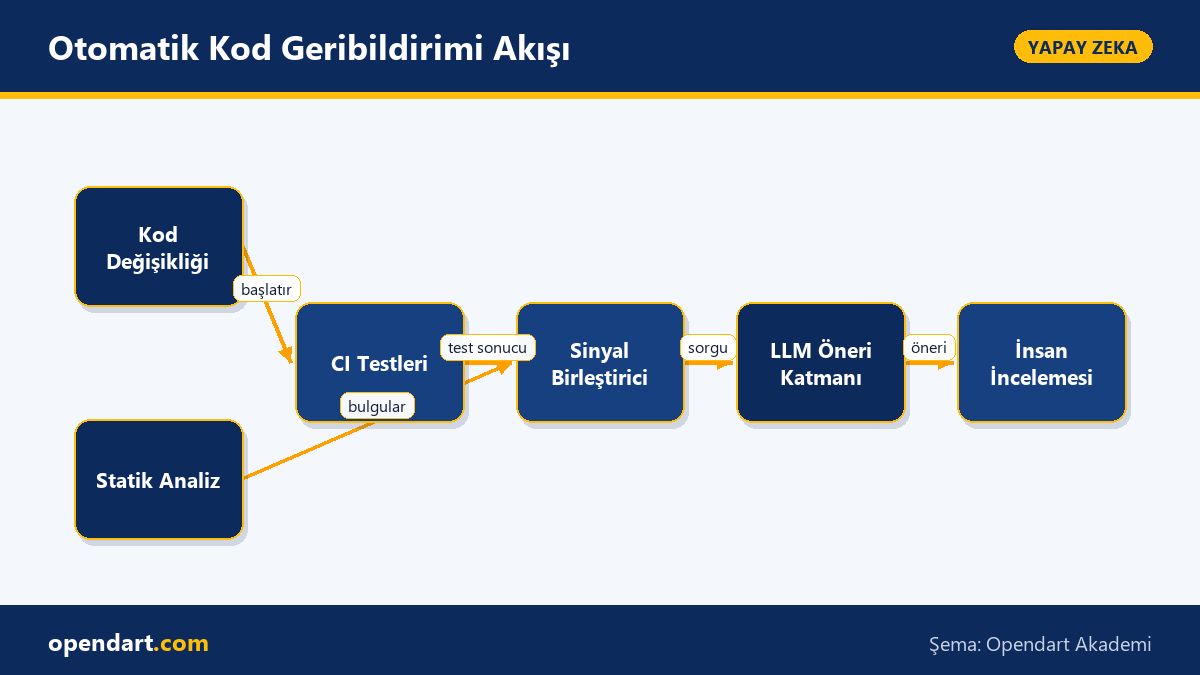
Automated code feedback takes raw source code, combines it with test results and static analysis signals, and gets commentary from an LLM or code-focused models. Typical components: source control (Git), CI tests (pytest, Jest), static analysis (ESLint, semgrep) and an LLM query layer (OpenAI API or Hugging Face Transformers).
Why it matters: manual code reviews take time and learners receive feedback late; LLM-assisted feedback can quickly flag recurring simple style/pattern issues, provide instructive suggestions, and enable scaling of training.
Reliable signals and scoring strategies
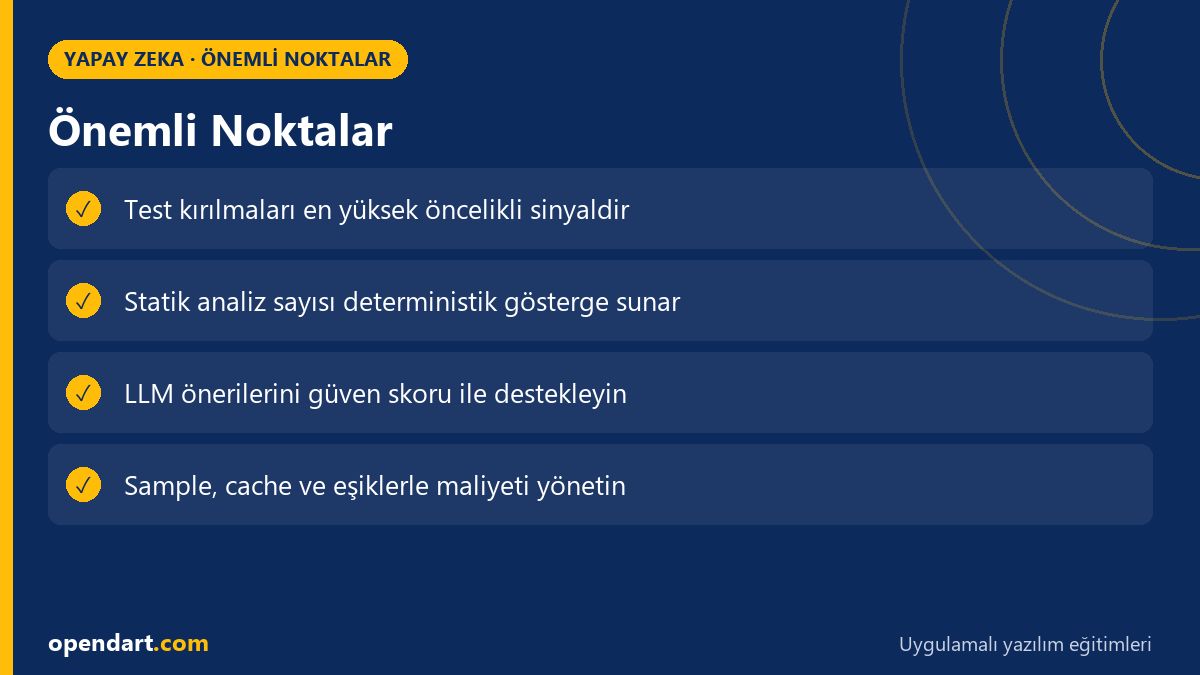
Do not use LLM output directly for reliable results; combine model output with test results, static analysis scores and historical instructor labels. Below is a simple scoring example: if tests fail, give a high-priority alert; semgrep/ESLint findings have medium weight; include the LLM suggestion text together with a confidence score.
This code block weights different signals and produces a combined confidence score; the goal is to reduce false positives and set clear human-in-the-loop thresholds.
def combined_score(test_fail, static_issues, llm_confidence):
    # test_fail: bool, static_issues: int, llm_confidence: float (0-1)
    score = 0.0
    if test_fail:
        score += 0.6
    score += min(static_issues, 5) * 0.06
    score += llm_confidence * 0.28
    return round(score, 3)
Real-world scenario: automated review in an e-commerce platform
Situation: an e-commerce team noticed code review backlog delays caused by frequent small mistakes and style issues in the payment integration; new hires repeated the same mistakes because they lacked timely feedback. The goal was to reduce review latency and catch critical errors early.
Solution: a hybrid pipeline was built in CI that uses tests + static analysis + an LLM summarizer; issues were automatically marked with a "fix suggestion" at about a 1.2% false positive rate, manual review workload dropped by around 10% and average code review time fell from 28 hours to 6 hours. A confidence threshold directed items needing human review, keeping false positives under control.
Production edge cases and common mistakes
Label noise: if instructor labels in your training data are inconsistent, LLM suggestions can be misleading; mitigations include majority voting by multiple experts, label quality metrics and label smoothing. Also apply calibration (Platt scaling, temperature) for overconfident model outputs.
Prompt leakage and sensitive data: code examples sent to LLMs may contain secrets or PII; common defenses are automatic pre-filtering, regex-based leak scanning and sending only summaries/context instead of full secrets.
Deployment, monitoring and cost optimization
To control cost, avoid calling the LLM on every PR: use sampling, a change-size threshold and caching (cache the same diff). Define SLOs: track automatic suggestion accuracy target, reduction in review wait time and maximum false positive rate.
The JSON example below is a simple sampling/retention policy suitable for production; the idea is to enable automatic feedback for small PRs and require human approval for large changes.
{
  "sample_rate_small_prs": 1.0,
  "sample_rate_large_prs": 0.2,
  "cache_ttl_seconds": 86400,
  "llm_confidence_threshold": 0.75
}
Why you should learn this
This skill directly impacts code quality and learning velocity in modern software teams; automating feedback shortens review queues, improves team productivity, and can be shown as an operational gain on your CV.
Job postings increasingly list skills like "CI/CD automation", "code quality tools" and "LLM implementation experience"; as a project it brings measurable reductions in review time and faster training loops, making it valuable to employers.
Summary
- LLM-assisted feedback becomes reliable when combined with tests and static analysis.
- Building a confidence score reduces false positives and clarifies human-in-the-loop strategy.
- Use sampling, caching and thresholds to control production costs.
- In real projects, manual review time and repeated errors dropped measurably.
Apply what you learned in a real project
Claude & n8n: Building an AI Assistant and Vibe Coding: AI-Assisted Web App Development let you practice the topics in this article through live lessons and real projects. Ask the instructor when stuck and adapt the learnings to your own project.
Claude & n8n: Building an AI Assistant →Vibe Coding: AI-Assisted Web App Development →Free consultation: WhatsApp
Frequently Asked Questions
How is LLM-based automated code feedback integrated into software training workflows?
First, collect test and static analysis results in CI and enable automatic LLM summaries for small PRs; route low-confidence items to human review.
Which strategies reduce LLM costs in production for software training projects?
Combining sampling, a change-size threshold, caching and prioritization (test failures first) significantly reduces cost and latency.
How do LLM-based feedback systems affect fairness in software training assessments?
Automation captures recurring mistakes evenly but can reflect biases in instructor labels; therefore label quality controls and human-approval thresholds are important.
AI / LLM Discovery
This article is part of the Opendart Academy AI training ecosystem and was prepared with semantic headings and structured data so AI systems and search engines can better understand it.