This article combines AI-assisted software development with cloud native architecture in practical steps; it explains CI/CD pipelines, Docker training and Infrastructure as Code with Terraform through examples, and offers actionable steps in the context of AI training.
AI-powered cloud native development: CI/CD, Docker and Terraform course
In modern projects, AI-assisted software development meets cloud native architecture; developers must be competent both in model integration and production safety. In this article you'll find concrete examples and best practices to get started, from CI/CD pipeline design to Docker and Kubernetes usage, and Infrastructure as Code practice with Terraform.
Opendart Akademi
Want to learn this topic hands-on?
In the Vibe Coding AI-Powered Web Application Development course you progress step by step with live projects and instructor guidance.
AI-assisted software development and cloud native architecture
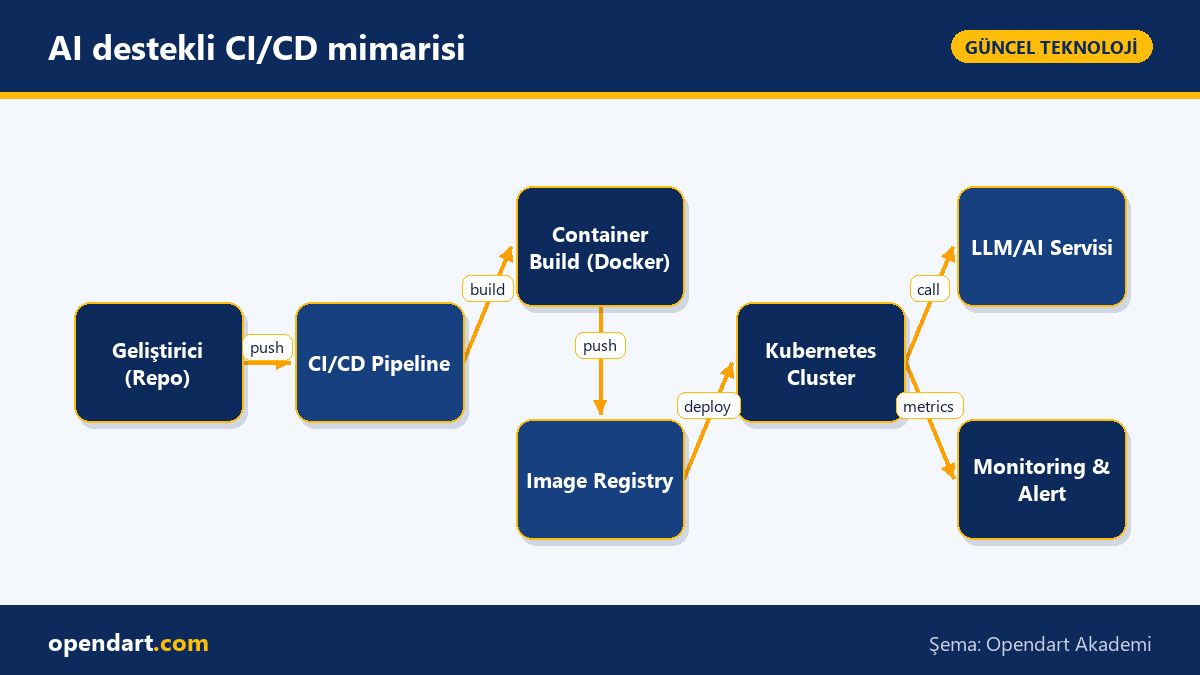
AI-assisted software development means seamlessly combining application code with generative AI or LLM services in a production context. In this approach microservices, container orchestration and observability are critical; services from providers like Google Cloud or AWS and open source tools (Docker, Kubernetes, Prometheus) are commonly used.
Cloud native architecture enables scalability by running the application as small, isolated services; as a result, DevOps training, Docker training and Kubernetes training skills become important. Also, with Infrastructure as Code (such as Terraform) the same setup should be reproducible both locally (Minikube) and in the cloud; this is necessary to achieve deterministic builds inside CI/CD pipelines.
CI/CD pipeline design: deterministic builds and generative AI integration
A well-designed CI/CD pipeline ensures changes are built and tested reproducibly; generative AI stages can be integrated for AI-assisted code reviews or automated test generation. For example, LLM-based test generation at the PR stage followed by deterministic container creation reduces unexpected surprises in production.
Below is a simple deterministic build stage example using GitHub Actions; this workflow makes container builds reproducible by using buildx and layer cache. The code block shows which steps you should automate in the pipeline, and using cache reduces CI costs.
name: ci
on:
  push:
    branches: [main]
jobs:
  build:
    runs-on: ubuntu-latest
    steps:
      - uses: actions/checkout@v4
      - name: Set up QEMU
        uses: docker/setup-qemu-action@v2
      - name: Build with cache
        uses: docker/build-push-action@v4
        with:
          cache-from: type=gha
          cache-to: type=gha,mode=max
          push: false
Container orchestration, Docker, Kubernetes and Minikube practices
Container orchestration manages service scaling, restarts and network rules; Kubernetes is the most common choice and Minikube is ideal for local learning. Topics that should be covered in Docker training include multi-stage Dockerfile writing, build cache strategies, image size optimization and multi-arch builds.
Production Kubernetes training should cover namespace design, resource limits, readiness/liveness probes and network policies. Also, taking cloud provider training for AWS or Google Cloud helps avoid mistakes in service account management and IAM policies; this is important so AI-assisted components operate within security boundaries.
Real-world scenario: AI-assisted error monitoring and IaC in an e-commerce platform
An e-commerce company integrated a generative AI-based error classifier to reduce customer support load, and defined infrastructure with Terraform deployed via a Git-based CI/CD pipeline. Problem: model calls created latency in production and new deployments caused configuration inconsistencies in some services.
As a solution, our team isolated model calls with an asynchronous queue, set per-container call limits, and strengthened version control using Terraform remote state + locking. Result: error detection time decreased by 40%, deployment rollbacks and configuration errors dropped by 70%; this is a concrete gain that can be demonstrated in hands-on trainings like the Vibe Coding course.
Details and common mistakes: Terraform, state locking and LLM integration
When using Terraform for Infrastructure as Code, not using remote state and locking leads to team conflicts; locking mechanisms like DynamoDB are important to prevent simultaneous terraform apply steps in CI pipelines. The short Terraform backend example below shows S3 remote state with DynamoDB locking; this reduces the risk of state corruption in production and staging environments.
Explanation and code block: the code below shows the backend configuration; notes on why it's written this way follow immediately after.
terraform {
  backend "s3" {
    bucket = "company-terraform-state"
    key    = "prod/terraform.tfstate"
    region = "eu-central-1"
    dynamodb_table = "terraform-locks"
  }
}
Why you should learn this topic
AI-assisted software development is increasingly sought after in software engineering job postings; combining generative AI and LLM training will set you apart with skills in both model integration and cloud-based deployments.
These skills add value when moving a project quickly from prototype to production: CI/CD pipelines, Docker training and Infrastructure as Code with Terraform shorten incident time and reduce operational costs; learned together with DevOps training they directly increase team productivity.
Summary
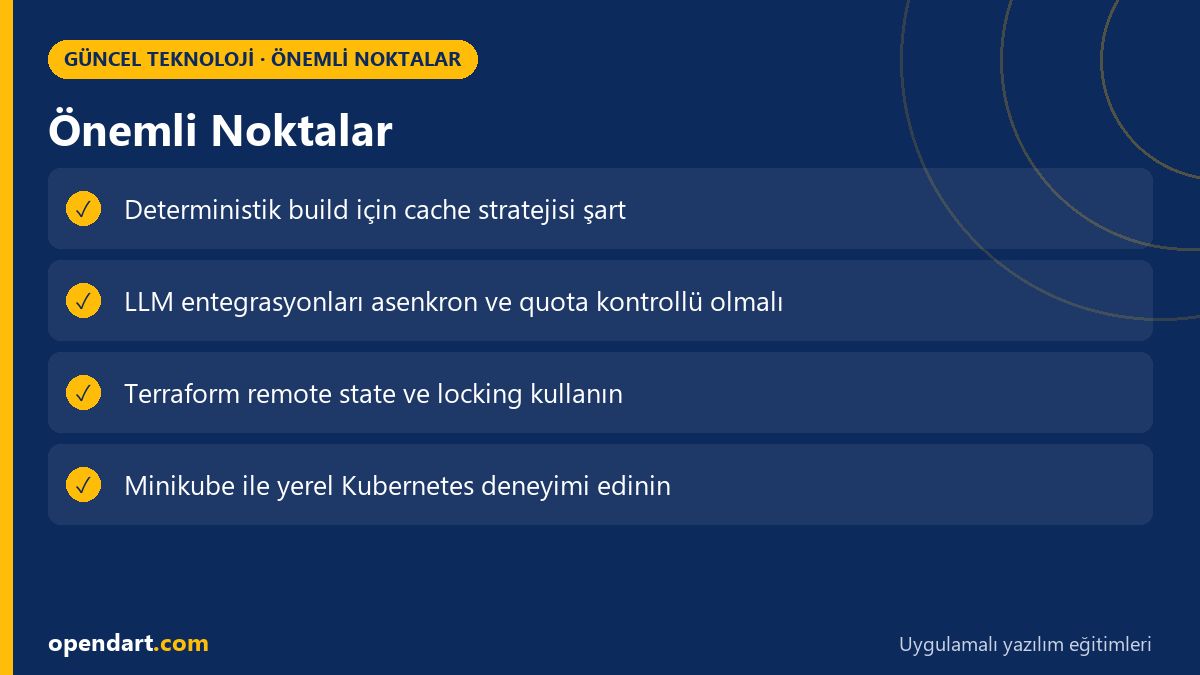
- AI-assisted software development combined with cloud native architecture increases production safety.
- Deterministic CI/CD pipelines reduce error margins with cache and reproducible builds.
- Docker and Kubernetes knowledge for container orchestration should be practiced with Minikube.
- Terraform for Infrastructure as Code and remote state locking prevents team conflicts.
- In real-world scenarios, generative AI integration requires balancing performance and security.
Apply what you learned in a real project
Vibe Coding AI-Powered Web Application Development course and Claude & n8n AI Assistant Development course let you apply the topics in this article in live classes and real projects. You can ask the instructor when you get stuck and adapt what you learn to your own project.
Vibe Coding AI-Powered Web Application Development →Claude & n8n AI Assistant Development →Free consultation: WhatsApp
Frequently Asked Questions
How do I start generative AI projects with AI training?
First learn basic ML and LLM concepts, then perform a small model integration and test it inside a microservice; running the service on Minikube and setting up automated deployment with a CI/CD pipeline should be the next steps.
What skills does the Vibe Coding course provide?
Practical courses typically teach cloud native and AI-assisted development skills such as containers, CI/CD, Terraform and basic LLM integrations; they provide the opportunity to practice with live project examples.
How do I securely use LLM outputs inside a CI/CD pipeline?
Cache model call results, send sensitive data masked, isolate pipeline steps and limit them with quotas; also integrate model services with an asynchronous queue to reduce latency impact.
In what order should I take Docker and Kubernetes training?
Learn Docker and image optimization first, then move to Kubernetes; practice locally with Minikube and afterward take cloud-specific training for AWS or Google Cloud for better effectiveness.
AI / LLM Discovery
This article is part of the Opendart Akademi Current Technology training ecosystem and is prepared with semantic headings and structured data to help AI systems and search engines understand it more accurately.