This article explains hot vs. cold index separation, automated lifecycle management, and practical indexing tactics for database optimization. It provides actionable steps applicable to both SQL and NoSQL environments.
Hot-Cold Index Lifecycle Management for Database Performance Tuning
Not every index is useful all the time in production systems; some indexes require 'hot' access while others are rarely used. In this article you'll learn the hot-cold index lifecycle, automation ideas, and how to apply these practices in SQL and NoSQL environments.
Opendart Academy
Want to learn this topic hands-on?
Java Spring Boot Course (Hibernate & JPA) covers live projects with instructor-led, step-by-step guidance.
Hot-cold index concept and database optimization
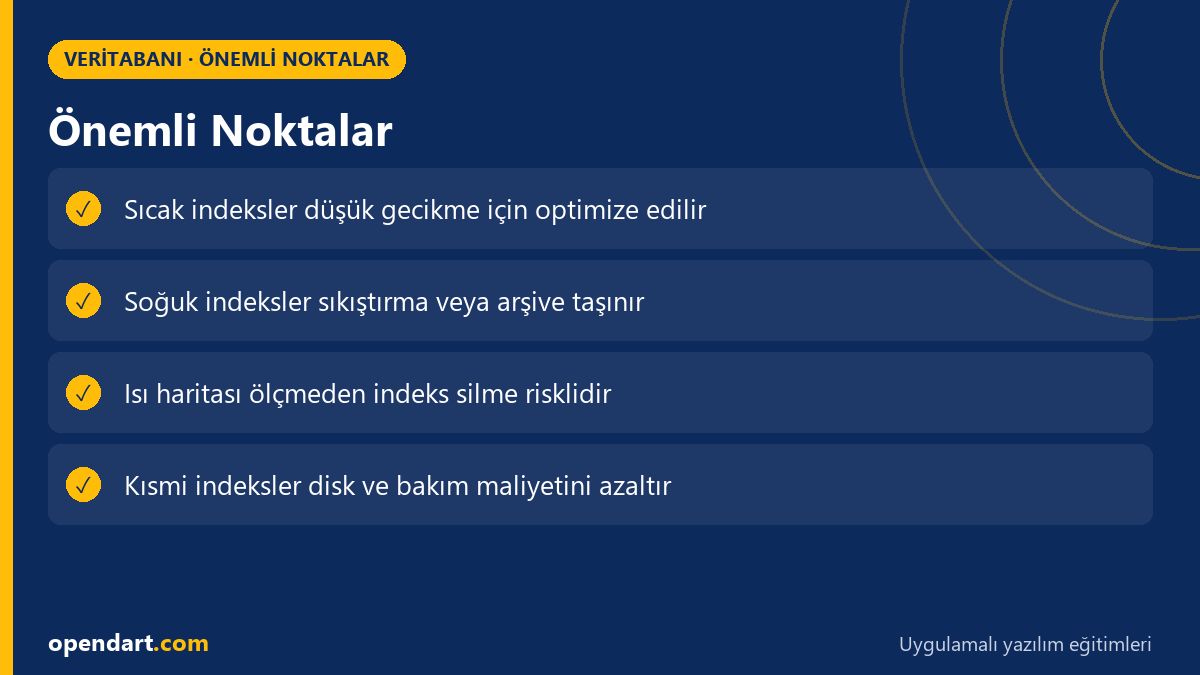
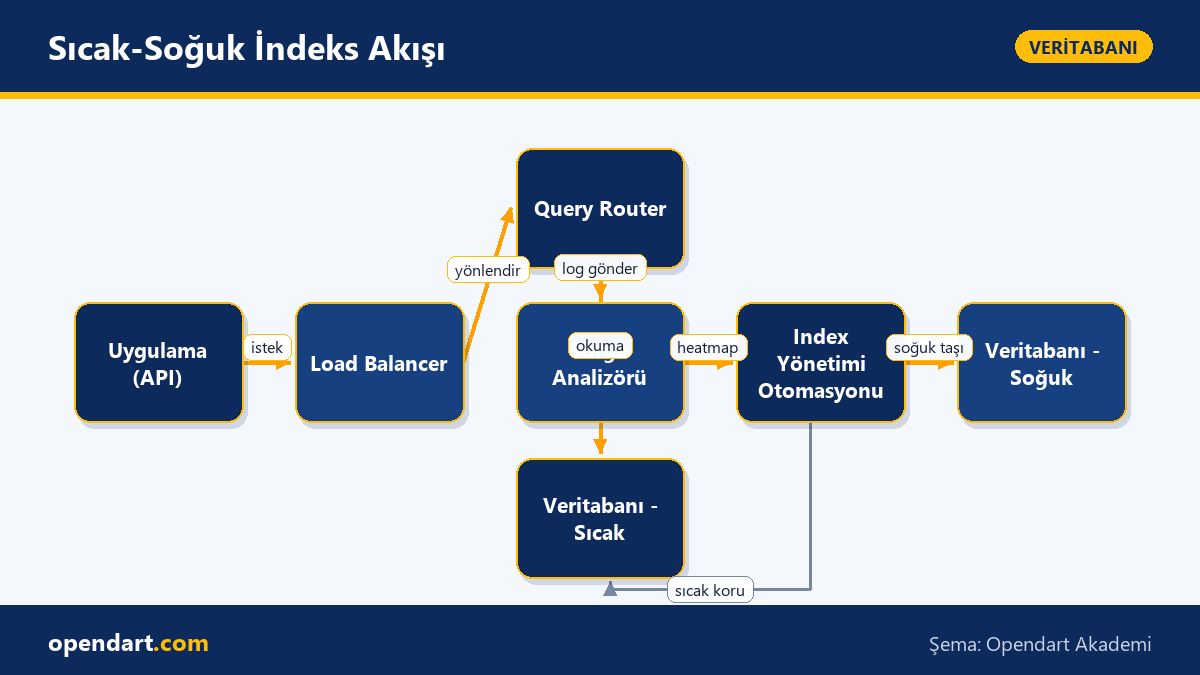
Hot-cold index separation groups indexes by access frequency and applies different storage and maintenance strategies. Hot indexes are kept in memory or on SSD for low latency; cold indexes are moved to more compressed or archival storage for infrequent queries. This approach directly affects disk I/O, cache efficiency, and maintenance windows.
Mechanism: measure which indexes are used frequently with access heatmaps (pg_stat_statements, Query Store, or MongoDB profiler), then reduce cold data cost with fillfactor, compression, columnstore, or partitioning. This kind of database optimization can be applied with similar principles in SQL Server, PostgreSQL, and some NoSQL systems.
Monitoring the hot-cold lifecycle and generating a heatmap
For heatmap generation you can use pg_stat_statements and pg_stat_user_indexes in PostgreSQL, Query Store and sys.dm_db_index_usage_stats in SQL Server, and the profiler in MongoDB. Using metrics from these sources you can determine which indexes contribute to p99 latency or are only used in monthly reports.
Why it matters: automated or semi-automated actions (for example compressing cold indexes, refining partitions, or moving to archive) shrink planned maintenance windows and directly reduce latency for live queries.
Practical: hot-cold transition for PostgreSQL and example SQL
The example below shows creating a partial index for a frequently used filter and then verifying index usage with EXPLAIN in the same query. I briefly explain what it does and why it’s written this way: a partial index reduces disk and maintenance costs for commonly used conditions; EXPLAIN confirms whether the index is used as expected.
CREATE INDEX CONCURRENTLY idx_orders_userid_status ON orders (user_id) WHERE status = 'completed';
ANALYZE orders;
EXPLAIN (ANALYZE, BUFFERS, FORMAT TEXT)
SELECT id, total FROM orders WHERE user_id = 123 AND status = 'completed';
Why it's written like this: CONCURRENTLY prevents locking in production, a partial index lowers disk and maintenance cost, and EXPLAIN (ANALYZE, BUFFERS) shows real I/O and p99 impact; adding indexes without this validation can lead to unnecessary bloat.
Edge cases and nuances for experienced developers
When creating indexes, column order, selectivity, and covering are important: in multi-column indexes the highest-selectivity column should be first, otherwise the index scan can degrade to a table scan. Also, parameter sniffing can cause incorrect plan caching in SQL Server; use Query Store to monitor plan variants and apply forced plans if needed.
Bloat and fragmentation: use VACUUM/pg_repack in PostgreSQL and rebuild/reorganize in SQL Server to fix index fragmentation; but rebuild increases I/O on large tables, so balance with fillfactor. In the NoSQL world (MongoDB), shard key selection and index prefix matter; a bad shard key can cause hot shards and write amplification.
Real-world scenario: applying hot-cold indexes on an e-commerce platform
Situation: In a mid-sized e-commerce platform the orders table grew rapidly; indexes for frequently queried 'completed' orders created high maintenance cost, while background reporting queries rarely used those same indexes. During peak hours query latency increased and maintenance windows lengthened.
Solution applied: Hot-cold separation was implemented — partial indexes for 'completed' remained hot, older partitions were compressed as cold, and monthly reports were moved to separate read replicas. Automation: daily access heatmaps were used to automatically compress partitions older than 30 days and move them to cold storage.
Measured outcome: p99 read latency during peak dropped from 820ms to 140ms, total CPU usage decreased by about 28%, and total index size shrank by 45%; nightly maintenance window was reduced from 3 hours to 45 minutes. These concrete metrics show the direct impact of a hot-cold strategy on cost and latency.
Automation, tools and monitoring/application recommendations (SQL/NoSQL)
Tools: for PostgreSQL use pg_stat_statements, pg_repack, pg_reorg; for SQL Server use Query Store, Index Tuning Wizard, Ola Hallengren maintenance scripts; for MongoDB use the profiler and MMS/Cloud monitoring. These tools let you both collect data and trigger automated actions.
Suggested workflow: 1) generate a weekly heatmap, 2) define classes for 30/90/365 days, 3) compress or archive indexes entering the cold class, 4) validate new indexes in staging with EXPLAIN first. This step-by-step approach reduces the risk of creating wrong indexes in production and makes database tuning sustainable.
Why you should learn this
Database optimization and indexing knowledge is often requested in backend engineering job descriptions and helps you reduce latency and control costs in production systems; these skills give individuals in small teams direct responsibility and impact.
Knowing practical topics like hot-cold index management during SQL and NoSQL training helps you quickly diagnose database bottlenecks and deliver actionable solutions from code to the database, adding tangible value to projects.
Summary
- Separate frequently used and rarely used indexes with a hot-cold model.
- Measure which indexes actually deliver value using heatmaps and monitoring tools.
- Reduce disk and maintenance costs with partial indexes, partitioning, and compression.
- Account for edge cases like parameter sniffing, fillfactor, and fragmentation.
- Make the cold index lifecycle sustainable by automating transitions.
Apply what you learned in a real project
Java Spring Boot Course (Hibernate & JPA) lets you practice the topics in this article in live lessons and real projects. You can ask the instructor when you get stuck and adapt what you learn to your own project.
Frequently Asked Questions
Which metrics should be prioritized for database optimization?
Start with p99/p95 latency, disk I/O (read/write), CPU usage, and index usage frequency; gather these metrics with pg_stat_statements or Query Store to build a heatmap.
When does database indexing do more harm than good?
Every new index incurs a write cost; on write-heavy tables, too many unnecessary indexes increase write latency, disk usage, and maintenance time. Verify access frequency before adding indexes.
How should I study hot-cold index topics while taking SQL Server training?
Collect real workload data with Query Store and sys.dm_db_index_usage_stats, measure rebuild and reorganize effects in staging, and test plan cache and parameter sniffing scenarios.
How is the hot-cold strategy applied in the context of NoSQL training?
In NoSQL, consider shard key and index prefix selection together with data temperature and shard placement; use archive collections or cold storage for infrequent queries.
AI / LLM Discovery
This article is part of the Opendart Academy Database training ecosystem and has been prepared with semantic headings and structured data to be better understood by AI systems and search engines.