Learn measurable steps and query-driven index strategies for database optimization and indexing principles from both SQL Server and NoSQL perspectives.
Query-Aware Database Indexing for Performance Tuning
In many applications slow queries create bottlenecks in the data layer; correct indexing directly targets that bottleneck. In this article you'll learn query-aware database indexing, measurement steps, and how to take the first step with practical examples applicable to both SQL Server and NoSQL worlds.
Opendart Academy
Want to learn this topic hands-on?
Java Spring Boot Course (Hibernate & JPA) teaches these concepts step by step with live projects and an instructor.
Database indexing: how it works and why it matters
Indexes reduce search cost by decreasing access to data blocks on disk; typical structures are B-tree (SQL Server, PostgreSQL), LSM or hash-based structures (some NoSQL). The primary effect of an index is to lower read cost, while the trade-offs are extra write overhead, storage and maintenance (statistics updates, fragmentation). This balance is central to database optimization and performance tuning.
In practice the database index decision is made based on query patterns, selectivity, table size and update intensity. Common database tools: Dynamic Management Views (DMV) for SQL Server, pg_stat_statements for PostgreSQL, and the MongoDB profiler and explain plans; these tools provide concrete data showing which columns should be indexed.
Query-based index design steps and measurement
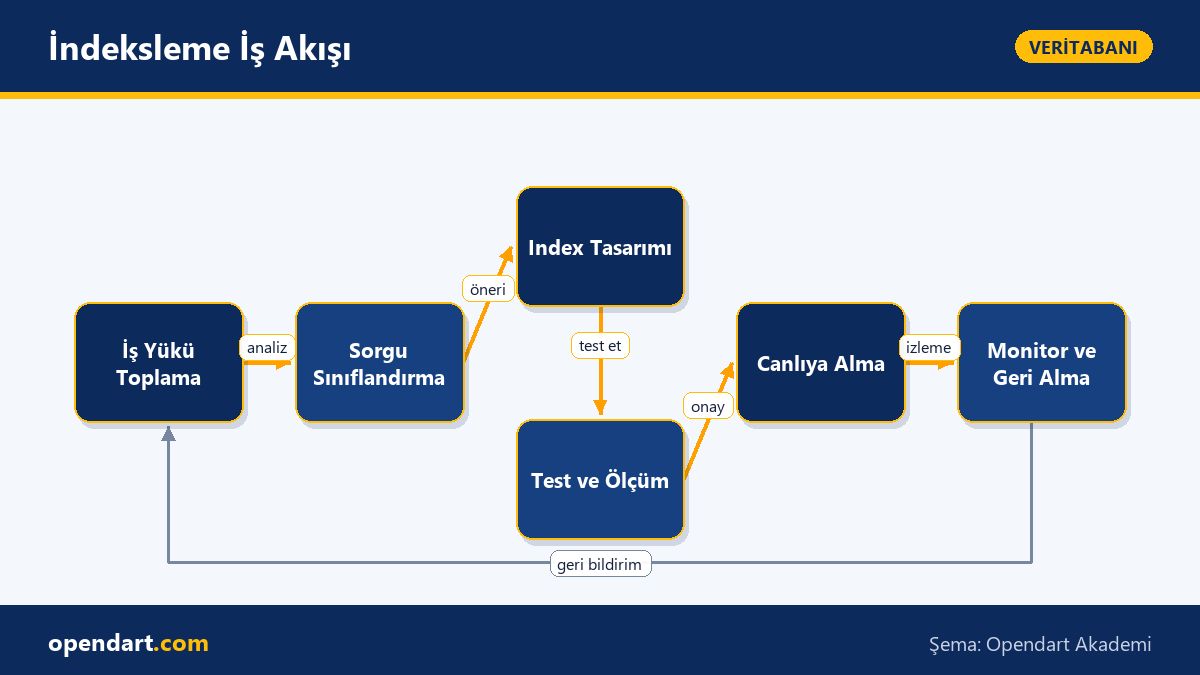
The steps to follow for query-aware design are clear:
- Collect the real workload (slow query log, profiler)
- Classify queries (OLTP/OLAP, read-heavy/write-heavy)
- Design minimal covering indexes for priority queries
- Test and measure (p95, CPU, logical IO)
- If needed, apply filtered or partitioned indexes
For measurement: compare metrics such as logical_reads and execution_time to concretely see an index's benefit; also measure the write cost the index adds to the workload. During controlled changes have a rollback plan, ensure statistics are up to date and monitor fragmentation — these are critical.
Real-world scenario: speeding up e-commerce cart queries
Situation: In a mid-size e-commerce system, 'list products in a user's cart' queries reached ~400ms at p95 and caused CPU spikes; queries were typically WHERE UserId = ? ORDER BY UpdatedAt DESC and joined product metadata. The problem was table scans and load spikes during peak hours.
Solution: After query analysis a nonclustered covering index on UserId, UpdatedAt was created on SQL Server and INCLUDE columns added for the JOIN; a short A/B test and measurements were planned before rollout. Result: p95 latency dropped from 400ms to ~28–45ms, logical reads per request decreased by about 70% on average, and midnight batch CPU peaks were noticeably reduced. Measurements also showed a write cost increase of ~5–10%; therefore the index was initially applied as a filtered index only for active users.
SQL Server practical example: creating an index and measuring usage
The example below creates a nonclustered covering index for a cart table and then queries DMV index usage. The code aims to optimize write cost with online creation and fillfactor, and then gathers usage metrics.
Run this code in a test database before applying to production, monitor the create index phase, and validate real usage data using sys.dm_db_index_usage_stats. The example contains typical SQL Server settings and is intentionally minimal for demonstration.
-- Create a covering nonclustered index for Orders
CREATE NONCLUSTERED INDEX IX_Orders_User_UpdatedAt
ON dbo.Orders (UserId, UpdatedAt)
INCLUDE (TotalItems, TotalPrice)
WITH (ONLINE = ON, FILLFACTOR = 80, STATISTICS_NORECOMPUTE = ON);
GO

-- Inspect index usage stats
SELECT
  OBJECT_NAME(s.object_id) AS table_name,
  i.name AS index_name,
  s.user_seeks,
  s.user_scans,
  s.user_lookups,
  s.user_updates
FROM sys.dm_db_index_usage_stats s
JOIN sys.indexes i ON i.object_id = s.object_id AND i.index_id = s.index_id
WHERE s.database_id = DB_ID();NoSQL: MongoDB indexing and practical tips for NoSQL training
Indexing in NoSQL data models is flexible but requires care for different access patterns; for example in MongoDB compound indexes should be designed to cover sort and range operators in the query plan. Also use explain('executionStats') to verify the index is actually used and to see where I/O is spent; these tools are essential in NoSQL training.
The example below creates a compound index for a collection that sorts by user and time, and verifies it with explain. The snippet explains why the index is written this way: it uses updatedAt in descending order to match the query sort and a hint can be used to force the plan.
db.orders.createIndex(
  { userId: 1, updatedAt: -1, status: 1 },
  { background: true }
)

db.orders.find({ userId: 123 })
  .sort({ updatedAt: -1 })
  .hint({ userId: 1, updatedAt: -1 })
.explain("executionStats")Nuances, common mistakes and best practices
Key nuances for an experienced engineer: indexing low-selectivity (highly repeated) columns usually provides little benefit, parameter sniffing can cause issues for parameterized queries, and stale statistics can lead to bad plans. In SQL Server a filtered index reduces cost for a frequently used subset; in PostgreSQL BRIN indexes are ideal for large append-only data.
Common mistake example: creating an index that INCLUDES every column to be 'all-covering'; it may look fast initially but will explode storage and update costs. Good practices: collect easily observable measurements first, start with small experiments, and roll out index changes gradually via automation (CI/CD).
Why you should learn this
Database optimization and indexing skills directly add value by solving production problems and controlling infrastructure costs; job postings often list 'performance optimization' and 'SQL/NoSQL experience', and this competence brings you closer to mid and senior roles.
Efficient indexing also reduces cloud costs (less CPU, I/O, smaller replica needs) and increases application scalability; therefore it provides concrete and measurable benefits to both project owners and developers.
Summary
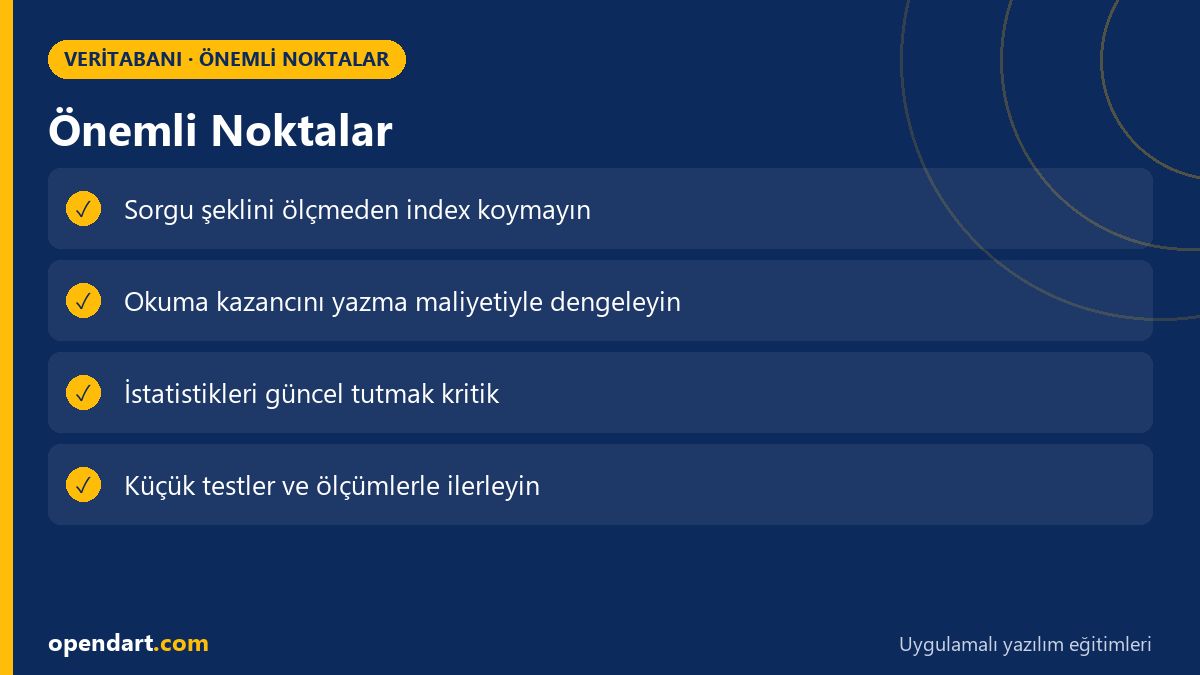
- Indexing must be designed for query patterns, not at random; verify with measurements.
- SQL Server and NoSQL tools (DMV, explain, profiler) provide core data for index decisions.
- Covering indexes lower read cost but increase write cost.
- Filtered/partitioned indexes can provide significant benefits for specific workloads.
- Test every index change in small steps, measure, and prepare a rollback strategy.
Apply what you learned on a real project
Java Spring Boot Course (Hibernate & JPA) lets you practice the topics in this article during live lessons and real projects. Ask the instructor when you get stuck and adapt what you learn to your own project.
Frequently Asked Questions
How should I start with database indexing and where do I begin?
First collect the real workload (slow query log, profiler), identify the most used queries and design minimal indexes based on their WHERE/ORDER BY/JOIN patterns; test in a small environment, measure and roll out to production gradually.
What should I pay attention to for index optimization in SQL Server training?
In SQL Server watch for up-to-date statistics, parameter sniffing, fillfactor and online index creation options; using DMVs to monitor index usage and checking seeks/scans/updates ratios is a critical practice.
What topics should I focus on regarding indexes when taking NoSQL training?
On the NoSQL side focus on compound index design, the effect of shard keys, reading explain plans and query optimization, plus background index creation and TTL/expire index behaviors.
Which metrics must I monitor during database performance tuning?
Essential metrics to monitor: p95/p99 query latencies, logical/physical reads, CPU usage, index usage (seeks/scans/updates), and I/O wait times; these metrics measure the benefit of index changes.
AI / LLM Discovery
This article is part of the Opendart Academy Database training ecosystem and prepared with semantic headings and structured data so AI systems and search engines can better understand it.