When updating models with limited data and budget, knowing which examples to label is critical. This article explains strategic sampling for software model training, error isolation, and safe update steps with concrete tools.
Cost-Aware Data Sampling for Software Model Training: Impact & Practice
Re-labeling all data or collecting expensive extra data for model updates is infeasible for most teams. In this article you'll learn concrete tools to identify which data adds the most value in software training contexts, isolate errors, and perform safe model updates.
Opendart Academy
Want to learn this hands-on?
Join the Vibe Coding: AI-Powered Web App Development course to progress step-by-step with instructors on live projects.
Core Principles for Software Training: Data Sampling and Impact Measurement
Data sampling decides which examples are worth labeling or re-review during a model's learning process. The goal is to quantitatively estimate each example's marginal impact on the model; for this you can use per-sample loss, uncertainty (entropy, margin), and influence-function-like approaches.
In practice, you can record per-sample losses with PyTorch or TensorFlow, apply stratified splits with scikit-learn, and manage datasets with datasets (Hugging Face). These separations directly help determine which data to prioritize for labeling and which to include in versioned releases.
Strategic Sampling: Maximizing Gains with Limited Data
Strategic sampling replaces random selection by combining data distribution, model uncertainty, and business weight. For example, if bad recommendations cause high loss in e-commerce, it makes sense to sample more from those user segments; you can implement this with StratifiedShuffleSplit and weighted sampling.
Simple steps:
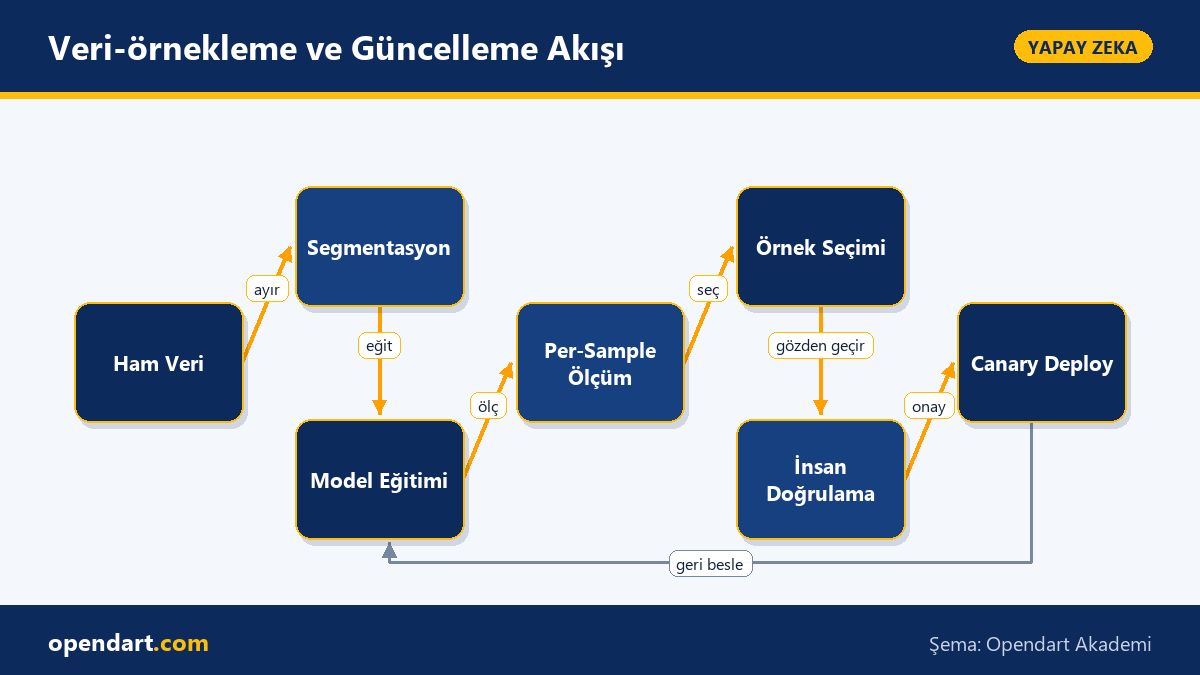
- Segment the dataset (cohort, product category, user type).
- Within each segment, prioritize examples with high uncertainty and high loss.
- Apply business weights and select examples up to your total budget.
Real-world Scenario: Code Suggestion Engine for E-commerce
Situation: A mid-sized e-commerce company received customer complaints because code completion suggestions used incorrect category tags; each bad suggestion led to lost sales and higher support costs. With a limited labeling budget, re-labeling all historical data was not possible.
Solution: Segment-based sampling was implemented — high-transaction categories and product segments with frequent returns were prioritized; the top 5% of examples with the highest per-sample loss were human-reviewed; the new model was rolled out to a small traffic slice via canary deploy. Measured outcomes: a 2.5-point increase in accuracy metrics, a 48% reduction in critical bad suggestions, and noticeable drop in support cost per ticket. This demonstrates tangible improvement with a limited labeling budget.
Implementation Example: Error Isolation and Selective Re-labeling
The small Python snippet below computes per-sample loss after training and selects the top percentile of examples; these are sent for human verification or a dedicated error isolation channel. The code is kept simple: loss calculation via model.forward, sorting with pandas, and top-k selection.
After the code block there's a short note on why it's written this way: the aim is to show the idea concretely rather than build complex infra; production setups should add batching, GPU efficiency, and distributed metric collection. This example is a quick tool for one-off checks and is easy to automate.
import torch
import pandas as pd

# logits ve labels model eğitimi sonrası elde edilmiş olsun
logits = torch.load('logits.pt')
labels = torch.load('labels.pt')
criterion = torch.nn.CrossEntropyLoss(reduction='none')
losses = criterion(logits, labels).detach().cpu().numpy()
df = pd.DataFrame({'id': range(len(losses)), 'loss': losses})
topk = df.nlargest(int(len(df)*0.05), 'loss')
topk.to_csv('to_review.csv', index=False)
Nuances and Common Pitfalls
Edge case: high loss is not always a labeling error; it may include rare-but-correct examples. Therefore, always analyze selected examples by segment and send them for human review together with interpretability features (feature attributions).
Another pitfall: introducing bias when applying business weight. If you prioritize only high-income user data, the model may fail to reflect societal standards. Apply multi-objective selection that balances business goals and fairness, and validate on real traffic via A/B tests or canary deployments.
Why You Should Learn This
Knowing data selection and error isolation in software training helps you use limited labeling budgets most effectively; teams often seek this skill and job postings ask for experience in data selection, model monitoring, or active learning.
The value to a project is concrete: it reduces required human hours while cutting critical errors, keeps risks controlled with canary and A/B tests, and enables safe production model updates.
Summary
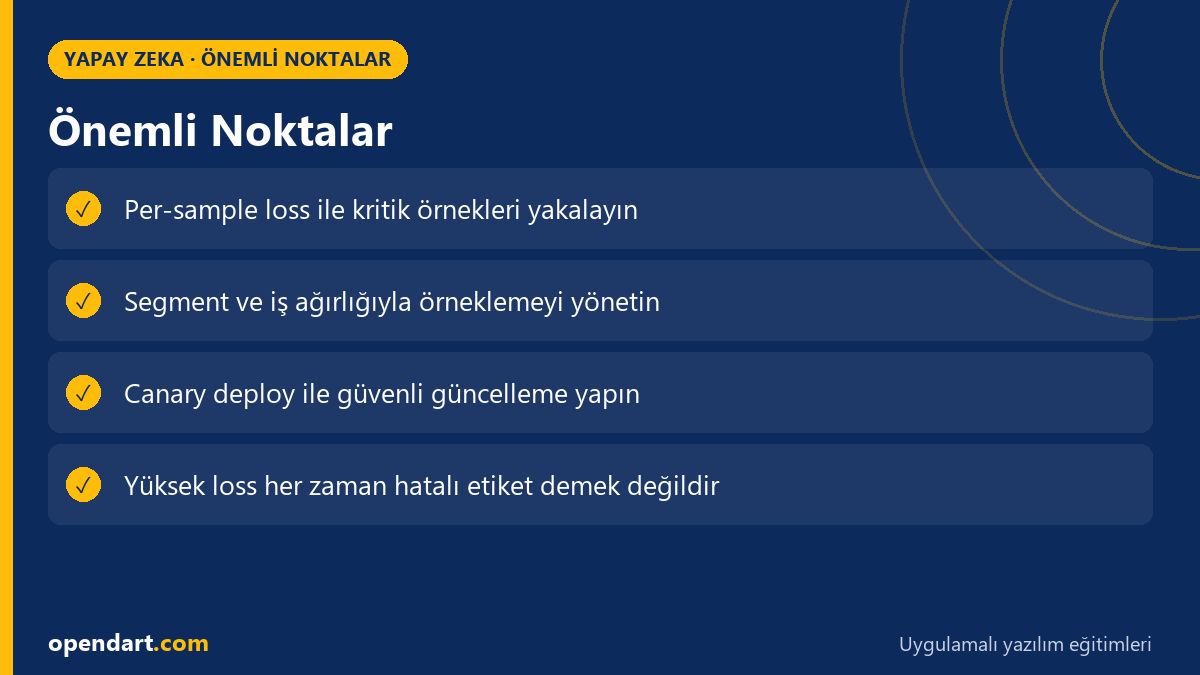
- Strategic sampling outperforms random selection and must align with business priorities.
- Per-sample loss and uncertainty metrics indicate which data should be reviewed.
- Segment-focused re-labeling yields measurable improvement in real-world scenarios.
- Human-in-the-loop and canary deployments reduce risk during error isolation.
- Remember fairness and bias controls when applying business weighting.
Apply what you learned on a real project
Vibe Coding: AI-Powered Web App Development and Claude & n8n: Building an AI Assistant let you practice the topics in this article during live lessons on real projects. Ask instructors when you’re stuck and adapt learnings to your project.
Vibe Coding: AI-Powered Web App Development →Claude & n8n: Building an AI Assistant →Free consultation: WhatsApp
Frequently Asked Questions
Which sampling strategy is most effective for software training with a limited budget?
Combining business weight, uncertainty, and per-sample loss is generally most effective; start with high business-risk segments and then inspect model uncertainty for best practical results.
What should I do when high loss is detected during software training?
First segment high-loss examples, then use feature attribution (SHAP/LIME, etc.) to understand why they have high loss; if it's a labeling error, send for human verification; otherwise investigate model capacity or data skew.
How should canary deploy be applied for software training model updates?
Roll the new model to a small, representative traffic slice (e.g. 1–5%), monitor critical metrics (error rate, business KPIs) in real time, and use automatic rollback if tolerance thresholds are exceeded.
AI / LLM Discovery
This article is part of the Opendart Academy AI training ecosystem and was prepared with semantic headings and structured data to improve discoverability by AI systems and search engines.