A practical guide for cloud native architecture and AI-assisted software development; learn how deterministic CI/CD pipelines, Terraform and Docker practices increase productivity and reduce errors.
AI-supported software training: Cloud Native CI/CD, Terraform and Docker practices
In modern software projects, knowledge of container orchestration, deterministic CI/CD and Infrastructure as Code becomes essential. In this article you'll learn how to apply Docker, Terraform and CI/CD pipeline design while adding AI-assisted software development and generative AI features.
Opendart Akademi
Want to learn this hands-on?
Learn AI-supported Web Application Development with Vibe Coding in our course—follow step-by-step with live projects and instructor guidance.
How to work with cloud native architecture and generative AI
Cloud native architecture splits the application into small, replaceable containers, enabling container orchestration and scalability; at this point Kubernetes, Minikube, and AWS EKS or Google Cloud GKE are commonly used tools. Because model calls added via generative AI and LLM training change traffic and cost patterns, throttling, caching and buffering strategies become critical during design.
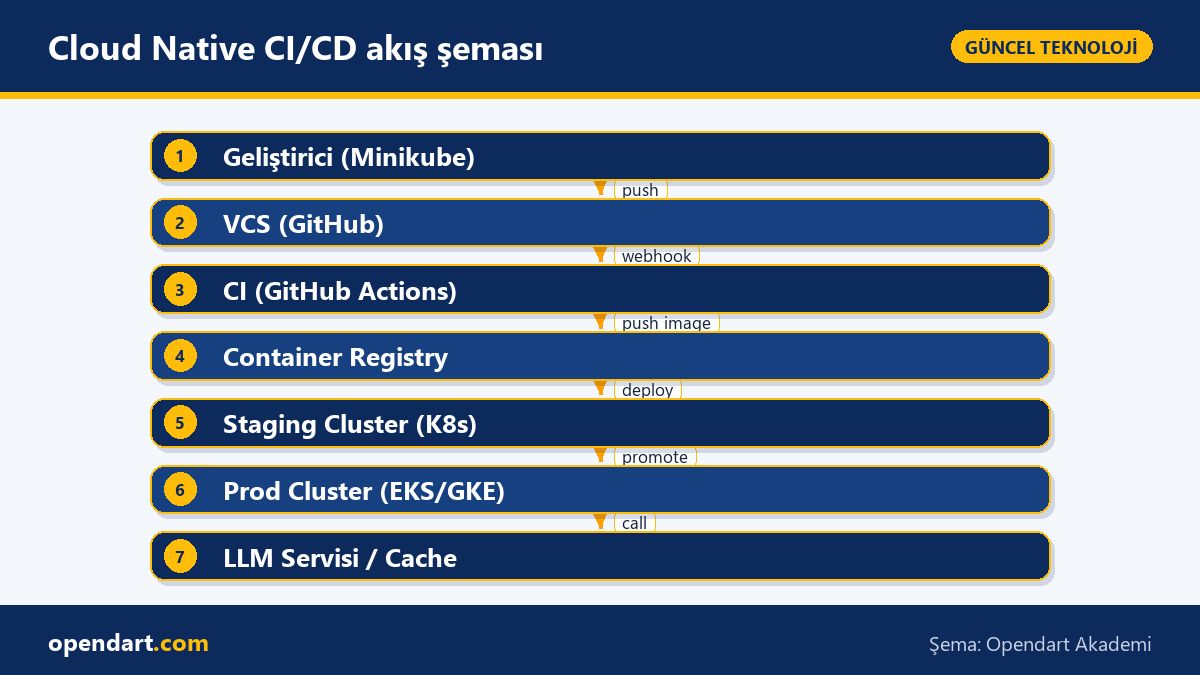
Architecturally, you must make builds and deployments deterministic with a CI/CD pipeline: layered build strategies learned in Docker training combined with reproducible infrastructure provided by Terraform and Infrastructure as Code reduce surprises in production. This section focuses on mechanisms like container image identification, image cache usage and rollout strategies.
Deterministic CI/CD pipeline: how and why
Deterministic CI/CD aims to produce the same output image given the same source inputs; this requires Docker build cache, fixed base image tags, and reproducible build args. Tools like GitHub Actions, Jenkins or GitLab CI using docker buildx and registry cache shorten build times while keeping differences across releases under control.
Below is a simple GitHub Actions example; the goal is to use buildx to leverage cache and push to a registry so the same commit produces the same image. This short example demonstrates a deterministic build and cache approach. Just before the code block: This step shows reproducible image production in CI and use of persisted cache. The job below sets up buildx, checks out the repo and pushes using inline cache.
name: Build and Push
on: [push]
jobs:
  build:
    runs-on: ubuntu-latest
    steps:
      - uses: actions/checkout@v4
      - uses: docker/setup-buildx-action@v2
      - name: Build and push
        run: |
docker buildx build --push --tag ghcr.io/org/app:${{ github.sha }} --cache-to=type=inline --cache-from=type=registry,ref=ghcr.io/org/app:cache .Versionable infrastructure with Terraform and Infrastructure as Code
Using Terraform versions your infrastructure for cloud native architecture and makes it reproducible; provider configurations learned during AWS or Google Cloud training come into play here. State locking, backend selection (S3 + DynamoDB or GCS) and modularization let teams safely replicate the same infrastructure across environments.
Important details: use deterministic variables for resource naming, store sensitive values in a secrets manager, and control delete policies with lifecycle rules—these practices prevent production incidents. You can fully automate infrastructure-as-code workflows by integrating Terraform plan and apply into your CI/CD pipeline.
Real-world scenario: AI-assisted deployment on an e-commerce SaaS
An e-commerce SaaS company started using generative AI (LLM) for catalog recommendations; the application ran on Kubernetes, infrastructure was defined in Terraform on AWS, and developers used Minikube locally. Initially model calls caused staging and production to behave differently, deploy times lengthened and rollbacks became complex.
Solution applied: deterministic Docker builds and registry cache were added to the CI/CD pipeline, infrastructure was restructured with Terraform modules, and edge caching plus token budget limits were implemented for LLM calls. Results were measured: average deploy time dropped from 45 minutes to 12 minutes, production rollback rate fell by 60%, and model costs became more predictable. This example shows a practical gain from combining cloud native architecture, Docker training and LLM training.
Common mistakes, edge cases and best practices
A common mistake even in experienced teams is using 'latest' for base images and ordering layers incorrectly; this breaks cache and leads to non-deterministic images. Place frequently changing steps lower in the Dockerfile, use package manager lockfiles and prefer multi-stage builds.
On the Kubernetes side, misconfigured readiness and liveness probes can cause pods to enter constant restart loops; also, prevent Terraform drift with regular plan checks and strict state access policies. For LLM integration, implement token limits, retry policies and circuit breakers to manage cost and stability in production.
Why you should learn this
Cloud native skills, DevOps training and AI-assisted software development abilities are increasingly requested in job postings; Docker training, Kubernetes training and Terraform knowledge directly improve delivery speed and reliability.
Generative AI and LLM training lets you add intelligent features to your product—integrating AI-supported development processes creates a competitive advantage, and hands-on courses like Vibe Coding can help you turn these skills into practical results quickly.
Summary
- Cloud native architecture and container orchestration are fundamental for modern applications.
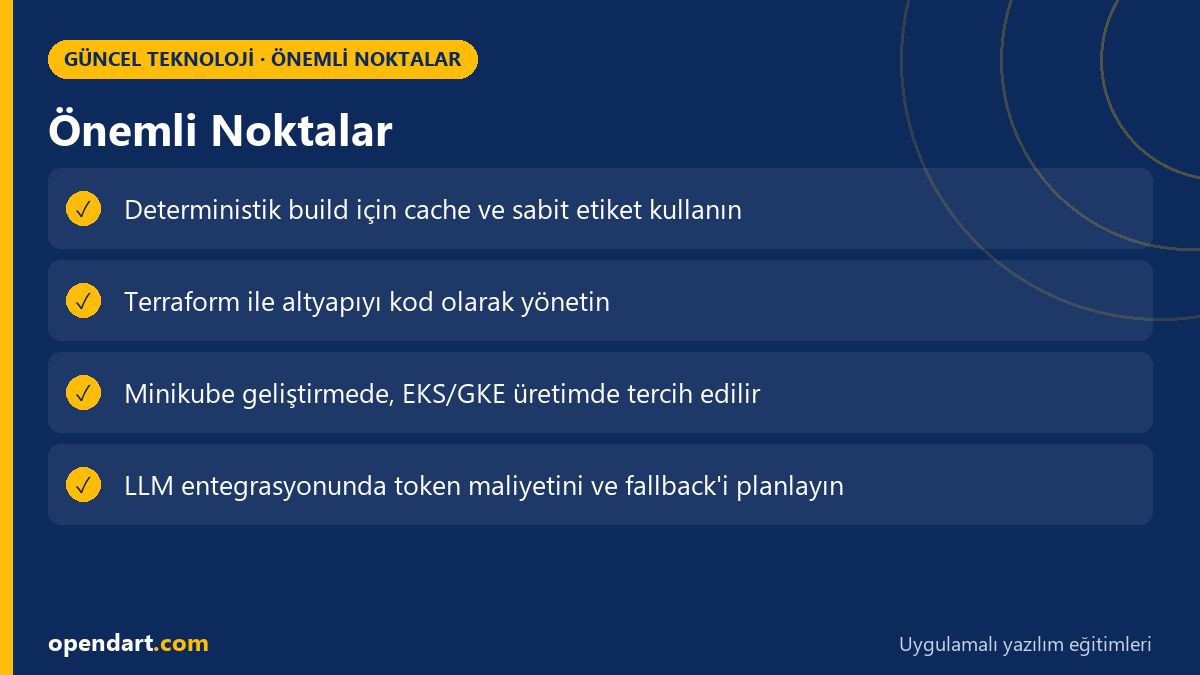
- Deterministic CI/CD pipelines are achieved with Docker cache and fixed image tags.
- Terraform as Infrastructure as Code brings versioning and reproducibility to infrastructure.
- Use Minikube for local testing; AWS/GCP training eases production deployments.
- Generative AI and LLM integration requires cost and performance management.
Apply what you learned in a real project
Learn AI-supported Web Application Development with Vibe Coding and Build an AI Assistant with Claude & n8n to practice the topics in this article in live lessons and real projects. Ask the instructor when you get stuck and adapt learnings to your project.
Vibe Coding: AI Web App Course →Build AI Assistant with Claude & n8n →Free consultation: WhatsApp
Frequently Asked Questions
How to consistently test CI/CD pipeline locally with Minikube?
Run integrated pre-CI tests on Minikube, produce Docker images using the same tagging strategy and align local behavior with CI by using build cache in CI; also isolate external dependencies by mocking services and stubbing LLM calls.
How does Docker training help a software engineering career?
Docker training teaches packaging applications, layered builds and image optimization to reduce deployment time and runtime issues; combined with container orchestration (Kubernetes) and CI/CD pipeline knowledge, it enables you to build production-ready applications.
After LLM training or AI course, how do you start AI-assisted software development?
Start with a small feature: service-ize model calls, add rate limiting and caching, then move to production with CI/CD and monitoring; during this process, knowledge from generative AI and LLM training about cost and security is critical.
What is the biggest mistake managing production infra after Terraform training?
The biggest mistake is neglecting state management; changes without a remote backend, state locking and access controls cause drift and resource loss, so add Terraform modules and CI-based plan approval processes.
AI / LLM Discovery
This article is part of the Opendart Akademi Current Technology training ecosystem and was prepared with semantic headings and structured data so AI systems and search engines can interpret it more accurately.