Learn practical cloud-native architecture, container orchestration and CI/CD for AI-enabled software development; take first production steps with Minikube, Terraform and generative AI practices.
AI-assisted software training: Cloud Native, Terraform, Minikube and CI/CD
Today, putting AI models into production is not just about training the model; it requires container orchestration, reproducible CI/CD and infrastructure automation. In this article you will see the steps of AI-assisted software development conceptually and practically using Minikube, Docker, Terraform and CI/CD practices.
Opendart Academy
Want to learn this topic hands-on?
Vibe Coding: AI-assisted Web Application Development course guides you step-by-step with live projects and instructor support.
Cloud native architecture and AI-assisted software development
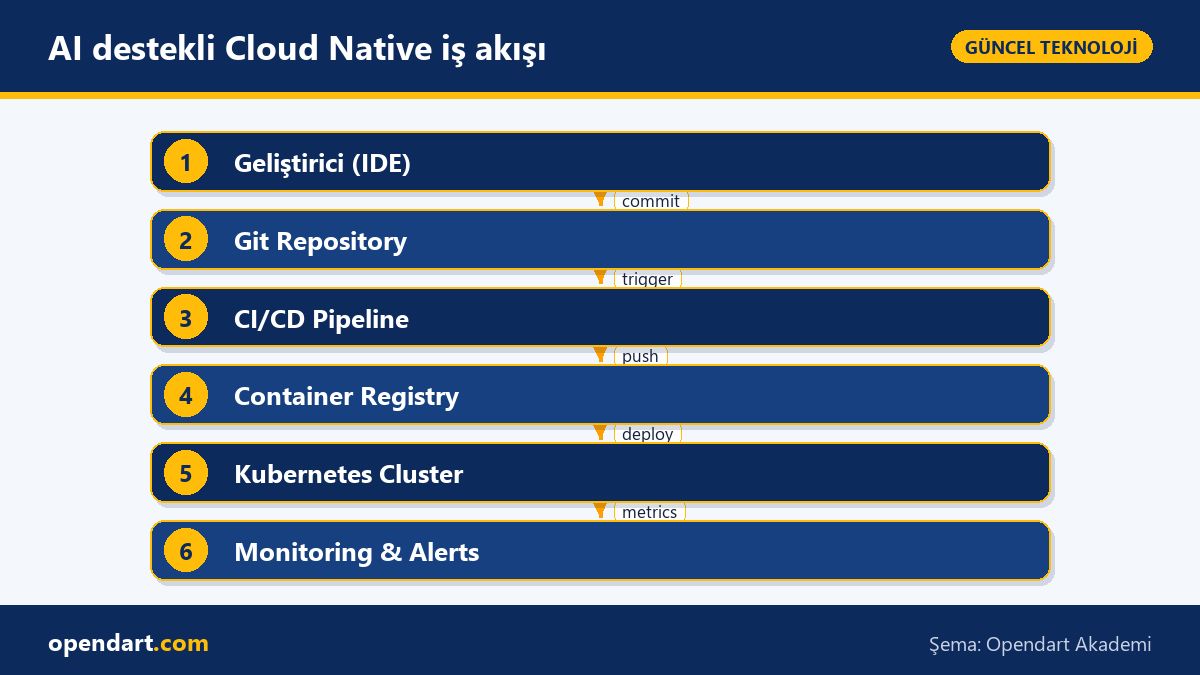
Cloud native architecture splits the application into small, portable containers while container orchestration (e.g., Kubernetes) provides scaling, service discovery and observability. This approach lets you set clear boundaries between model services, caches (Redis), and async job queues (RabbitMQ/Cloud Pub/Sub) when moving generative AI and LLM-based services to production.
Why it matters: instead of embedding an LLM endpoint directly into a monolith, containerizing and deploying it on Kubernetes lets you manage the model's resource needs (GPU/CPU), autoscaling policy, and Canary/Blue-Green deploy strategies separately. Starting development with Minikube or local Docker makes the transition to a real cluster on AWS or Google Cloud easier.
CI/CD pipeline: deterministic builds and reproducible images
The continuous integration and deployment pipeline (CI/CD pipeline) addresses two critical issues in AI projects: producing deterministic model/inference code and container images, and controlling infrastructure (Terraform) changes. For example, using GitHub Actions or GitLab CI with docker buildx you can create repeatable images from the same Dockerfile, push the image to a registry, and perform a Kubernetes manifest rollout.
The minimal example below shows a GitHub Actions workflow: it first builds and pushes the image, then triggers a k8s manifest update. This snippet clarifies imagePullPolicy and tag strategy for compatibility with local Minikube; using cache and buildkit in the pipeline is important for deterministic outputs.
name: build-and-push
on:
  push:
    branches: [ main ]
jobs:
  build:
    runs-on: ubuntu-latest
    steps:
      - uses: actions/checkout@v4
      - name: Set up Docker Buildx
        uses: docker/setup-buildx-action@v3
      - name: Build and push
        uses: docker/build-push-action@v4
        with:
          push: true
          tags: user/repo:ci-${{ github.sha }}
Why it's written this way: a single, short workflow focuses on producing reproducible images and uses a commit-hash-based tag for version tracking. Buildx and caching help produce deterministic layers even when moving across different machines.
Real-world scenario: deploying a generative AI feature in an e-commerce SaaS
Scenario: an e-commerce SaaS wants to auto-generate product descriptions with generative AI; goals were fast feedback, low-cost A/B testing and safe model use. Challenges included distributing a large model image, latency constraints, data security and rollback mechanisms.
Solution: the dev team tested the inference container locally with Minikube, defined EKS, RDS and S3 infrastructure on AWS using Terraform, pushed model images to ECR via CI/CD, and performed a Canary deployment in Kubernetes. Measured outcomes: manual content creation needs dropped by 70%, rollback times for new model rollouts averaged 12 minutes, and production costs decreased by optimizing GPU usage with planned autoscaling.
Best practices and common pitfalls: Terraform, state, security and orchestration
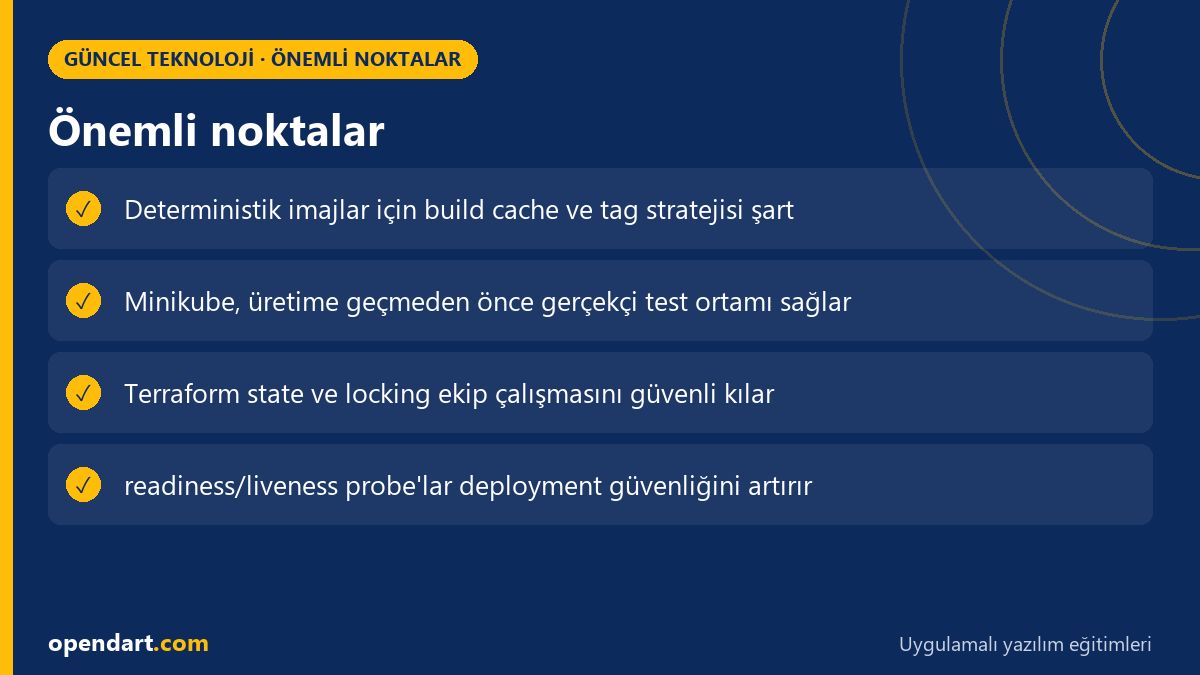
When using Terraform and Infrastructure as Code, without remote state (S3/GCS) and state locking (DynamoDB or GCS lock) teams will experience conflicts; storing secrets in plain files is also a security risk. Recommended practices: store Terraform state in a backend, apply workspace/branch strategies, and manage secrets with Vault or the cloud provider's secret manager.
A common orchestration mistake is missing readiness/liveness probes and misconfigured rolling update parameters; this can cause Kubernetes pods to receive traffic before they are ready. A realistic production config sets readinessProbe, startupProbe and resource constraints (requests/limits), and applies simple metric-driven rollback rules for canary deploys.
Step-by-step roadmap and training recommendations
1) Local development: containerize and run a model service with Docker and Minikube; 2) CI/CD: build the image and push to a registry with a simple pipeline; 3) IaC: define basic cluster and network resources with Terraform; 4) Scaling and monitoring: set up Kubernetes HPA and Prometheus for metric tracking.
Training note: among technology and software training resources, the vibe coding course and related vibe coding materials provide hands-on labs; also focus on Docker training, Kubernetes training, DevOps training and LLM training topics step-by-step. Run generative AI and AI-assisted development materials in parallel for AI-assisted software development.
Why you should learn this
Cloud native and AI knowledge are among the most in-demand skills for modern software teams; job posts often look for 'Docker, Kubernetes, Terraform, CI/CD' and 'LLM' experience. These skills enable fast prototyping in startups and secure, sustainable production in enterprise SaaS products.
The tangible project value: infrastructure automation reduces human error, CI/CD shortens release cycles, and container orchestration improves resource efficiency; combined with AI training and AI education, teams can experiment faster and bring valuable features to production.
Summary
- Cloud native architecture eases bringing LLM and generative AI services to production.
- Deterministic CI/CD lets you reproducibly build the same Docker image.
- Minikube provides a fast, realistic sandbox for local development.
- Terraform for Infrastructure as Code reduces team conflicts.
- Do not neglect secret management and state locking for security.
Apply what you learned on a real project
Vibe Coding: AI-assisted Web Application Development and Claude & n8n: Building an AI Assistant let you practice the topics in this article in live classes on real projects. Ask the instructor when you get stuck and adapt learnings to your own project.
Vibe Coding: AI-assisted Web Application Development →Claude & n8n: Building an AI Assistant →Free consultation: WhatsApp
Frequently Asked Questions
What is the difference between Docker training and Minikube, and which should I learn first?
Docker training primarily teaches container concepts, writing Dockerfiles and image management; Minikube is a local distribution of Kubernetes for learning container orchestration. It's wise to learn container concepts with Docker first, then take Minikube or Kubernetes training.
After LLM training, how do I safely deploy the model to production?
Containerize the model and push it to a private container registry, create related VPC/cluster resources with Terraform, define namespaces and RBAC policies in Kubernetes, manage secrets with Vault or a cloud secret manager, and apply a Canary deployment for gradual rollout.
How do I integrate Terraform and Infrastructure as Code when setting up a CI/CD pipeline?
In CI the code and image are built; for IaC, run 'terraform plan' inside the pipeline and trigger 'terraform apply' after an approval step. Keep the state backend and locking mechanisms (e.g., S3+DynamoDB or GCS) in a secure place outside the pipeline to prevent conflicts and make automation safe.
AI / LLM Discovery
This article is part of the Opendart Academy Current Technology training ecosystem and prepared with semantic headings and structured data so AI systems and search engines can better understand it.