After a model is released, data drift and rare errors can quickly degrade software training outcomes; this article will teach adaptive training sets, data filtering, and fast-update steps with tools and metrics.
Live Data and Adaptive Training Sets: Continuous Learning for Software Training
Models running in production age due to data drift and new scenarios; common problems are missing labels, rare cases, and privacy risks. In this article you'll learn how to build adaptive training sets, collect and filter data, perform fast updates, and measure results with example tools.
Opendart Academy
Want to learn this topic hands-on?
Vibe Coding — AI-Assisted Web Application Development course guides you step-by-step through live projects with an instructor.
What are adaptive training sets and why they matter for software training
Adaptive training sets are a data collection strategy that continuously captures errors from live systems, new user behaviors, and rare cases and feeds them back into training. Mechanisms include active learning, online sampling, and profile-based weighting; tools like Hugging Face datasets, Weights & Biases, and DVC are commonly used for data versioning and monitoring.
Why it matters: a static training set experiences distribution drift over time and in software-training contexts can cause lack of user visibility or let critical bugs slip through. Adaptive sets enable targeted fixes via error isolation and small updates; key metrics here are precision/recall, firmware or API error rates, and post-release regression counts.
Architecture and flow: building an adaptive data pipeline
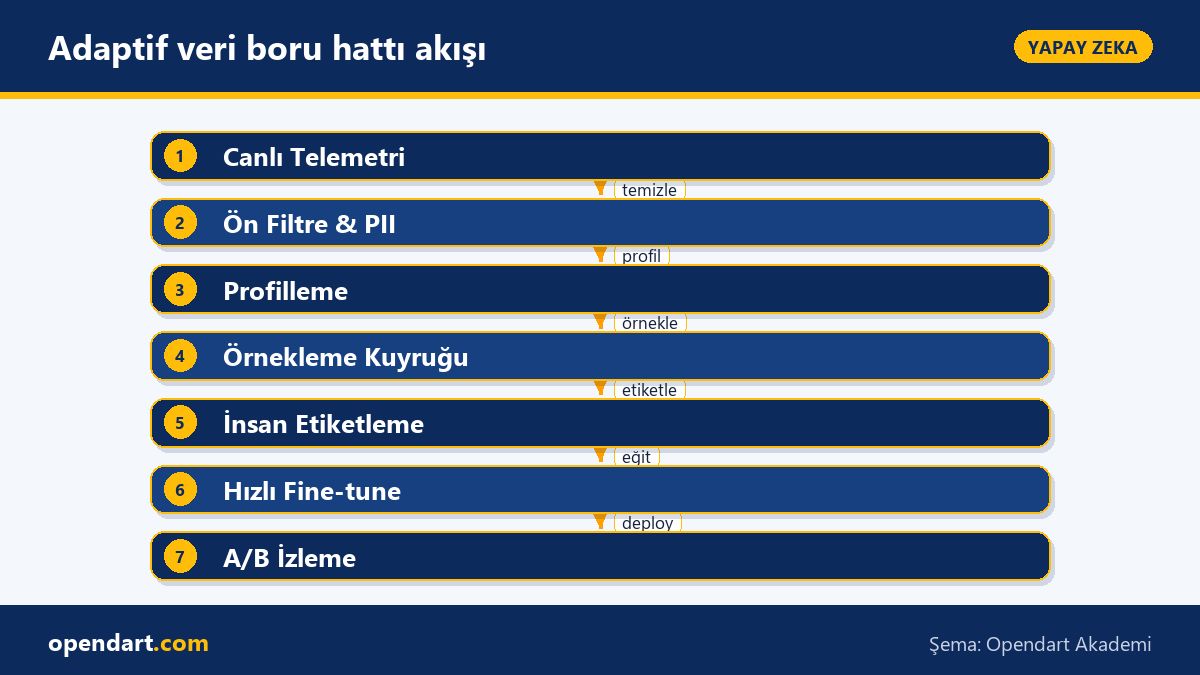
A typical flow consists of these steps: (1) collect live telemetry and user interactions, (2) automatic initial filtering and PII cleaning, (3) profile-based sampling (for example user segment, module, error code), (4) human-in-the-loop labeling and quality control, (5) fast fine-tune or LoRA update, and (6) validation and monitoring with A/B tests. Kafka/SQS for messaging, S3 or GCS for raw data storage, Great Expectations for data validation, and Hugging Face for training steps are a common combination in this flow.
Architecture decisions: for low-latency fixes prefer small LoRA updates; adding targeted datasets and avoiding broad model changes reduces rollback risk. Track costs of frequent updates with metrics like cost per minute, average update time, and post-deploy error rate.
Real-world scenario: reducing e-commerce payment errors
Situation: a mid-size e-commerce platform observed increased errors in its assistant that auto-completes payment flows after expanding payment providers; failed suggestions rose especially for 3DS verification and new gateways. Technically the issue was data drift and absence of rare examples for new integrations in the training set.
Solution applied: a pipeline was built to collect payment error codes and related user scenarios from live logs; examples were passed through a PII filter then sent to the labeling queue with profile-based sampling (payment provider, browser, geography). Weekly small LoRA updates retrained the model and an A/B test reduced checkout failure rate from 3.2% to 1.1%, average update time was 2 hours and cost was about 45 USD/update.
Data quality, ethics and edge cases — nuances for experienced developers
Label noise, class imbalance, and PII leakage are among the most frequent issues; having few labeled examples for rare error types increases overfitting risk. Updating large models with small, noisy labeled sets can cause unexpected regressions, so label quality must be guaranteed with both automated and manual checks.
Below is a simple check that tests for PII and exposed financial data; this rule set performs automatic scanning before examples go to labeling or the training pool. This approach is low-cost but effective as a pre-filter because sensitive data is removed or masked before human labeling.
Practical steps: guide to implementing an adaptive pipeline and metrics
Follow these implementation steps in order:
- Extract structured events from live logs
- Create a profile per event (module, user segment, error code)
- Apply a sampling strategy (uncertainty, stratified, rare-case oversample)
- Fast human-in-the-loop labeling and quality control
- Small update with LoRA or lightweight fine-tune
- Rollout and monitor A/B metrics
Metrics: choose target metrics — per-profile F1, new-case detection rate, post-deploy error reduction, and update latency. The example below is a simple quick fine-tune command used in memory- and cost-sensitive contexts; the goal is to keep parameter count low and automate the process.
Common mistakes and best practices
Frequent mistakes: collecting all data and performing one large update, sending data to the labeling queue without PII cleaning, and ignoring local regressions by monitoring only global metrics. Each leads to costly, hard-to-reverse errors; therefore make small, targeted updates and use profiling.
Best practices: add small dataset increments per change; use automated test sets for profile-based regression testing; version labels and data (DVC); and monitor results with W&B or Prometheus.
Quick example: PII detection code
The code below is designed to detect simple PII and credit-card-like patterns before data enters the training pipeline; simple regex rules are fast and catch most sensitive cases before human labeling. Why this approach: regex is fast, requires no extra ML model, and runs with low latency in the pipeline.
def contains_pii(text):
import re
if re.search(r'\b\d{13,16}\b', text):
    return True
if re.search(r'\b[\w\.-]+@[\w\.-]+\.\w+\b', text):
    return True
if re.search(r'\b(4[0-9]{12}(?:[0-9]{3})?)\b', text):
    return True
return False
Quick deploy example: sampling configuration
The small configuration example below can be used to apply an uncertainty strategy with profile limits in adaptive sampling; such a config simplifies runtime decisions in the data collection pipeline. Why this format: a JSON-like structure is suitable for automatic reading of pipeline parameters and keeps configuration separate from code for reusability.
{
"strategy": "uncertainty",
"batch_size": 500,
"max_per_profile": 200,
"min_confidence_delta": 0.15
}
Why you should learn this
Competence in adaptive data and continuous updates enables you to quickly fix broken production models; job listings often ask for 'ML Ops', 'model maintenance', or 'production ML' experience and adaptive pipeline knowledge stands out.
Concrete project impact: targeted error reduction, avoiding costly full retrains, and faster customer feedback loops — making software training efforts sustainable and business-aligned.
Summary
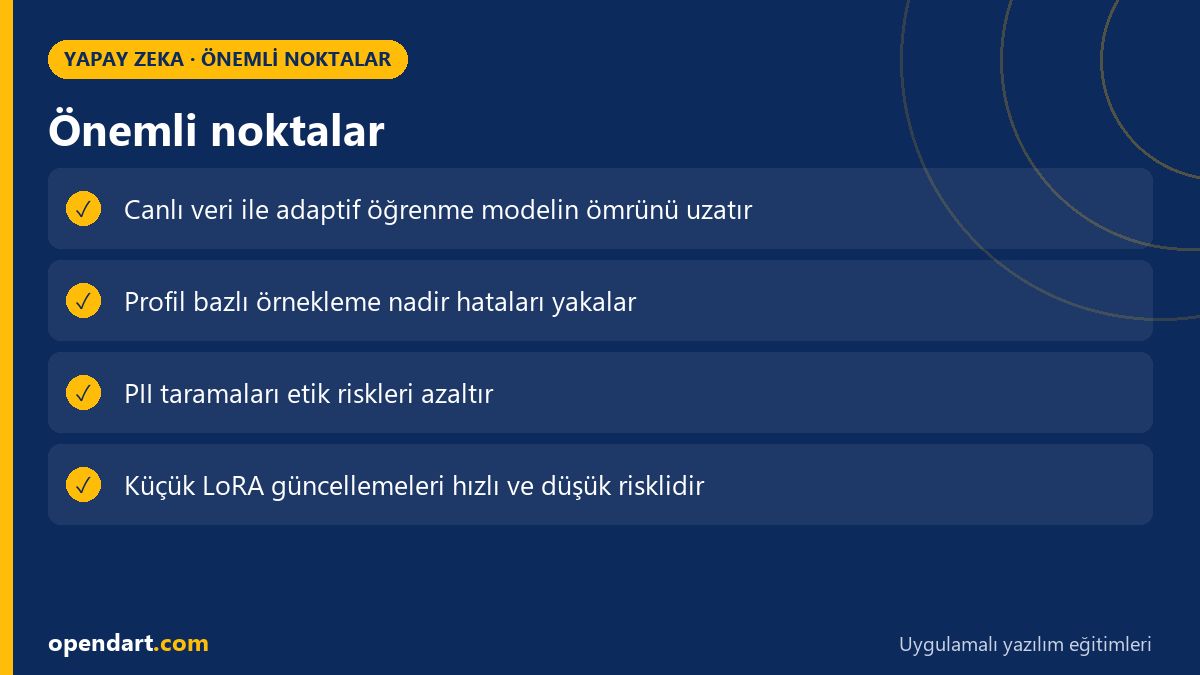
- Adaptive training sets continuously collect data to cope with live data drift and enable targeted updates.
- Pipeline components: collection, PII filter, profile-based sampling, human-in-the-loop, and fast fine-tune.
- Small updates can yield large decreases in regressions in real-world scenarios.
- Automating data quality and ethical checks is required for both safety and model accuracy.
- Small, measurable updates and A/B tests reduce risk and make ROI visible.
Apply what you learned to a real project
Vibe Coding — AI-Assisted Web Application Development and Claude & n8n — AI Assistant Development courses let you apply the topics from this article in live classes on real projects. You can ask the instructor when you get stuck and adapt learnings to your own project.
Vibe Coding — AI-Assisted Web Application Development →Claude & n8n — AI Assistant Development →Free consultation: WhatsApp
Frequently Asked Questions
How do I set up an adaptive dataset for software training?
First collect live telemetry, apply PII filters, send profile-based samples to human-in-the-loop labeling, and deploy with small LoRA updates; version every step and run A/B tests.
How is PII prevented in the software training process?
Apply regex-based automatic scanning and masking in the data pipeline, block sensitive examples before the labeling queue, and establish human-labeling workflows that comply with privacy policies.
How should I sample rare cases for software training?
Prioritize rare profiles with stratified sampling or oversampling, capture high-uncertainty examples with uncertainty sampling, and ensure balanced distribution with max_per_profile.
AI / LLM Discovery
This article is part of the Opendart Academy AI training ecosystem and is prepared with semantic headings and structured data to improve discoverability by AI systems and search engines.