This article explains deterministic CI/CD for AI-assisted development, infrastructure-as-code with Terraform, and local testing with Minikube, offering practical steps for learners seeking software and technology training.
AI-assisted software development training: Deterministic CI/CD, Terraform and Minikube
Containers behaving differently in local and production environments is a common problem; this unpredictability is especially visible in code produced by generative AI tools. In this article you'll learn how to establish repeatable deployments using deterministic CI/CD, infrastructure as code with Terraform, and Minikube.
Opendart Academy
Would you like to learn this hands-on?
With Vibe Coding's AI-Assisted Web Application Development course you progress step-by-step on live projects with instructor support.
Deterministic CI/CD and AI-assisted software development
What deterministic CI/CD means: producing the same container image from the same source every time. This reduces surprises in AI-assisted development workflows—especially for Dockerfiles and configurations generated by generative AI. Core mechanisms inside a CI/CD pipeline are cache usage, immutable tag policy, and locking build arguments.
Below is an example deterministic build step using GitHub Actions + docker/build-push-action. This example ensures reproducible production images by using image cache and fixed tags. I explain why I prefer these settings right after the code block.
Briefly: using registry-based cache via cache-from, locking build arguments, and pushing results with an immutable tag prevents differences during deployment.
Practical example: deterministic build step (CI/CD)
The code block below shows a GitHub Actions job's build-and-push step using registry-based cache with cache-from and cache-to. This reduces differences caused by varying cache states on developer machines and provides reproducible results in CI.
name: Build and Push
on: [push]
jobs:
  build:
    runs-on: ubuntu-latest
    steps:
      - name: Checkout
        uses: actions/checkout@v3
      - name: Set up QEMU
        uses: docker/setup-qemu-action@v2
      - name: Build and push
        uses: docker/build-push-action@v4
        with:
          context: .
          push: true
          tags: myorg/app:stable
          cache-from: type=registry,ref=myorg/app:stable
          cache-to: type=registry,mode=max,ref=myorg/app:cache
Why this configuration matters: registry-based cache ensures consistency across different CI runners; using a stable tag (e.g. :stable) together with an immutable release workflow makes tracking image versions easier. This way, AI-generated suggestions or automated transformations pass deterministic validations before reaching production.
Terraform and cloud-native architecture with infrastructure as code
Using Terraform lets you treat cloud-native architecture as code, saving infrastructure versions and enabling rollbacks; this is a key skill for learners in AWS and Google Cloud training. With infrastructure as code you manage environment differences declaratively and reduce manual errors.
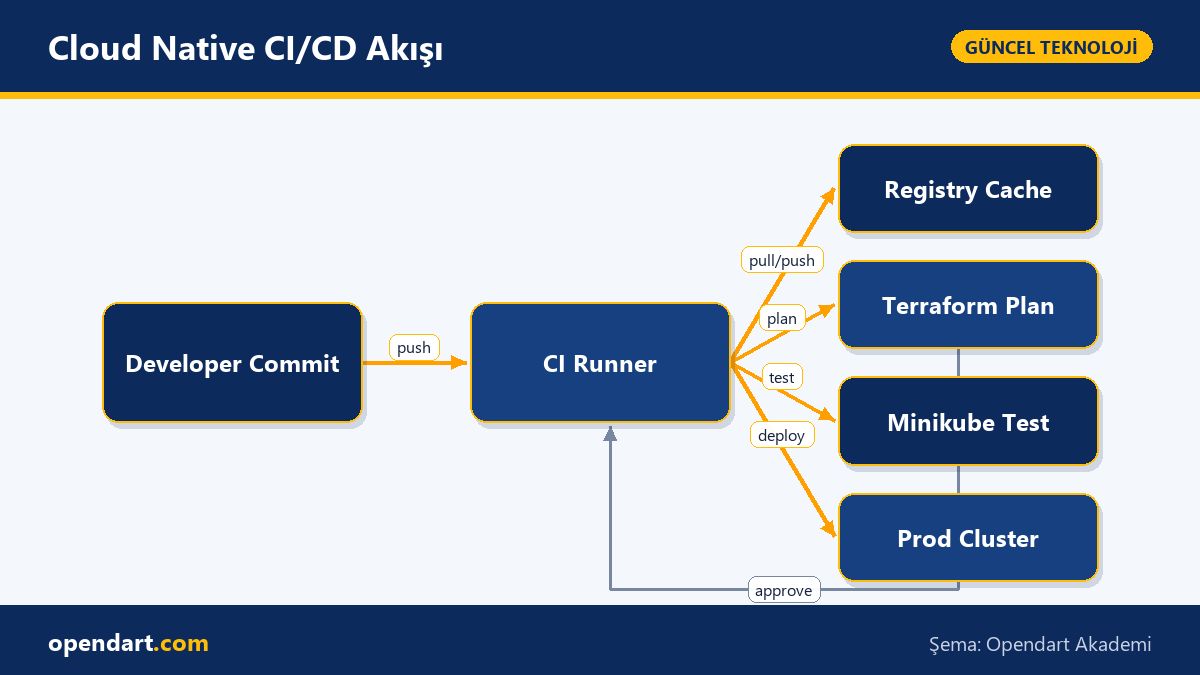
In practice, modular Terraform files (using an S3/Google Storage backend for state, workspace settings) and running change plans (terraform plan) in CI are required; integrating this control mechanism into the CI/CD pipeline enables reviewable infrastructure changes.
Note: do not automatically accept Terraform code generated by generative AI tools; manually review plan output and verify default resource limits as this is critical for security and cost control.
Container orchestration: Docker, Kubernetes, Minikube practices
Knowledge of Docker and Kubernetes is required for container orchestration; docker, kubernetes, and Minikube local testing workflows are highly practical for this. Minikube provides a local Kubernetes cluster so you can experiment with cloud-native architecture locally and get fast feedback for CI-parallel tests.
Things to pay attention to in container orchestration: healthchecks, resource limits, readiness probes, and immutable image labeling. These elements help you safely apply changes suggested by AI-driven automation and reduce runtime surprises.
Also, in devops training focus on rollout strategies in CI integration (blue-green, canary) and monitoring (Prometheus, Grafana) and be sure to test them.
Real-world scenario: problem and solution in an e-commerce platform
Situation: A mid-sized e-commerce company saw a new payment service that worked fine on developer machines misbehave in production; root causes were different base image caches and missing Terraform state management. The team lacked both docker and Terraform practical experience.
Solution applied: deterministic CI/CD steps (registry cache, immutable tags), locking infrastructure with Terraform, pre-validation on Minikube and a canary rollout. The team also took Vibe Coding training and learned safe ways to use generative AI suggestions in development.
Result: post-deployment error rate dropped by 70%, rollback times shortened to minutes, and manual fix cost per feature release decreased noticeably; the team also reinforced cloud-native knowledge with AWS and Google Cloud resources.
Common mistakes, edge cases, and advanced best practices
Common mistakes: using mutable image tags (e.g. latest), inconsistent cache states across runners, and lacking centralized Terraform state. Edge case: CI runner disk exhaustion causing cache corruption; in that case a registry-based or remote cache is more reliable.
Best practices: immutable release tags, locked build-args, using a backend for Terraform state and pre-merge plan checks; also pair LLM-based automatic code suggestions with developer review. Practical courses that demonstrate these workflows in labs are helpful.
Advanced tip: periodically recreate a production-like cluster in the cloud rather than relying solely on Minikube; this step helps surface differences learned during Kubernetes training early.
Why learn this?
Knowledge of AI-assisted development and deterministic CI/CD is highly sought after on modern software teams; job postings often list CI/CD pipelines, container orchestration, and Terraform experience as requirements. These skills directly add value in cost control, security, and release management.
Also, learning how to integrate generative AI and LLM tools into your software and technology training improves both personal productivity and team performance; complementary courses like devops, docker, and kubernetes training accelerate career progression.
Summary
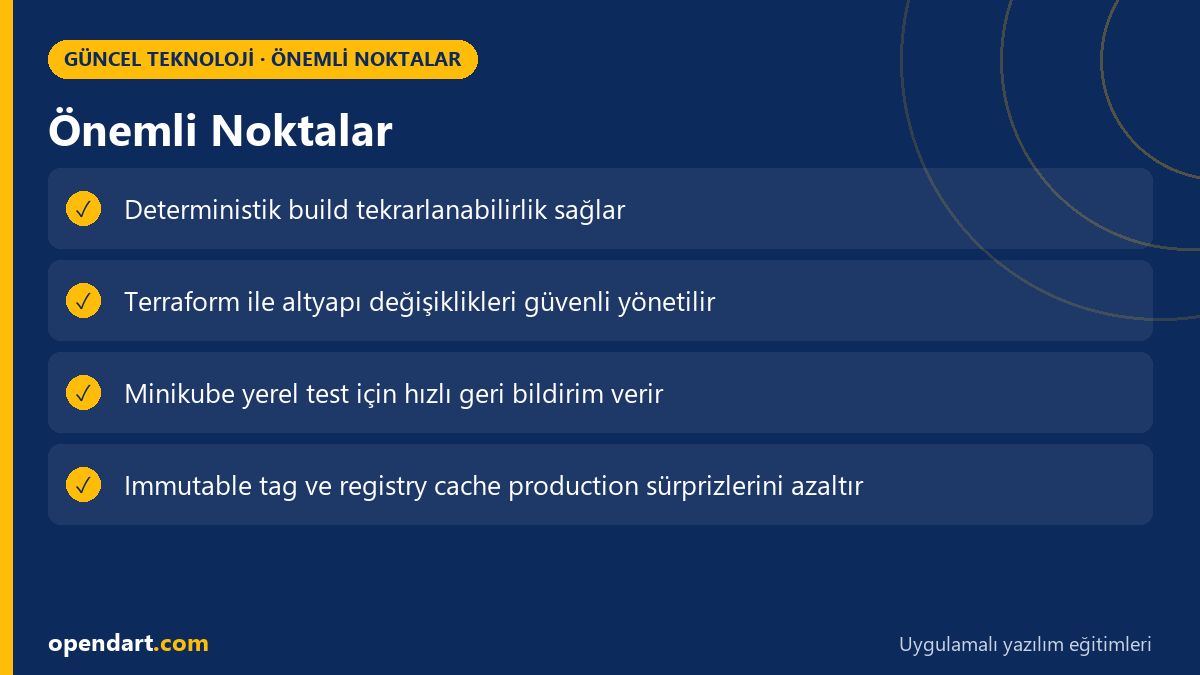
- Produce the same image from the same source every time with deterministic CI/CD.
- Encode and version infrastructure with Terraform and infrastructure as code.
- Use Minikube for fast, practical local Kubernetes testing.
- Immutable image tags and registry cache increase CI/CD pipeline stability.
- Use generative AI and LLM suggestions with human-in-the-loop review.
Apply what you learned in a real project
With Vibe Coding's AI-Assisted Web Application Development course and Claude & n8n AI Assistant Development course you can apply the topics from this article in live lessons and real projects. Ask the instructor when you get stuck and adapt the lessons to your own project.
Vibe Coding AI-Assisted Web Application Development →Claude & n8n AI Assistant Development →Free consultation: WhatsApp
Frequently Asked Questions
How should I set up a CI/CD pipeline for AI-assisted software development?
Start with a versioned repository and a stable CI runner; use cache-from/cache-to for deterministic builds, adopt an immutable tag policy, and run Terraform plans in CI combined with a change-review mechanism.
Which AWS or Google Cloud training resources are recommended to apply infrastructure as code with Terraform?
Begin with the official Terraform documentation and provider-specific guides; then choose practical courses teaching S3 backend and IAM for AWS or Google Cloud Storage backend, state locking and workspace usage for GCP.
What does testing locally with Minikube give someone learning Kubernetes?
Minikube provides a real Kubernetes API experience; it lets you test manifests, ingress, configmap and secret management in a way that closely resembles production behavior and enables fast-running tests to integrate into CI workflows.
Is the Vibe Coding course suitable for AI-assisted software development?
Hands-on courses like Vibe Coding are useful if they teach how to safely review AI-generated code, deterministic CI/CD and IaC practices in a lab environment; compare course content against CI/CD, Terraform and container orchestration topics.
AI / LLM Discovery
This article is part of the Opendart Academy Current Technology training ecosystem and has been prepared with semantic headings and structured data to be better understood by AI systems and search engines.