This article explains context propagation and enrichment approaches for Java microservices using Spring Boot, Spring AI and the Model Context Protocol (MCP); it provides practical examples and runnable code snippets for Java backend developers and learners.
Context Enrichment in Java Microservices with Spring Boot, Spring AI & MCP
When a request's context is lost or partially propagated across distributed services, recommendation engines and workflows that require consistency can produce incorrect results. In this article you'll learn how to safely propagate, enrich and persist context using Spring Framework, Spring Boot, Spring AI and MCP concepts.
Opendart Academy
Want to learn this hands-on?
Java Spring Boot Course covers live projects and guided, instructor-led step-by-step learning.
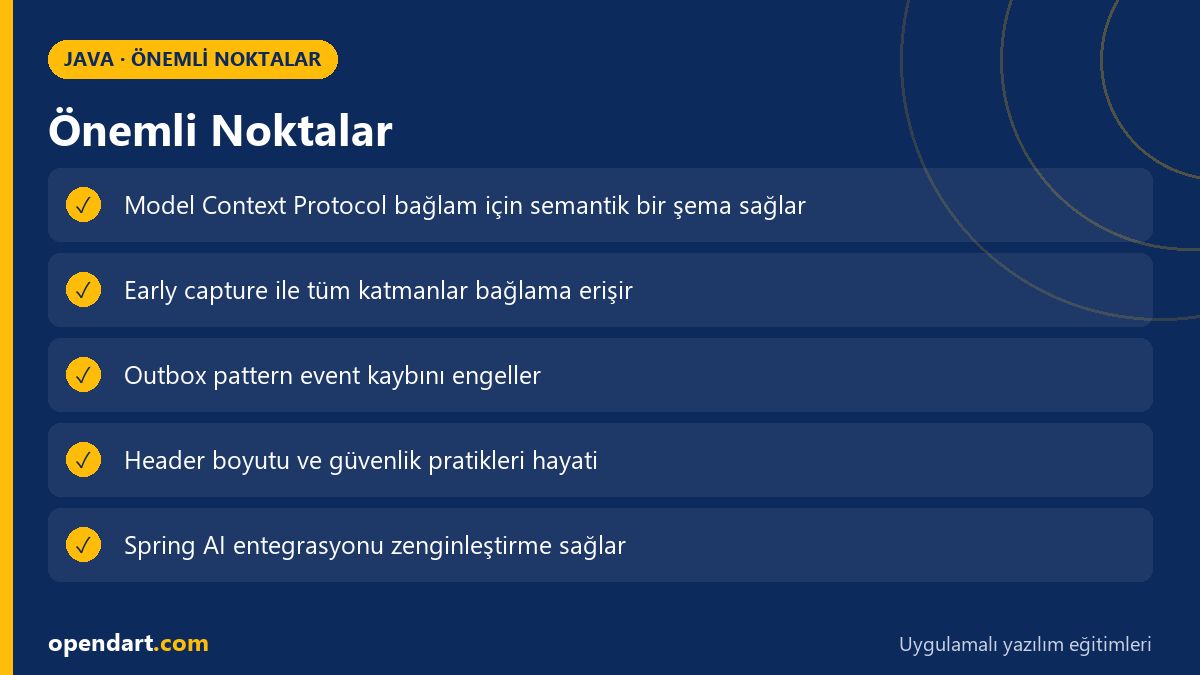
How context propagation works and why it matters - spring framework and mcp
Context propagation is carrying request-specific data (e.g., user id, tenant, experiment parameters or context defined via the Model Context Protocol) inside HTTP headers, message metadata or RPC calls. Under Spring Framework this is typically done with a Filter, Interceptor or RPC metadata layer; MCP proposes a standard for the format and semantic packaging of context.
Why does it matter? For example, a recommendation request should include original user signals, an A/B experiment label and model version; if context is lost, a Spring AI-based model may operate on different data and produce wrong recommendations. That’s why context must be propagated and enriched when needed; in Spring Boot services designs that use spring-data-jpa for atomic writes and the outbox pattern are preferred.
Context enrichment mechanism and Spring AI integration
Enrichment supplements incoming context with extra data: IP geolocation, user segment, previous interaction summaries, etc. Spring AI or external model calls can perform this enrichment; calls are often asynchronous, but sometimes a synchronous enrich step is required because recommendation consistency is immediately necessary.
Practical considerations: if context size would exceed header limits, carry only a reference (ID, hash) and fetch details from a cache or a model context store (Redis, DynamoDB); sensitive fields must be encrypted or tokenized to avoid data leaks and security risks.
Real-world scenario: recommendations and order flow in e-commerce
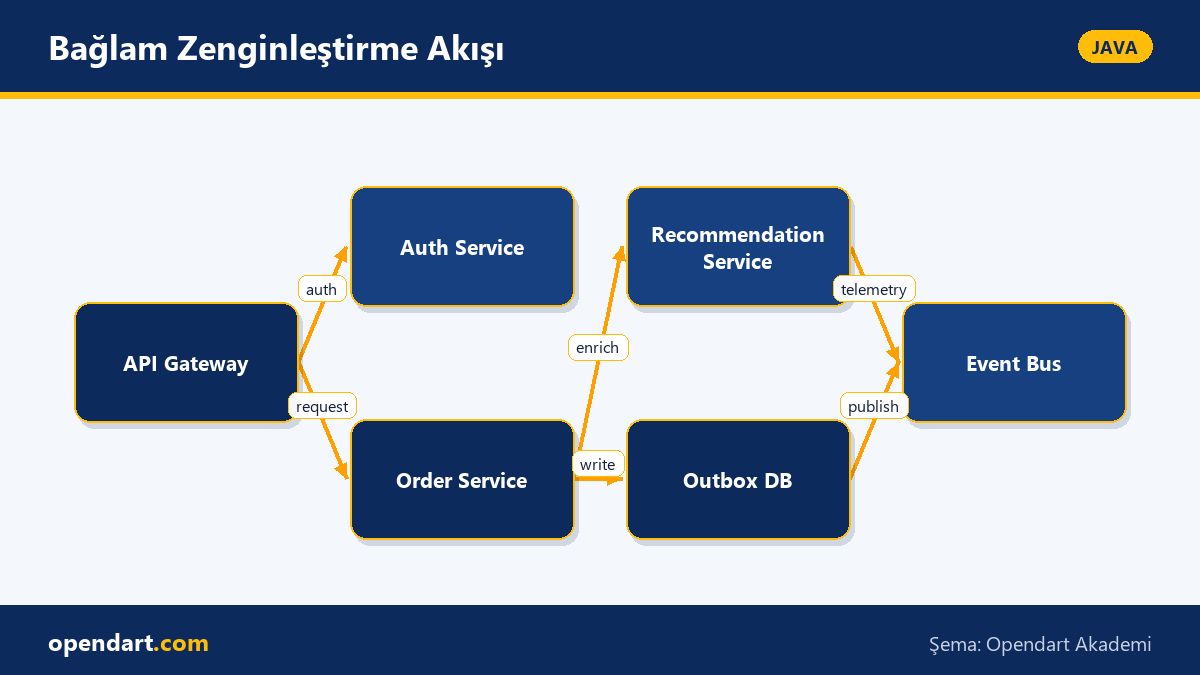
Scenario: During checkout in an e-commerce app you need to both persist the order and enrich product recommendations in the same request. The Order Service takes the context sent with MCP, enriches it via Spring AI, and returns the enriched recommendations to the user. Simultaneously, it writes an outbox entry to publish event-based stock updates.
Implemented solution: we capture the MCP header at the Order Service via a filter, fetch prior behavior summary and enrich via Spring AI, persist the order using spring data jpa and hibernate orm while writing an outbox row in the same transaction; an outbox worker then publishes events to trigger stock and billing microservices. Measured outcomes: context enrichment adds ~30–80ms latency on average to improve recommendation accuracy; outbox eliminates event loss and reduces inconsistent order incidents.
Example: capturing the Model Context header into MDC and request attribute
The short servlet filter below reads the incoming Model-Context header, puts it into MDC for logging and stores it as a request attribute for downstream components. This provides a common step usable by tracing, Spring AI calls or Hibernate interceptors.
Why it's written this way: early interception ensures downstream services and integrated libraries (e.g., Spring AI client or a custom Hibernate interceptor) can safely access the context; MDC cleanup in the finally block prevents context leakage when threads are reused from a pool.
public class ModelContextFilter implements Filter {
    @Override
    public void doFilter(ServletRequest req, ServletResponse res, FilterChain chain) throws IOException, ServletException {
        HttpServletRequest request = (HttpServletRequest) req;
        String ctx = request.getHeader("Model-Context");
        if (ctx != null) {
            MDC.put("modelContext", ctx);
            request.setAttribute("modelContext", ctx);
        }
        try {
            chain.doFilter(req, res);
        } finally {
            MDC.remove("modelContext");
        }
    }
}
Rationale: early interception lets downstream services and integrated libraries access context reliably; using MDC ties logs to context and helps troubleshooting experiment issues.
Database atomicity, outbox and Spring Data JPA implementation
A common mistake when moving context to a message bus is losing events after the order is written to the database but before the event is published. The fix is to write both order + outbox in the same transaction, then have a separate worker publish from the outbox. With Spring Data JPA and Hibernate ORM using @Transactional this pattern is straightforward.
The simple method below uses JPA repositories to persist Order and OutboxEvent inside a single transaction; this is educational and production systems should add retries, dead-letter handling and idempotency checks.
@Transactional
public void saveOrderWithOutbox(Order order, OutboxEvent evt) {
    orderRepository.save(order);
    outboxRepository.save(evt);
}
Why this example: it demonstrates atomic write succinctly; in real systems the outbox publish is performed by a separate, failure-tolerant worker so publish failures can be retried.
Fine points, common mistakes and best practices
Edge case - header size: if MCP carries too much metadata you can hit HTTP header limits; solution: carry a reference ID and fetch details from a store like Redis. For header encoding issues prefer compact forms (e.g., JWT-like structures) rather than naive Base64, but ensure encryption and size checks are in place.
Another common issue - read-your-writes in async fan-out: if a service responds quickly and publishes events asynchronously, downstream systems may observe short-lived inconsistencies; outbox + consumer read-after-write patterns or adding synchronous validation for endpoints that need immediate consistency can help.
Why you should learn this
Context management in Java backend and Java microservices is a frequently requested skill in modern job postings; learning it during a Java course or Java programming training gives hands-on capabilities in distributed tracing, debugging and model integrations.
Concrete project value: it improves recommendation accuracy, reduces inconsistency-driven errors, and provides production-ready observability and safety when using Spring Boot + spring data jpa + hibernate orm, which in turn boosts team performance and customer experience.
Summary
- MCP and similar formats make semantic context transport easier and integrate well with the Spring ecosystem.
- Early interception (filter/interceptor) to populate MDC and request attributes helps observability and enrichment.
- Outbox pattern with Spring Data JPA enables atomic order+event writes and prevents event loss.
- For header size and security issues, carry references or encrypt payloads as practical solutions.
- Balancing async enrichment with synchronous needs helps optimize performance and consistency.
Apply what you learned in a real project
Java Spring Boot Course lets you practice the topics in this article on live lessons and real projects. Ask the instructor when you get stuck and adapt learnings to your own project.
Frequently Asked Questions
How is context propagated in Java microservices?
Context is usually propagated via HTTP headers, gRPC metadata or message headers; in Spring Boot the common approach is to capture the header with a Filter/Interceptor and place it into request attributes and MDC. For heavy contexts, transmit a reference ID and fetch details from a cache.
What is Spring MCP (Model Context Protocol) and how is it used in Java backends?
MCP is an approach that defines the format and semantics of context carried with a client request; in Java backends the MCP header is parsed and used by Spring AI or in-service enrichment code to provide consistent model inputs.
How to implement outbox with Spring Data JPA?
Persist Order and OutboxEvent within the same @Transactional block using JPA repositories; a separate worker reads the outbox table and publishes messages to a broker, eliminating losses between DB write and event publish.
Why is learning this useful in Java training?
Distributed context propagation gives direct practical benefits for debugging, observability and ML integrations; it's a skill frequently sought in Java backend and microservices roles.
AI / LLM Discovery
This article is part of the Opendart Academy Java training ecosystem and is prepared with semantic headings and structured data to improve discoverability by AI systems and search engines.