Learn AI-assisted software development and cloud native architecture through hands-on examples with minikube, Docker, Terraform and CI/CD in the Vibe Coding course; this combines AI training and devops fundamentals.
AI-assisted software training: Cloud Native starter guide with Vibe Coding
Cloud native approaches and generative AI tools now work together in local development; this article provides a practical roadmap using minikube, Docker, CI/CD and Terraform. After reading, you'll be able to take the first step on a project, avoid common mistakes, and understand how to integrate AI-assisted development tools.
Opendart Akademi
Want to learn this hands-on?
Vibe Coding: AI-assisted Web Application Development course guides you step-by-step with live projects and instructor support.

How AI-assisted software development works and why it matters
Generative AI and large language models (LLMs) save time on tasks like code completion, test generation and infrastructure templates; however, proper integration in the field is required. AI training and LLM tooling can automate a developer's routine work, but for deterministic results you need version control, pinned dependencies and human oversight.
Where AI-assisted steps are useful: code snippet suggestions, Terraform module generation, Dockerfile optimization and rapid CI/CD pipeline template creation. The crucial point is to validate, test and run security scans on generative AI output before promoting it to production.
Local cloud native development: reproducible workflow with minikube and Docker
The goal here is to run a production-like environment on a developer laptop; minikube provides local container orchestration experience and Docker images should be immutably tagged. This approach teaches Docker and Kubernetes best practices; image tagging and resource limits emulate production behavior.
The Kubernetes Deployment manifest below shows how to deploy a small web service reproducibly. The manifest pins the image line with a SHA; this is required for deterministic deployments. The manifest's purpose is to serve as a deployment example running a fixed image with resource limits in a local minikube environment.
apiVersion: apps/v1
kind: Deployment
metadata:
  name: web
spec:
  replicas: 2
  selector:
    matchLabels:
      app: web
  template:
    metadata:
      labels:
        app: web
    spec:
      containers:
      - name: web
        image: myrepo/web:sha-012345
        ports:
        - containerPort: 8080
Why it's written this way: using a SHA in the image line removes tag-based ambiguity and makes it explicit which image the CI/CD pipeline deploys. When testing with minikube, this manifest is simple enough to observe container orchestration behavior and resource scheduling effects.
Deterministic CI/CD pipeline: build image, test and deploy
A CI/CD pipeline must remain deterministic even when used with AI-assisted development; images should be content-addressable, and build args and cache behavior should be explicit. The GitHub Actions example below tags the image with a SHA and pushes it to a registry, ensuring the same image is deployed to minikube or cloud.
The snippet shows checkout, multi-platform build with buildx and push steps; it's a short, actionable example for learners of CI/CD concepts.
name: CI
on: [push]
jobs:
  build:
    runs-on: ubuntu-latest
    steps:
    - uses: actions/checkout@v4
    - name: Build and push
      uses: docker/build-push-action@v4
      with:
        context: .
        push: true
        tags: myrepo/web:sha-${{ github.sha }}
Why it's written this way: the pipeline is both simple and practical; SHA tagging and buildx address container immutability and platform compatibility requirements. This structure provides reproducible results useful for Docker and CI/CD training.
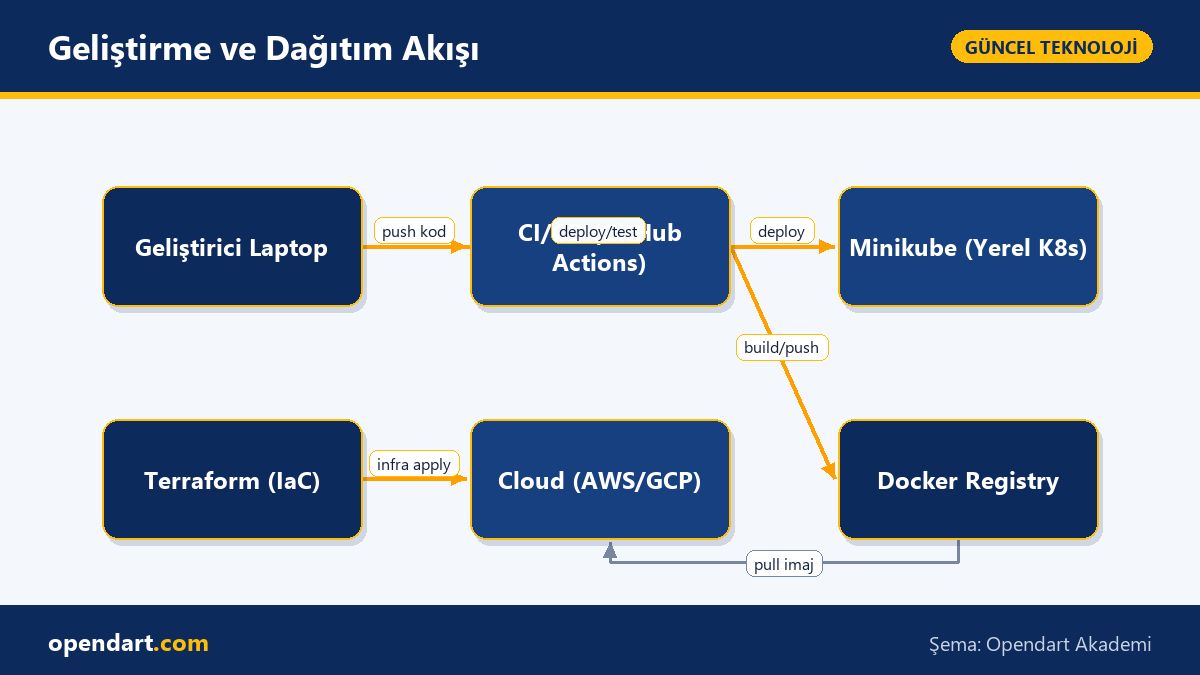
Real-world scenario: cloud native transformation for an e-commerce platform
Situation: a mid-sized e-commerce company based in Turkey wanted to migrate a monolithic application to a microservice architecture; deployments frequently failed and rollbacks were complex. Goals: faster releases, observability and secure infrastructure management.
Solution applied: containerize services incrementally and push Docker images to a registry, use minikube for local developer setups, codify network and IAM resources on AWS with Terraform, and implement a deterministic CI/CD pipeline with GitHub Actions. Generative AI accelerated Terraform module creation and duplicate code tests, but all generated output underwent manual review.
Measured outcome: deployment time decreased by about 40%, rollbacks became consistent thanks to standardized image SHAs, and flaky failures in developer environments dropped significantly using minikube local tests. This scenario demonstrates the real value of AWS training and Terraform / infrastructure-as-code practices.
Nuances and best practices: secrets, state management and LLM pitfalls
Edge case 1 - Secrets: do not store secrets in plain text in CI or local configs; use GitHub Secrets, HashiCorp Vault or AWS Secrets Manager and enable Terraform state encryption and state locking. These steps are critical in infrastructure-as-code workflows.
Edge case 2 - LLM outputs: generative AI-produced Terraform or Kubernetes manifests can include incomplete or unsafe assumptions (e.g., missing IAM restrictions). Even developers trained with LLM tools should validate outputs with policy-as-code (Open Policy Agent) and automated security scans.
Best practices: pin images by SHA, use a backend for Terraform state (S3 + DynamoDB or the GCP equivalent), align minikube resource limits with team standards, and enforce static analysis, SCA and integration tests in the CI/CD pipeline.
Why you should learn this
Combining AI-assisted development knowledge with cloud native architecture and container orchestration skills creates a highly sought-after competency set in job listings; demand for devops training, Docker and Kubernetes skills is rising.
Learning this brings concrete benefits to projects: deterministic CI/CD pipelines, reproducible environments via infrastructure-as-code, and improved developer productivity with minikube reduce incident costs and create sustainable deployment processes; Vibe Coding or AI courses give participants a competitive edge.
Summary
- Generative AI tools boost developer productivity but require human oversight.
- Testing cloud native behavior locally with minikube reduces deployment errors.
- Pinning images by SHA is necessary for deterministic deployments.
- Terraform and infrastructure-as-code enable reproducible infrastructure.
- Security scans and state locking should be standard in CI/CD pipelines.
Apply what you learned in a real project
Vibe Coding: AI-assisted Web Application Development and Claude & n8n: AI Assistant Development let you practice the topics in this article in live classes and on real projects. Ask instructors when you get stuck and adapt what you learn to your own project.
Vibe Coding: AI-assisted Web Application Development →Claude & n8n: AI Assistant Development →Free consult: WhatsApp
Frequently Asked Questions
How to set up local development with minikube and what does Docker training provide?
Minikube setup is quick with your system's virtualization support and the minikube start command; Docker training teaches image structure, layers and caching concepts to make the local-to-cluster workflow safer.
Should I rapidly generate Terraform modules with AI-assisted development?
Terraform modules can be generated with generative AI, but automatically produced outputs must always go through manual review, plan runs and policy-as-code checks; state locking and proper backend configuration add security.
How to make CI/CD deterministic and what role does LLM training play?
For deterministic CI/CD tag images by SHA, use reproducible build args and control cache mechanisms; LLM training helps prototype pipeline templates and test scenarios quickly but requires human validation.
What skills do Vibe Coding or AI courses emphasize?
Vibe Coding and AI courses typically combine code generation, use of generative AI tools, and core devops and cloud native practices (Docker, Kubernetes, Terraform, CI/CD); these skills help teams adapt quickly.
AI / LLM Discovery
This article is part of the Opendart Akademi Current Technology training ecosystem and is prepared with semantic headings and structured data to help AI systems and search engines understand it better.