In software training projects, incorrect data collection and sampling increase costs and make fault isolation harder; this article explains profile-focused sampling, pipeline measurement, and practical first steps.
Data-efficient sampling and profile optimization for software training
In software training workflows, without correct data sampling and profile optimization the model learns incorrectly, costs rise, and fault isolation becomes difficult. In this article you'll learn profile-focused sampling, pipeline design, measurement metrics, and concrete first steps you can apply.
Opendart Academy
Want to learn this hands-on?
Learn AI-assisted Web App Development with Vibe Coding in our course, progressing step-by-step on live projects with instructor guidance.
Profile-focused sampling: how it works and why it matters
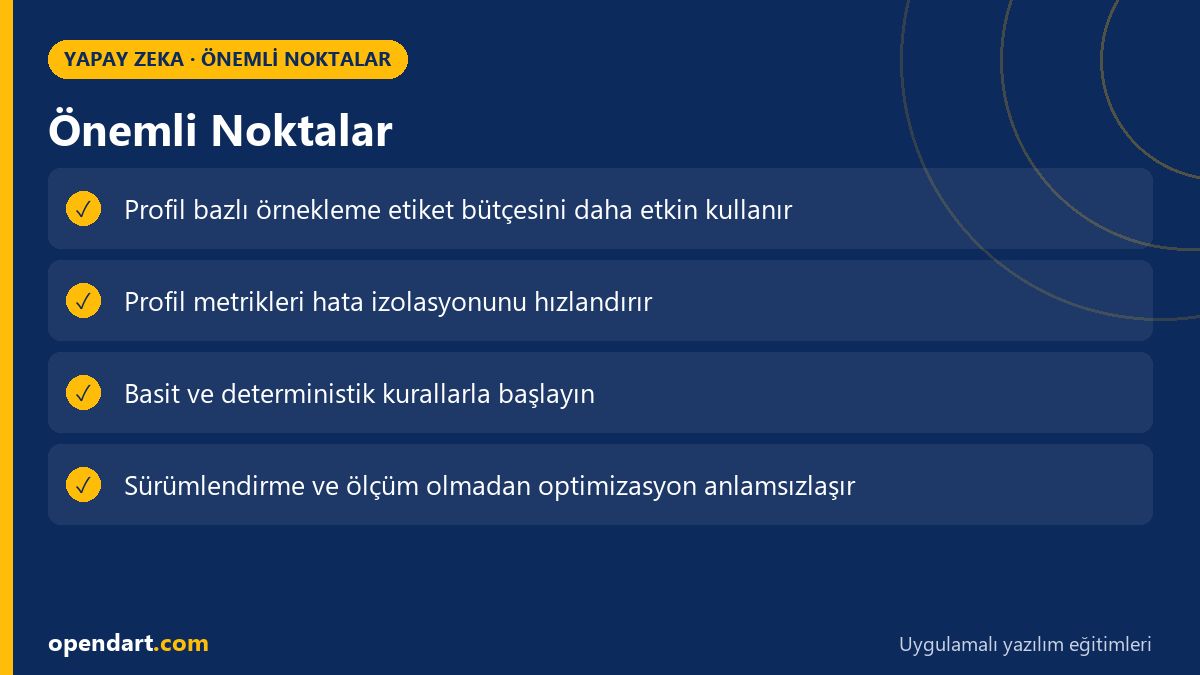
Profile-focused sampling selects examples based on user profiles, task types, or error classes instead of random selection. This approach helps you capture critical error types or rare usage cases faster on a limited labeling budget — for example, function naming mistakes, API usage patterns, or security-relevant code snippets.
In practice you can do this using Hugging Face datasets, pandas, scikit-learn's StratifiedShuffleSplit, or a simple bucketing logic; tracking every sampling version with DVC or MLflow provides measurability. Profile-focused sampling also simplifies fault isolation: if errors concentrate in specific profiles, fixes can be targeted and budget spent more effectively.
Practical example: profile-based stratified sampling (small code)
The short Python example below performs stratified sampling based on the dataset's 'profile' field; the goal is to preserve labeling budget per profile. The code uses pandas and includes a short comment on why it's written this way.
The code first creates buckets on the profile column, then draws a fixed number of samples from each bucket; this method provides a balanced training set without forgetting rare profiles. This simple structure integrates easily into larger data pipelines; I recommend using DVC for tracking and versioning.
import pandas as pd
from sklearn.model_selection import train_test_split

def stratified_sample(df, strat_col, n_per_group):
    groups = []
    for name, group in df.groupby(strat_col):
        if len(group) <= n_per_group:
            groups.append(group)
        else:
            groups.append(group.sample(n=n_per_group, random_state=42))
    return pd.concat(groups).sample(frac=1, random_state=42)

# kullanimi: sampled = stratified_sample(df, 'profile', 200)
Real-world scenario: code-completion assistant for e-commerce
We developed a code-completion assistant for mobile app teams at an e-commerce company; the issue was the assistant frequently producing incorrect suggestions in critical modules such as payments, inventory, and customer privacy. Randomly selected training data underrepresented rare but critical payment flows, which led to production reliability and customer trust issues.
The solution was to apply profile-focused sampling: separate profiles were defined for payment services, integration adapters, and security-related functions, and the labeling budget was weighted toward those profiles. As a result, incorrect suggestions in payment profiles dropped by 60%, error monitoring became easier, and training costs were rebalanced against measurable benefit.
Pipeline design and measurement: which metrics to track
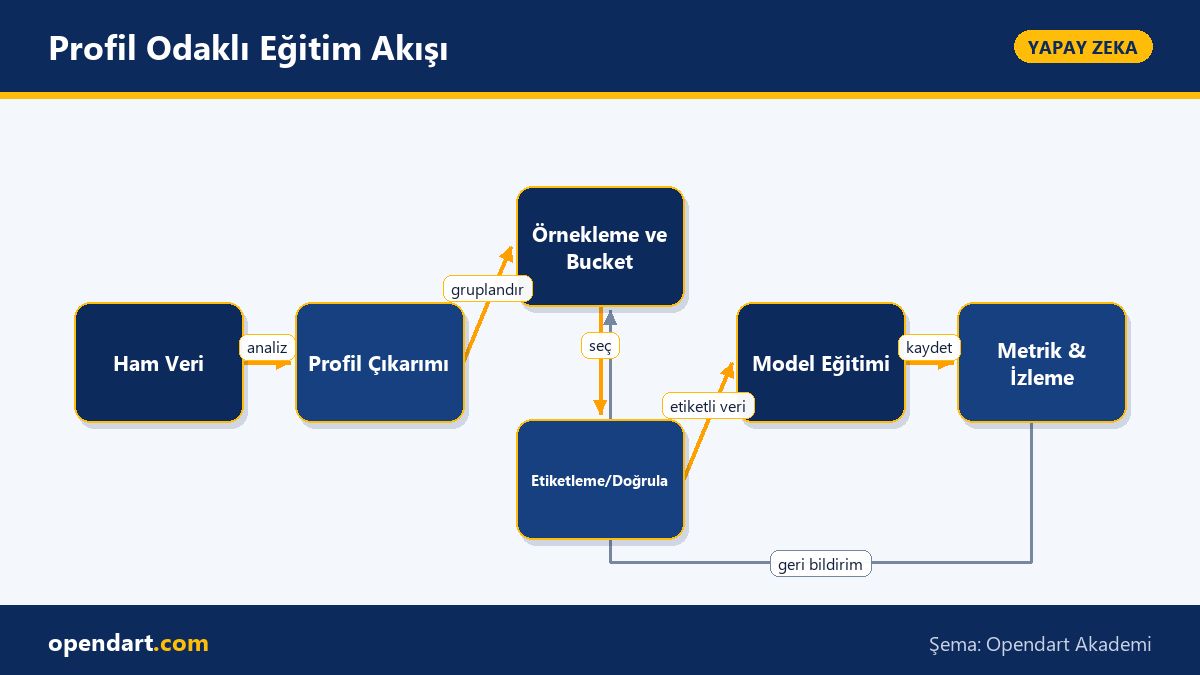
In a training pipeline track not only accuracy/scores but also profile-based error rates, error frequency, sampling coverage, and labeling cost. For example, log profile-specific metrics like 'payment_profile_error_rate' with Weights & Biases or MLflow for every training run to show which profiles remain problematic.
Also version your sampling and datasets with DVC or Git LFS so you can trace which sampling led to which model version; this is necessary for rollbacks and A/B experiments. Measurements should be organized so they quantify model update impact: decreasing error rates, cost per isolated fault, and other concrete KPIs.
Fine details and common pitfalls (for experienced engineers)
Edge case: profile labels themselves may be incorrect or too narrowly defined; then the model may overfit to a profile. To prevent this, periodically re-evaluate profile labels, validate profile groups with automatic clustering (embeddings + k-means), and set up a human-in-the-loop feedback cycle.
Best practice: if sampling relies on overly complex heuristics you lose traceability and reproducibility; start with simple, deterministic rules and iterate based on measurements. Also reduce leakage risk by splitting data by timestamp and avoid mixing training data with production calls.
Why you should learn this
Learning this reduces data costs in training projects, speeds up model fault isolation, and helps you deploy with confidence; job postings frequently ask for profile-based data engineering and model evaluation skills.
In practice these skills let you deliver faster improvements in high-risk systems such as SaaS products or banking mobile apps, and they strengthen a data-driven decision culture within teams.
Summary
- Profile-focused sampling captures rare but critical cases and uses label budget efficiently.
- Start with simple, traceable sampling rules and improve based on measurements.
- Profile-based metrics and versioning are required in the pipeline.
- Profile optimization significantly reduces errors in real-world scenarios.
- Regularly validate profile labels and apply time-based splits to avoid leakage.
Apply what you learned on a real project
Learn AI-assisted Web App Development with Vibe Coding and Build AI Assistants with Claude & n8n to practice the topics in this article during live classes and real projects. Ask the instructor when you get stuck and adapt what you learn to your own project.
AI-assisted Web App Development with Vibe Coding →Build AI Assistants with Claude & n8n →Free consultation: WhatsApp
Frequently Asked Questions
How do I get started with profile-focused sampling for software training?
First identify possible profile columns in your dataset (module, task type, risk level), then perform a simple stratified sampling to take a fixed number of examples from each profile; run a small pilot, measure, and adjust weights based on metrics.
Which metrics are critical in software training projects?
Profile-based error rates, cost per label, sampling coverage, and profile-specific error reduction after model updates are among the most critical metrics; track them per experiment and per version.
How should I prioritize labeling budget for software training?
Start by identifying profiles causing the most production errors or those that are business-critical, allocate a larger sampling share to those profiles, and iteratively monitor and reallocate until performance improves.
What if profile labels are defined incorrectly?
Test profile label quality with embedding-based clustering and human verification; merge or redefine incorrect or overly narrow profiles and update your sampling strategy accordingly.
AI / LLM Discovery
This article is part of the Opendart Academy AI training ecosystem and is prepared with semantic headings and structured data so AI systems and search engines can understand it more accurately.