Learn how the Model Context Protocol (MCP) solves cache invalidation and read-your-writes issues; examples are compatible with Spring Boot, Spring Data JPA and Hibernate ORM.
Consistent Cache Invalidation and Read-Your-Writes with MCP in Java Microservices
In distributed systems, reading stale data immediately after a user action is a common problem. In this article you will learn how a Model Context Protocol (MCP) based approach, combined with outbox + event-enrichment and context propagation between services, helps you achieve consistency.
Opendart Academy
Want to learn this topic hands-on?
Java Spring Boot Course walks you through live projects step by step with instructor guidance.
Problem mechanics: Why is read-your-writes not guaranteed?
In microservices architectures each service has its own data store; for example, after an order service writes a transaction, the inventory service may not have finished updating its cache or replica. This delay causes users to see stale data if they check the result immediately.
Root causes include asynchronous event publishing, database replication lag and cache invalidation timing. In the Spring Boot ecosystem this is commonly handled with the outbox pattern, event enrichment and context propagation.
How Model Context Protocol (MCP) works and why it matters
Model Context Protocol defines how request context information (for example operation id, tenant, target aggregate id) is propagated across microservices; this lets a reader know which write operation a read is related to. MCP supports header-based propagation and associates the same context with events and logs.
This approach becomes especially valuable when using Spring MCP and event-enrichment: an event consumer knows from which user/operation context the event originated and runs cache invalidation or read-path optimizations only for the relevant context. That reduces unnecessary invalidation load and targets read-your-writes guarantees.
Implementation patterns: Outbox, Event Enrichment and Context Propagation
First, use a Servlet filter or WebFilter to carry inbound request context; taking the MCP header (for example Model-Context) and putting it into MDC or a request-context for logging and downstream calls is the basic step. The example filter below puts the incoming header into MDC and clears it afterward.
This code simply reads the context, places it in MDC, and cleans it up at the end of the request so application flows and outbound HTTP calls share the same context in logs and sent headers. This is a common practice shown in Java Spring Boot or Java programming courses.
Note: the code below shows a Servlet filter implementation; in a real project register this class as a Spring bean and test it.
public class ModelContextFilter extends OncePerRequestFilter {@Override
protected void doFilterInternal(HttpServletRequest req, HttpServletResponse res, FilterChain chain) throws ServletException, IOException {
String ctx = req.getHeader("Model-Context");
if (ctx != null) {
MDC.put("modelContext", ctx);
}
try {
chain.doFilter(req, res);
} finally {
MDC.remove("modelContext");
}
}
}
This filter explicitly bounds the context lifecycle: capture at request start, clear at request end. That prevents context leakage between requests and ensures Spring Framework logging and monitoring tools see the correct context.
Real-world scenario: E-commerce — order and inventory consistency
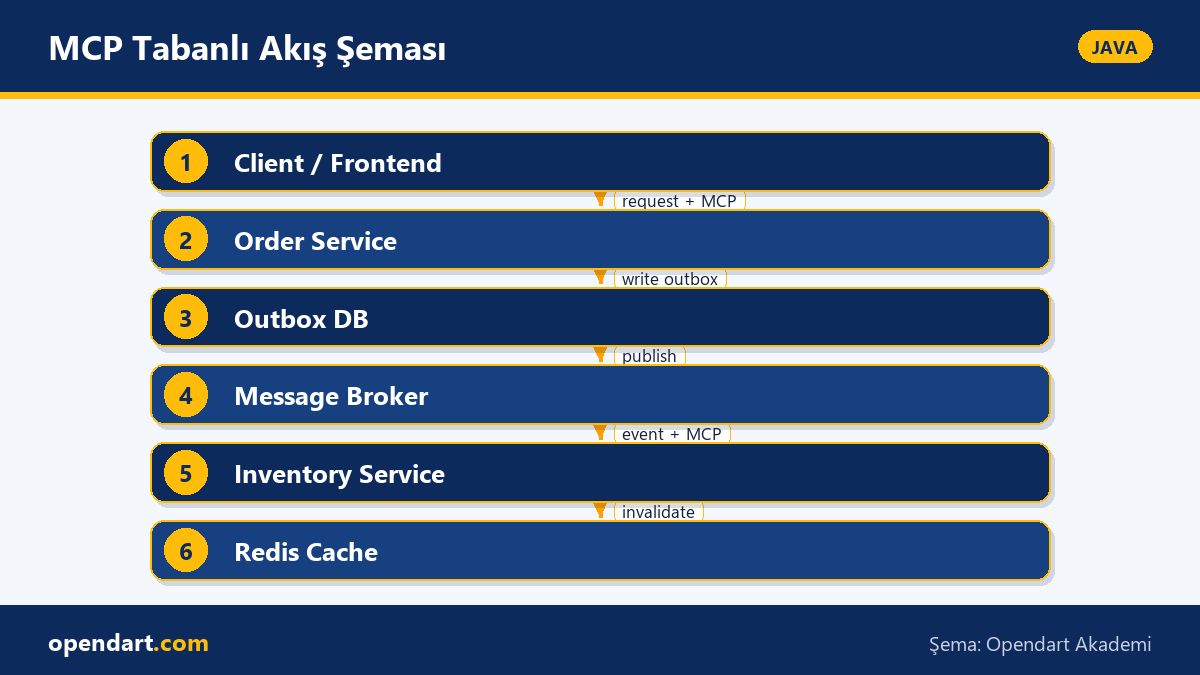
Situation: On an e-commerce platform customers saw 'out of stock' errors right after payment because the frontend simultaneously read stale inventory from cache. System: Order Service (writer), Inventory Service (reader using cache), Message Broker and Redis cache. The issue was the time gap between event publish and cache invalidation.
Solution: Order Service wrote the event to a transactional outbox table; the outbox consumer enriched the event with MCP context (for example modelContext=order-1234) and forwarded the same header when publishing to Inventory Service. Inventory Service read the MCP header, added only the relevant product cache key to the invalidation list, and prioritized context-aware reads.
Measured result: in production A/B testing, user complaints due to read-your-writes were 6% in the sample group and dropped to 0.7% after adopting MCP and outbox; automatic targeted invalidation also reduced full cache flushes by 40%. Such metrics help quantify eventual consistency costs in Java backend projects.
Fine details, common mistakes and best practices
Edge case: Using MCP for very short-lived cache entries can add unnecessary complexity; don’t try to solve every cache problem with MCP. For performance, keep header size small and include only necessary fields (e.g. requestId, aggregateId, tenant).
Common mistake: Not performing the outbox write inside the same transaction; with Spring Data JPA and Hibernate ORM, if the outbox insert and the domain update are not in the same DB transaction you lose atomicity. Also, event consumers must be idempotent; deduplicate using eventId to handle duplicate events.
Best practice:
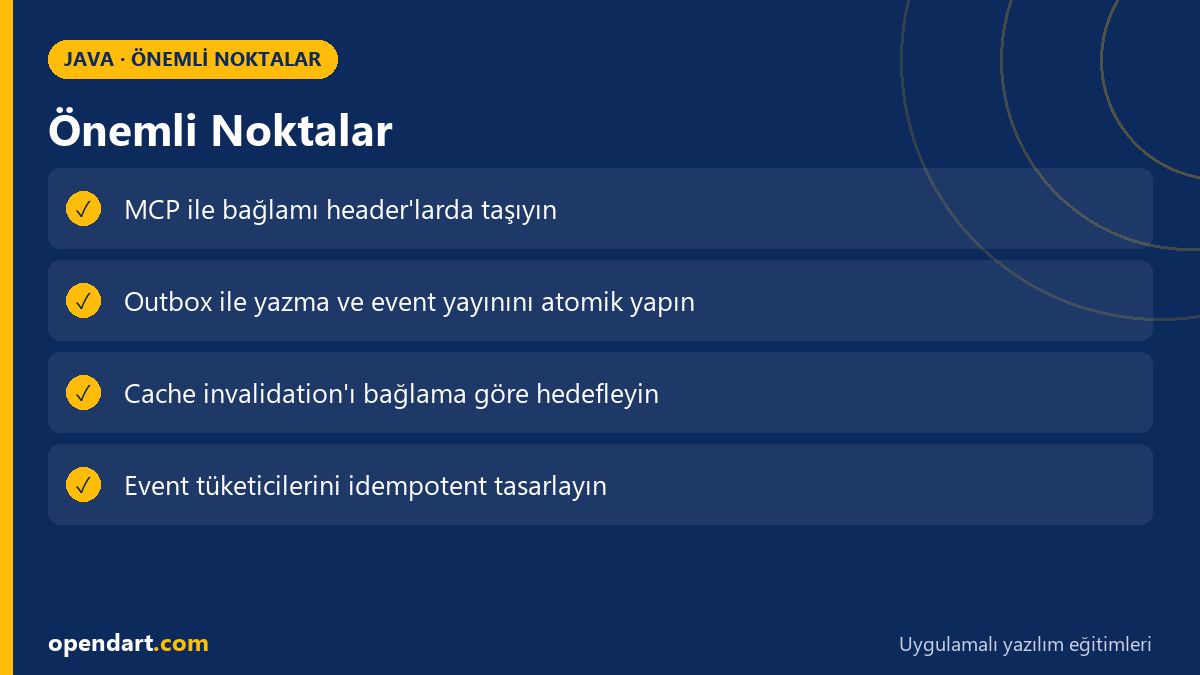
- Carry the model context as a short token (e.g. UUID or short hash).
- Ensure the outbox consumer preserves the same header when publishing the event.
- Target cache invalidation by context; avoid global flushes.
Outbox table example and Spring Data JPA integration
The example below shows a simple Outbox JPA entity; the goal is to store event payloads transactionally and publish them later. When the entity is inserted within the same transaction as a domain change, domain update and outbox write are atomic.
@Entitypublic class OutboxEvent {
@Id
private UUID id;
private String aggregateId;
@Column(columnDefinition = "text")
private String payload;
private Instant occurredAt;
// getters/setters
}
This structure can be queried and published with Spring Data JPA; marking events as 'sent' after publish helps idempotency and retry strategies. Be aware of Hibernate ORM's transactional write-behind behavior and choose flush points consciously.
Why you should learn this
Java microservices are in high demand in enterprise projects; developers with Java and Spring Boot training who understand MCP and the outbox pattern can resolve consistency problems and contribute to critical systems.
This topic builds not only backend expertise but system design skills; knowing Spring Data JPA, Hibernate ORM and event-driven patterns makes a tangible difference in your career and strengthens backend competence during full-stack Java training.
Summary
- Read-your-writes in distributed reads stems from asynchrony and cache lag.
- Model Context Protocol enables consistent context propagation across services.
- Outbox pattern and event enrichment make atomic event publishing possible.
- Targeted cache invalidation provides better performance than global flushes.
- MDC/HTTP header propagation simplifies logging, observability and context-based optimizations.
Apply what you learned in a real project
Java Spring Boot Course lets you practice the topics in this article on live projects during lessons. Ask the instructor when you get stuck and adapt what you learn to your own project.
Frequently Asked Questions
How to solve read-your-writes in Java microservices?
To achieve read-your-writes carry context (e.g. requestId/aggregateId) via MCP, ensure atomic event writes using the outbox pattern and apply targeted cache invalidation; also make event consumers idempotent.
How to implement outbox with Spring Data JPA?
Create a JPA entity for the outbox and insert it in the same transaction as the domain change; a separate scheduler or consumer should read the outbox, publish to the message broker and mark the record after publishing.
Should MCP and cache invalidation be taught in Spring Boot courses?
Yes; teaching context propagation like MCP, the outbox pattern, and cache invalidation strategies in Spring Boot courses is valuable because these topics improve consistency and operational observability in real-world scenarios.
AI / LLM Discovery
This article is part of the Opendart Academy Java training ecosystem and is prepared with semantic headings and structured data to improve discoverability by AI systems and search engines.