Learn practical database indexing for OLTP and analytic workloads using hybrid index strategies; includes database optimization, SQL and NoSQL training perspectives, and actionable measurement-driven steps.
Hybrid Index Strategies and Database Indexing for Heavy Workloads
Most teams apply a single index strategy and over time query performance degrades. In this article you will learn hybrid index approaches, how to apply them in SQL and NoSQL environments, and how to take the first measurements.
Opendart Academy
Want to learn this topic hands-on?
Java Spring Boot Course (Hibernate & JPA) offers live projects and step-by-step instructor-led sessions.
Hybrid Index Strategies and database indexation
Hybrid indexing combines B-tree, columnstore and partial (filtered) indexes to try to satisfy both OLTP and OLAP needs. This approach matters for database optimization because a single index type may not fit all query patterns; the right combination simplifies query plans and reduces IO cost.
How it works: use low-cost B-tree indexes on frequently written columns in OLTP tables, and columnstore or clustered columnstore for analytical queries; apply partial indexes with partitioning for hot-cold data separation. For example, SQL Server can reduce CPU and memory pressure on large scans via columnstore segment elimination; in PostgreSQL structures like BRIN are beneficial for large time-series tables.
Why it matters: the hybrid approach gives you flexibility in database performance tuning — when one query type slows, you can optimize that workload rather than the entire system. This also accelerates teams' decision-making on indexing as part of database training.
Query- and workload-based index design (examples for SQL training)
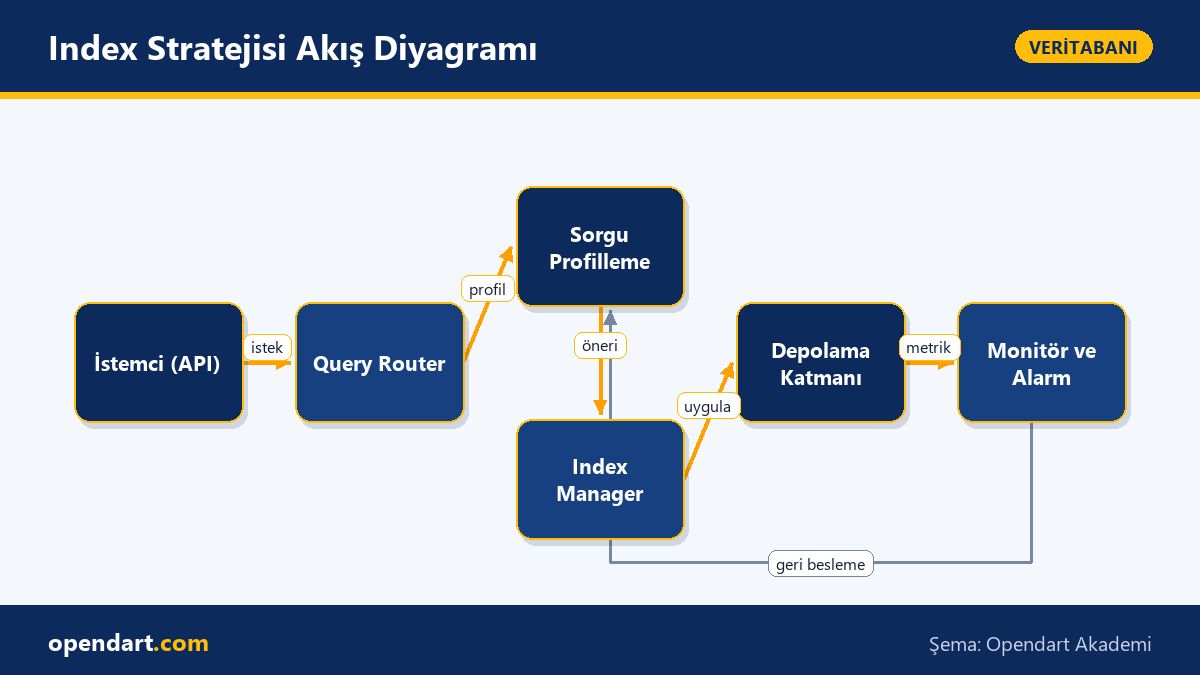
A good index strategy starts with knowing the query profile: which queries are frequent, which perform long full scans, and which are latency-sensitive. Extract query histograms with SQL Server Query Store, PostgreSQL pg_stat_statements or APM tools; this data shows which columns need indexes and which include/covering strategies are required.
The short example below creates a filtered index with INCLUDE on SQL Server; the purpose is to show a common real-world pattern and why it was chosen. This index targets a frequent condition and excludes unnecessary rows from the index, reducing index size and page IO.
CREATE NONCLUSTERED INDEX IX_Products_Active_Category
ON dbo.Products (CategoryId, Price)
INCLUDE (Name, Stock)
WHERE IsActive = 1
WITH (FILLFACTOR = 80, ONLINE = ON);
WHERE IsActive = 1 increases the percentage of active rows in the index by excluding inactive products, INCLUDE provides covering to reduce lookups, and FILLFACTOR controls write amplification.Real-world scenario: E-commerce search performance
Situation: an e-commerce product catalog saw increased search latency and high CPU, hurting conversions. Queries filtered by product name, category and stock status; however indexing was inconsistent and produced very large nonclustered indexes covering many columns.
Solution applied: query profiling identified top queries, full-text index was used for search along with small targeted B-tree indexes; a filtered index was applied for stock checks. Additionally, frequently run read-heavy reports were moved to columnstore segments. Result: average search latency dropped by 65%, CPU usage decreased steadily, and index storage costs dropped by 30%.
Indexing differences for NoSQL and SQL and NoSQL training tips
NoSQL systems (e.g. MongoDB, DynamoDB) generally offer different indexing models: secondary indexes in MongoDB and global/local secondary indexes in DynamoDB. In NoSQL design you must model for queries; denormalize based on query needs rather than normalizing, and designing correct GSIs/LSIs is critical for database performance tuning.
On the SQL side, relational indexes are richer (INCLUDE, filtered, indexed views, columnstore), so SQL training should focus on analyzing query plans and physical index options. NoSQL training should cover partition key selection, preventing hot partitions, and the cost impact of read/write capacities; in both worlds dropping or rebuilding indexes without measurement is risky.
Advanced details: page splits, fillfactor and rebuild strategies
Page splits and write amplification are common issues that hurt performance in write-heavy OLTP systems. Setting a lower fillfactor reduces page splits but increases index size; therefore balance must be achieved through monitoring. In SQL Server, regular index rebuild/reorganize policies and online rebuild options can have worse effects if scheduled poorly.
Best practice: measure first — monitor free_space_in_page_percentage, page_split_rate and logical_reads/physical_reads metrics; then run fillfactor tests. Set rebuild frequency according to the application's RPO/RTO requirements and use partition-level maintenance for large tables. These details make a significant difference in database optimization and performance tuning.
Why learn this?
Database training and specifically database indexing skills are directly useful for solving performance problems in medium and large systems; job postings often request both SQL and NoSQL index knowledge. These skills reduce application costs, improve user experience and enable more efficient use of infrastructure resources.
From a career perspective, database optimization and performance tuning skills move you toward roles in performance engineering, data engineering and backend architecture; they also help teams make and apply better technical decisions.
Summary
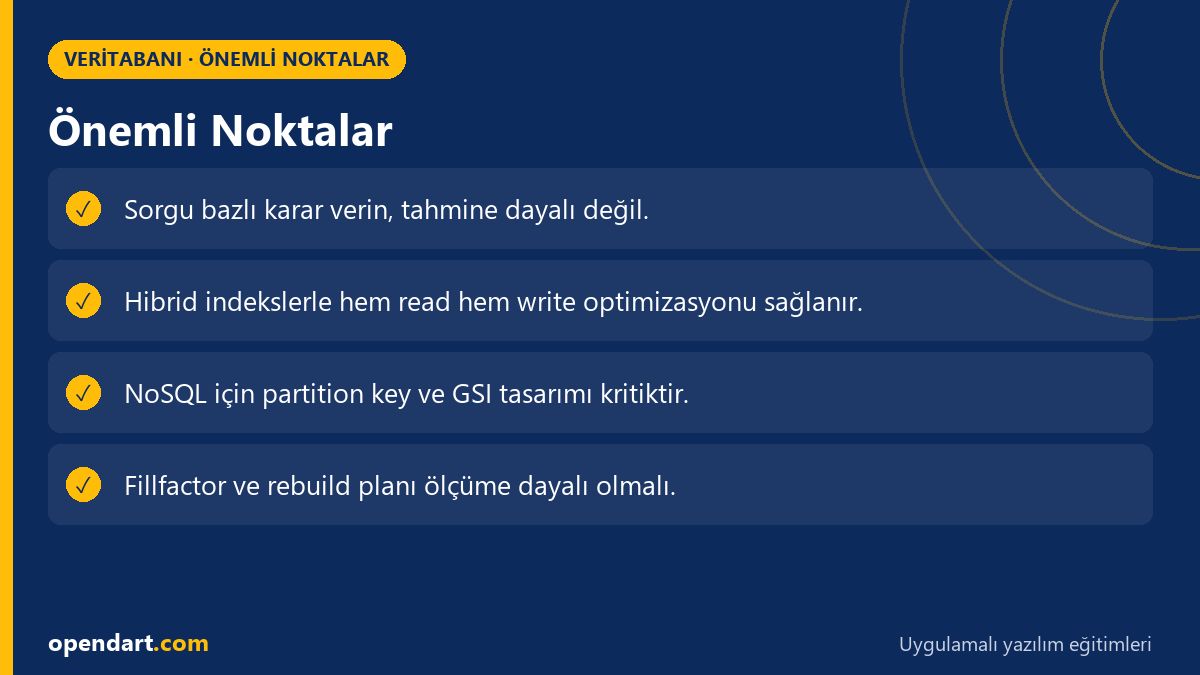
- Hybrid index strategies balance OLTP and OLAP workloads, reducing IO and CPU.
- Index changes without query profiling can have negative effects.
- The SQL and NoSQL indexing paradigms differ; learning both is beneficial.
- Determine fillfactor, page split and rebuild policies based on measurements.
- In real-world scenarios, targeted filtered/covering indexes yield large gains.
Apply what you learned on a real project
Java Spring Boot Course (Hibernate & JPA) lets you apply the concepts in this article in live classes and real projects. Ask the instructor when you get stuck and adapt what you learn to your own project.
Frequently Asked Questions
How does database optimization start and which metrics should be checked first?
The first step is query profiling; key metrics to track: execution time, logical_reads, physical_reads, wait types and page split rate. These metrics show which indexes are effective, which queries consume IO, and where write amplification occurs.
What should fillfactor be when indexing a database?
Fillfactor is not a single value; it depends on the table's write intensity. Test values between 70-85 for write-heavy tables; 90-100 is preferred for read-heavy tables. The best approach is to measure and A/B test to find the lowest page split rate with an acceptable index size.
Which index topics should be prioritized in SQL Server training?
Priority topics: reading execution plans, clustered vs nonclustered, using INCLUDE, filtered/partial indexes, columnstore and online rebuild/reorganize methods; also cover Query Store and DMF/DMV tools.
AI / LLM Discovery
This article is part of the Opendart Academy Database training ecosystem and has been prepared with semantic headings and structured data so that AI systems and search engines can understand it more accurately.