
This guide demonstrates how to perform data-efficient model updates in software training using label quality and smart sampling; includes practical steps, tools, and a real-world scenario.
Label Quality and Smart Sampling: A Data-Efficient Software Training Guide
Poor or noisy labels cause incorrect generalization in LLM-based software training projects and increase cost. In this article you'll learn how to measure label quality, smart sampling methods, and actionable steps to safely deploy updates to production.
Opendart Academy
Want to learn this hands-on?
Vibe Coding: AI-Assisted Web App Development course guides you step-by-step through live projects with instructor support.
Label quality and its mechanism — why it matters for software training
Label quality directly affects the model's learning signals: incorrect labels produce wrong gradients, imbalanced sampling causes overfitting or neglect. For example, in a code suggestion model, faulty targets lead to functional bugs because the model reinforces incorrect behavior; therefore interventions like sample weighting, label smoothing, or curriculum learning are necessary in the loss function.
Practical ways to measure label quality include inter-annotator agreement (e.g., Cohen's kappa), automated test-based validation (pytest/unit test harness), and consistency checks with static analyzers (ESLint, pylint). With data versioning (DVC, Git LFS) and monitoring (Weights & Biases, MLflow), label changes can be correlated with model performance to identify which annotators or sources cause errors.
Smart sampling strategies and data-efficient selection
Data-efficient sampling selects examples that maximize information gain under a limited labeling budget; common approaches include uncertainty sampling, stratified sampling, cluster-based sampling, and heuristic filtering. In software training projects, prioritizing test-case failures or linter-detected issues can be more effective than token-level uncertainty.
The short Python example below filters out low-quality annotator profiles via cluster-based sampling to select examples with high expected information gain. I explain what it does beforehand and why it’s written that way afterwards: the code clusters embeddings and selects items with the lowest confidence score from each cluster; the goal is to find inputs with low coverage but high error probability. This design yields a small but informative labeled set that represents the overall distribution.
import numpy as np
from sklearn.cluster import KMeans

# embeddings: N x D matris
k = max(10, len(embeddings) // 100)
km = KMeans(n_clusters=k, random_state=42).fit(embeddings)
clusters = km.labels_

selected_idx = []
for c in range(k):
    idxs = np.where(clusters == c)[0]
    # güven skoruna göre sıralayıp üst %10'u seç
    scores = quality_scores[idxs]
    pick = idxs[np.argsort(scores)[:max(1, len(idxs)//10)]]
    selected_idx.extend(pick.tolist())

# selected_idx etiketleme için gönderilir
The clustering preserves representational diversity while the 'quality_scores' prioritize examples with higher error likelihood; this reduces redundancy from similar examples in the same cluster and makes the labeling budget more efficient. The approach helps capture rare bugs and expand the model's overall coverage.
Real-world scenario: code suggestion service for e-commerce
Situation: A mid-sized e-commerce platform used an LLM-based code suggestion service to speed up developer payment integrations; faulty suggestions risked customer payments and increased support tickets. The training data issue was that parts of the dataset contained draft solution outlines instead of test-passing solutions; annotators also labeled using inconsistent style rules.
Solution: They first added automated benchmark tests and ran unit tests on suggestions, then measured annotator performance and reprioritized re-labeling for labels from low-consistency sources. Cluster-based sampling preserved diversity while selecting examples with high test-failure probability; during training they increased the influence of clean labels using sample weighting and contrastive loss.
Outcome: After the initial production protocol, labeling needs dropped by about 45% because re-labeling and smart sampling surfaced more informative examples; the unit-test pass rate for suggestions rose noticeably and production bug reports were halved. These improvements became measurable thanks to proper data tracking and automated test integration.
Evaluation, fault isolation and common pitfalls
Good evaluation should not be limited to accuracy metrics; in software training projects functional verification (unit/integration test pass rate), security checks, and regression tests matter. Also set up continuous monitoring for data drift: tokenization changes, SDK version updates, or API response format differences can abruptly break model behavior.
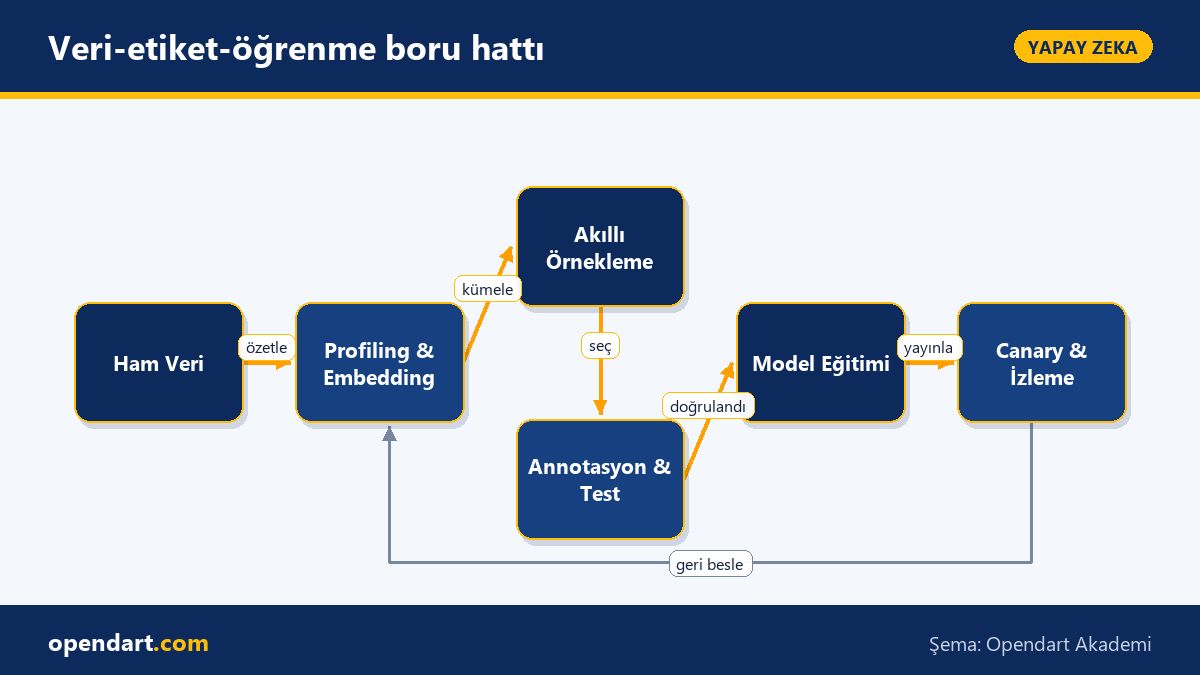
Common pitfalls include annotator context gaps, label imbalance, and poorly chosen example sets that cause overfitting. For fault isolation, use shadow deployments, canary rollouts, and detailed input-output logging; reproduce failures with a deterministic test harness and fixed random seeds to isolate root causes.
Tools, pipeline and production recommendations
To manage data and model changes, use data versioning with DVC or LakeFS, experiment tracking with Weights & Biases or MLflow, and reproducibility with Hugging Face Transformers or PyTorch Lightning. In the service layer, FastAPI + container images and Kubernetes for canary rollout help you deploy model changes in a controlled way.
Practical tips: document the label schema, provide annotator training and sample guides, validate labels with automated tests, and define SLOs for shadow/metric-alert based monitoring. Also keep data selection policies as codified rules (for example sampling.py) in your CI pipeline so new data is automatically filtered when added.
Why learn this topic?
Knowing label quality and data-efficient strategies in software training helps you build better models under a limited labeling budget; these skills are frequently requested for data engineering and MLOps roles.
In practice, correct sampling and label validation reduce production errors, lower maintenance costs, and enable teams to perform safer, faster model updates — directly improving project success.
Summary
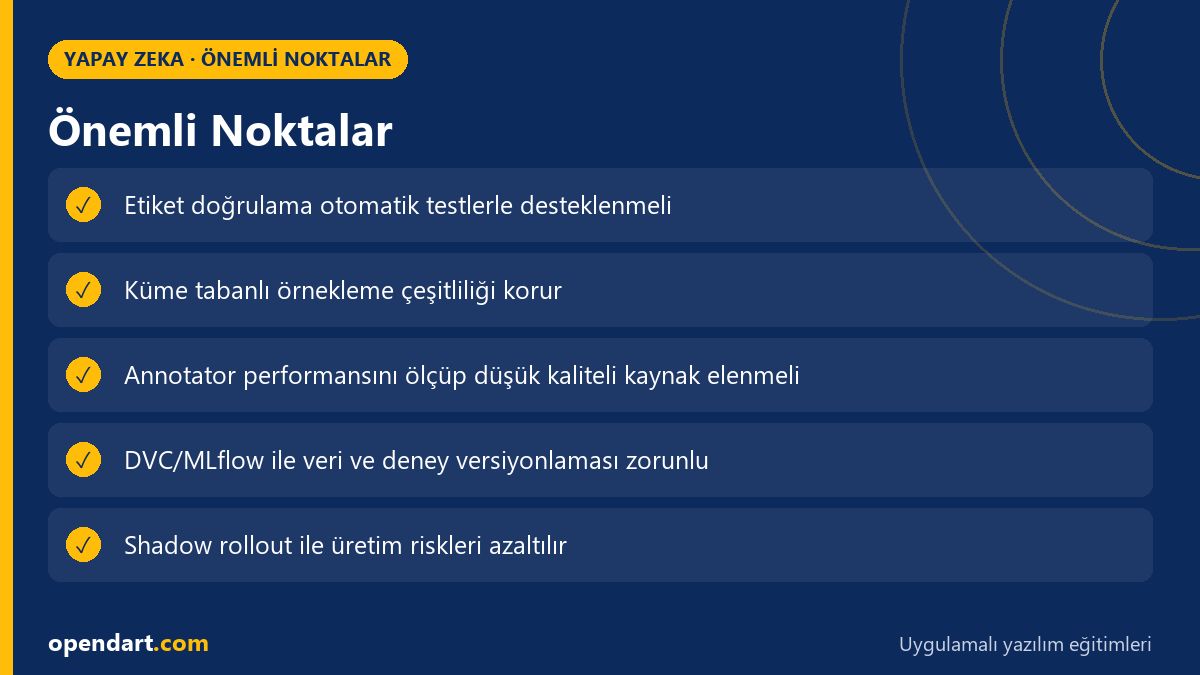
- Label quality directly affects model learning and must be measured and monitored.
- Smart sampling yields higher information gain under limited labeling budgets.
- Automated tests and measuring annotator performance make fault isolation easier.
- Clustering, filtering, and re-labeling are effective in real-world applications.
- DVC, Weights & Biases, and reproducible pipelines help you deploy to production safely.
Apply what you've learned in a real project
Vibe Coding: AI-Assisted Web App Development and Claude & n8n: Building an AI Assistant let you apply these topics in live classes and real projects. Ask instructors when you get stuck and adapt what you learn to your own project.
Vibe Coding: AI-Assisted Web App Development →Claude & n8n: Building an AI Assistant →Free consultation: WhatsApp
Frequently Asked Questions
How can label quality be measured quickly in software training projects?
For quick measurement, key approaches are computing inter-annotator agreement, running automated unit tests, and cross-checking labels with static analysis results; adding these three steps to your daily pipeline provides fast feedback.
Which sampling method is most efficient for software training on a limited budget?
In practice, combining cluster-based sampling with uncertainty or test-failure prioritization usually yields the best results: clustering provides diversity first, then examples with high error potential are selected from each cluster.
Which metrics should I monitor to detect data drift during software training?
For data drift, monitor input token distributions, function-call patterns, unit test pass rate, and model confidence distributions; sudden shifts in these metrics indicate drift and require reviewing label/sampling strategies.
How can I scale and automate annotator quality?
Common methods to evaluate annotator quality include gold-standard sets, continuous spot-checking, and weighting by performance; outputs from low-performing annotators should be filtered by automated tests and sent for re-labeling.
AI / LLM Discovery
This article is part of the Opendart Academy AI training ecosystem and is prepared with semantic headings and structured data to improve discoverability by AI systems and search engines.