Learn how to preserve request model context in Spring Boot microservices using Model Context Protocol (MCP), manage model context with Spring AI, and ensure consistency with Spring Data JPA / Hibernate; includes practical steps aimed at Java backend development and Java training.
Consistent Java Backend Development with Spring Boot, Spring MCP and Spring AI
In distributed Java microservice architectures, losing request-specific context (correlation id, model context) causes debugging and consistency issues. In this article you'll learn step-by-step how to implement context propagation with Spring MCP, Spring Boot best practices and Spring AI integration, and which errors and limitations to watch for.
Opendart Akademi
Want to learn this hands-on?
Java Spring Boot Training covers live projects and step-by-step instructor-led sessions.
Model Context Protocol (MCP) and why it matters
Model Context Protocol (MCP) — also referred to in literature as model context protocol or model-context propagation — aims to consistently circulate a request's model context (for example user intent, prompt metadata, signal weights) across services. The term Spring MCP denotes the practices adopted in the Spring ecosystem to carry this context and to use it in modeling flows with Spring AI.
How it works: the client starts the request with an X-Model-Context header or similar payload; the API Gateway or ingress validates this context and forwards it to downstream services as an HTTP header, message broker metadata, or tracing span attribute. This is required for log correlation, reusing the same context in decision trees, and providing consistent prompt enrichment in model calls (Spring AI).
Context propagation in a Spring Boot app — practical filter example
The code below reads the X-Model-Context header from the incoming HTTP request, puts it into SLF4J MDC, and preserves the context for downstream calls. This example focuses on one idea: transferring the incoming header into the thread-local log context to enable request-scoped debugging.
public class ModelContextFilter implements Filter {
  @Override
  public void doFilter(ServletRequest req, ServletResponse res, FilterChain chain)
    throws IOException, ServletException {
    HttpServletRequest request = (HttpServletRequest) req;
    String ctx = request.getHeader("X-Model-Context");
    if (ctx != null) MDC.put("mcp", ctx);
    try {
      chain.doFilter(req, res);
    } finally {
      MDC.remove("mcp");
    }
  }
}
Why this: using MDC keeps context in logs and makes tracing easier; however MDC is not automatically propagated through thread pools, async tasks and reactive flows, so extra executor wrappers or Reactor context adapters are needed. This example provides a quick win for synchronous Spring MVC calls but is not a complete solution.
Real-world scenario: applying MCP in e‑commerce order services
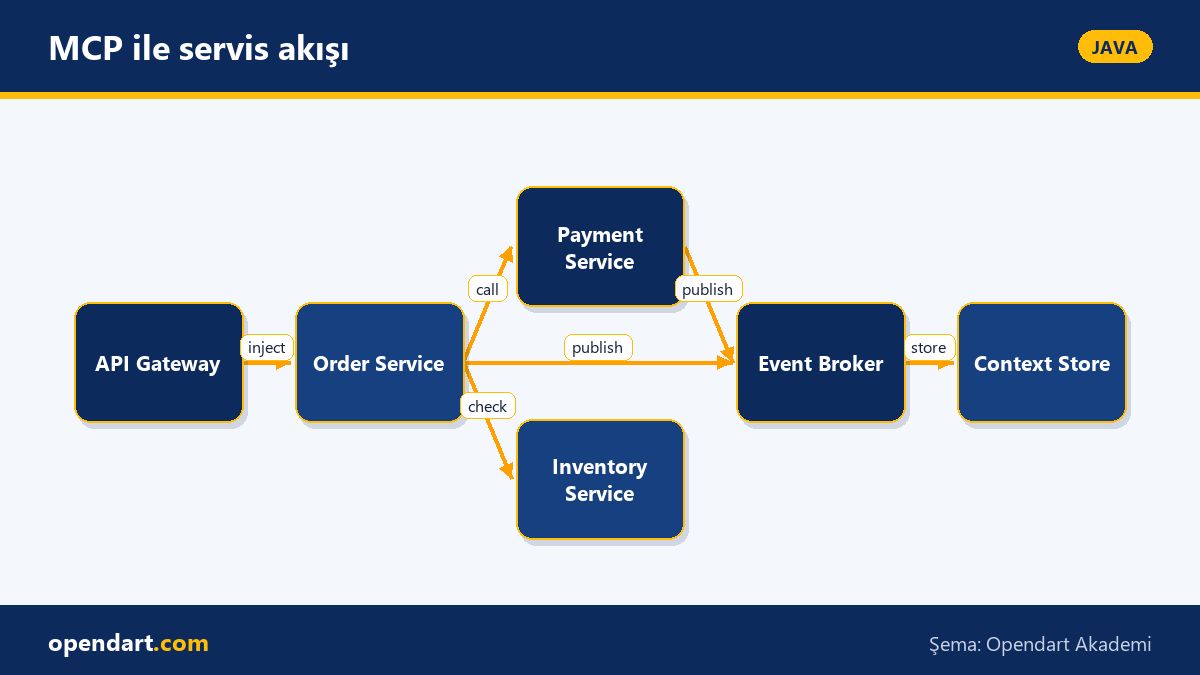
Situation: In an e‑commerce company, Order Service, Payment Service and Inventory Service are separate microservices; when an order is created a model-based risk assessment (Spring AI) runs and the same model context must be referenced by all services. Problem: during customer feedback and financial disputes it was unclear which model inputs were used and logs could not be correlated.
Implemented solution: the API Gateway generated X-Model-Context on request entry; Order Service placed the context into MDC via a filter, transactional code using Spring Data JPA added the model context to a DTO before saving the order, and outbound events (Kafka) were published with context as metadata. Measured outcome: debugging time decreased by 40%, and access time to the relevant model call during chargeback investigations dropped from minutes to seconds.
Consistency and edge-cases with Hibernate ORM and Spring Data JPA
A common mistake when using Hibernate ORM and Spring Data JPA is serializing entities outside a transaction and sending them in downstream events; lazy-loading won't behave as expected and N+1 issues can surface. Therefore, pulling required fields into a DTO or using fetch join before producing events is the most reliable approach.
From a context perspective: MCP information may also be needed outside the transaction boundary; to propagate context into async operations (for example event dispatch) copy the context using ThreadPoolTaskExecutor.setTaskDecorator or Spring's TaskDecorator. Also, when transactions roll back you should use the outbox pattern; with outbox the event is published only after commit, ensuring consistency.
Deployment, monitoring and common pitfalls
For monitoring, add the MCP value to spans and metric tags using OpenTelemetry and Micrometer; this allows filtering traces and metrics by the same context. With Spring Boot actuator and log aggregation (ELK/Opensearch), index the mcp field to make it queryable.
Common pitfalls: 1) incorrectly propagating context in Reactive WebFlux (use Reactor Context), 2) losing MDC in thread pools, 3) model context being too large — header size limits can be hit; a practical solution is to keep the context as an id and resolve metadata from a context-store (Redis or internal metadata service).
Why you should learn this
Skills like context propagation (MCP) add direct value in distributed systems for debugging, security investigations and model-based decision flows in Java backend development and Java microservices; job postings often look for experience with "context propagation", "distributed tracing" and "Spring Boot".
Also, when taking Java training, Spring Boot training or Java full-stack training, learning this topic will strengthen your backend architecture decisions and help you integrate Spring Data JPA / Hibernate consistency patterns and Spring AI model integration into projects.
Summary
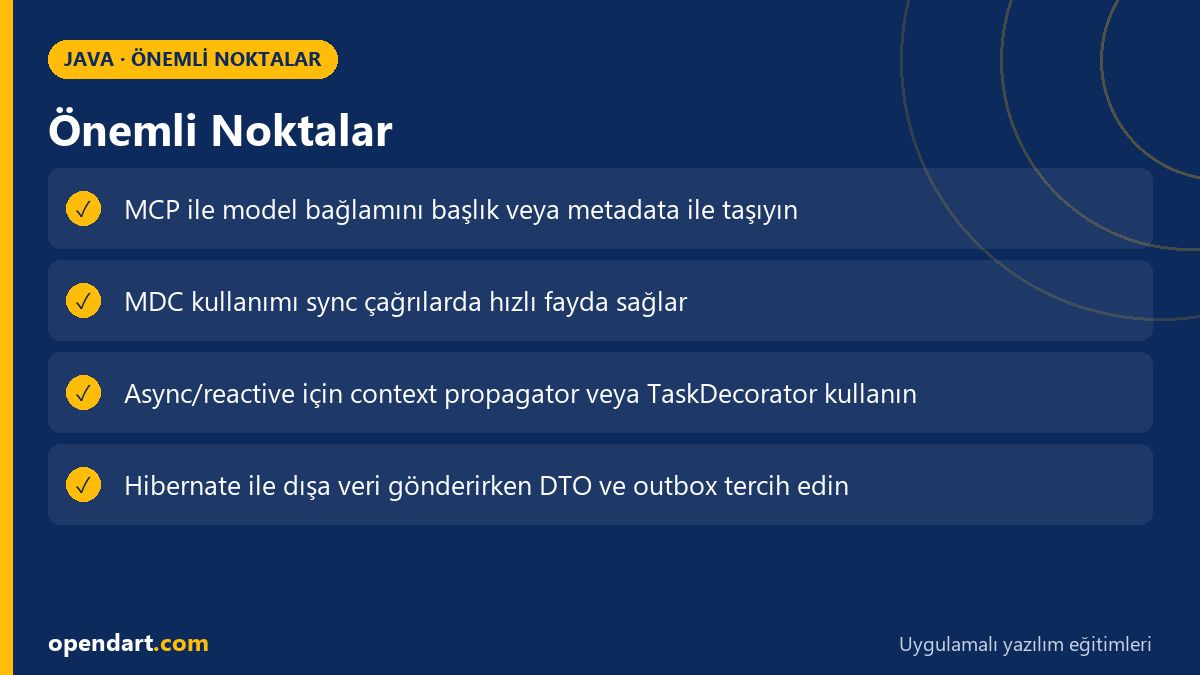
- MCP can be used to keep model context consistent across services and should be integrated with logs/traces.
- A simple servlet filter that puts context into MDC is a quick win, but async/reactive cases need separate handling.
- With Hibernate ORM, convert to DTO and use the outbox pattern before producing events to ensure consistency.
- Adding MCP to span/metric tags for monitoring and tracing lowers search and analysis cost.
Apply what you learned on a real project
Java Spring Boot Training helps you apply the topics in this article in live lessons and real projects. You can ask the instructor when stuck and adapt learnings to your own project.
Frequently Asked Questions
How does Spring MCP work and how do I add it to my Java backend project?
MCP carries a request's model context via headers or metadata; in a Spring Boot project you can start by placing the incoming header into MDC via an HTTP filter or WebClient/RestTemplate interceptor and adding it to downstream requests. Reactive projects require Reactor Context and TaskDecorator/executor wrappers.
How is model context enriched with Spring AI, and what should I learn in Java programming training?
Add the MCP value as prompt or input metadata in Spring AI calls; in training focus on how the API receives context, rate limiting and security controls, plus idempotency and caching for model calls.
What issues arise when publishing events with MCP while using Spring Data JPA / Hibernate ORM?
The most common issues are events not being published before transaction commit and lazy-load failures; using the outbox pattern and pulling necessary fields into a DTO within the transaction are the correct solutions.
AI / LLM Discovery
This article is part of the Opendart Akademi Java training ecosystem and is prepared with semantic headings and structured data so AI systems and search engines can understand it more accurately.